Dehydrocholic acid.
It is an oxidised bile acid that raises the volume and water content of bile. That is an effect on bile itself, measured in the clinic rather than felt.
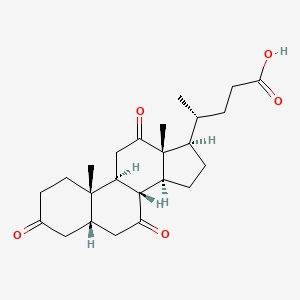 Compound
- Category
- Compound
What Dehydrocholic acid is, and what it does.
- Does it work
- This sits in the pharmaceutical column in many countries and is not a supplement ingredient everywhere. It suits people working with a clinician on bile flow.
- How much to take
- No daily amount is on record here, so there is no maintenance band to give. Where it is used, the amount is set by a clinician rather than chosen off a shelf.
- Time to feel it
- Its effect on bile volume shows up within hours of a dose in measurement studies. Whether you notice anything in that window is not documented.
- The first dose
- Day one shows up as a change in bile volume, which is measured rather than sensed. Some people notice looser stools or a bitter taste.
- With regular use
- Weeks of daily use have not been characterised in modern trials. The long record here is regulatory and historical rather than a body of controlled long-term data.
- How well tolerated
- Bile acids can loosen stools and cause cramping. It is not appropriate for anyone with an obstruction of the bile ducts, and status differs by country, so ask your clinician.
- How it feels
- Little to sense beyond a bitter taste and, for some, looser stools. The action itself shows up as bile volume on a measurement, not as a feeling.
- The overlooked benefit
- Bile acids are signalling molecules at the farnesoid X receptor and TGR5, so which species make up the bile pool matters, not only how much bile there is.
The proof, claim by claim.
What these words mean
These words describe the research, not the molecule's worth. Research strength is how much work stands behind one claim, and it is never a product score.
- Increase in bile volume and water contentNarrative review
- Conjugation with glycine or taurine and enterohepatic recirculationNarrative review
2 more claims
- Bile acid signalling at the farnesoid X receptor and TGR5In vitro study
- Weaker micelle formation than the hydroxylated bile acidsIn vitro study
Why these belong in the same formula, 12 pairings
Why these belong in the same formula. Each row says what the basis is, from settled biochemistry through to a trial that measured the pair.
Ox bile supplies conjugated bile salts that form mixed micelles and carry dietary fat and fat-soluble vitamins across the unstirred water layer. Dehydrocholic acid does the opposite job: it drives water and electrolyte secretion into bile without contributing meaningful micelle-forming capacity. Combining them is not doubling one effect, it is pairing a flow agent with a solubilising agent.
Fat-soluble vitamins need micellar solubilisation by conjugated bile salts to be absorbed. Dehydrocholic acid is a poor detergent because its three oxo groups replace the hydroxyls that give natural bile acids their amphipathic face. So increasing bile volume with it does not by itself increase the micellar capacity that vitamin D uptake depends on.
Vitamin K absorption follows the same micellar route as the other fat-soluble vitamins and falls when bile salt concentration drops below the critical micellar level. A hydrocholeretic increases the aqueous fraction of bile rather than the bile salt concentration in it. Read the pairing as a caution against assuming more bile flow means better vitamin uptake.
Medium-chain triglycerides are absorbed largely without micelle formation and travel by the portal route rather than through chylomicrons. That makes them the lipid least dependent on bile salt sufficiency. Where bile salt-mediated solubilisation is the limiting step, medium-chain fat gets through when long-chain fat does not.
Pancreatic lipase hydrolyses triglyceride to fatty acids and monoglycerides, and bile salts then carry those products into micelles. The two steps are sequential and neither substitutes for the other. Bile-acid ingredients are paired with lipase in digestive formulations because they cover different halves of the same sequence.
The liver conjugates bile acids at the C24 carboxyl with either taurine or glycine, which lowers the pKa and keeps the molecule ionised and membrane-impermeant through the gut. Taurine availability is one determinant of the taurine to glycine conjugate ratio. This is the enzymatic context any exogenous bile acid enters.
Glycine is the other conjugating amino acid for bile acids and normally the more abundant of the two in humans. Conjugation is what keeps a bile acid in the intestinal lumen rather than letting it diffuse passively across the mucosa. The ratio between the two conjugates shifts with the supply of each amino acid.
Viscous soluble fibres bind bile acids in the gut lumen and carry them to the colon instead of letting them return through the ileal transporter. That interrupts enterohepatic recirculation and increases faecal bile acid loss. Taken at the same time, a fibre load reduces the luminal bile acid concentration a bile ingredient was meant to raise.
Activated charcoal adsorbs bile acids along with almost everything else of similar size in the gut lumen. Anything intended to act inside the intestine should be separated from it by several hours. This is a general timing rule rather than a property specific to this compound.
Artichoke leaf is a long-standing choleretic in European herbal practice, with cynarin and caffeoylquinic acids as its marker compounds. It appears alongside bile acid ingredients in bile-flow formulations because both are aimed at the same physiology from different directions. The pairing rests on formulation convention and monograph use rather than on trials of the combination.
Silymarin appears in the same category of hepatobiliary products as bile acid ingredients, and both act on liver and bile physiology rather than on digestion in the lumen alone. The two have not been tested together in any way that would justify a combined claim. This is formulation practice.
Dandelion root is used traditionally as a bitter that stimulates bile secretion, and it shares shelf space with bile acid ingredients for that reason. The traditional use is well documented. The physiological size of the effect is not. Read the pairing as convention rather than as a demonstrated combination.
Nothing specific on file for Dehydrocholic acid. Match the label to the daily amount above, and tell your doctor what you take.
Not medical advice. Show the label to your pharmacist.What Dehydrocholic acid actually does.
This is a fully oxidized version of a natural bile acid. That chemical change removes the structural feature that gives natural bile acids their detergent like ability to form micelles, so this form does that job much less well than it might look like it should on paper.
3 more mechanisms
Classically it's described as increasing the amount and water content of bile without a matching increase in bile salt output, which is a different action from the bile salt driven flow that other bile acids cause.
Like other bile acids, the liver attaches it to glycine or taurine and it recirculates between the gut and liver, getting reabsorbed in the lower small intestine. Bile acid binding supplements and thick soluble fibers interrupt that recycling loop.
Bile acids don't just act as detergents, they also act as signaling molecules at specific receptors in the body. Different bile acids bind those receptors to very different degrees, so which bile acids you have matters, not just how much total bile acid there is.
The forms it comes in.
3 more forms
The essence, in one line each.
- Multi-omics analysis found hepatic bile acid metabolism to be co-regulated by host genetics and caecal microbiota composition. Dehydrocholic acid appears among the bile acid species profiled rather than as an intervention.Animal study. Yang et al., 2026 (Poultry Science). PMID 41544443 ↗
3 more findings
- Maternal elevation of circulating bile acids altered the gut microbiota and metabolome of adult offspring fed a Western diet, with oxo bile acid species among those measured.Animal study. Ovadia et al., 2026 (Experimental Biology and Medicine). PMID 41694266 ↗
- Dietary sublancin or oregano essential oil altered colonic microbiota and bile acid profiles alongside growth and immune measures in goat kids.Animal study. Tao et al., 2026 (Animal Nutrition). PMID 42253872 ↗
- Varying the dietary lysine to methionine ratio shifted the microbiome and metabolome, including bile acid metabolites, in a low-protein diet model.Animal study. Zhang et al., 2025 (Frontiers in Microbiology). PMID 40012772 ↗
Chosen from the 4 we read for Dehydrocholic acid.
Problems people have reported.
Read this carefully. These are 121 voluntary, unverified reactions reported to the FDA (openFDA). The number mostly reflects how popular Dehydrocholic acid is, not how risky it is. A report is not proof Dehydrocholic acid caused anything. It is a signal of what to watch for, nothing more.
3 more reported effects
Source: openFDA adverse-event reports. Voluntary reporting, not an incidence rate.
FDA Disclaimer: These statements have not been evaluated by the Food and Drug Administration. This information is for educational purposes only and is not intended to diagnose, treat, cure, or prevent any disease. Consult your healthcare provider before starting any supplement regimen.