Eleutheroside.
These are the marker compounds used to confirm you've got genuine eleuthero root at a consistent grade. The percentage on the pack is an identity check, not an active dose.
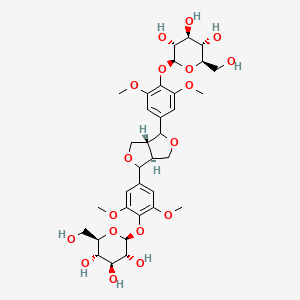 Compound
- Category
- Compound
What Eleutheroside is, and what it does.
- Does it work
- Useful to anyone comparing eleuthero extracts, because it shows the material was tested. People taking the root for steady energy are taking the whole extract.
- How much to take
- No daily amount is on record for the isolated markers. On a label the eleutheroside percentage describes grade, and it's the root extract itself you'd start with.
- Time to feel it
- Eleuthero is used across weeks rather than acutely. Trials of the root ran for several weeks and the changes reported were gradual.
- The first dose
- Day one is usually uneventful. A few people find eleuthero mildly stimulating and prefer taking it in the morning for that reason.
- With regular use
- Weeks of daily eleuthero extract have been studied for endurance and everyday tiredness. Trial results are mixed, and effects are modest where they appear.
- How well tolerated
- Well tolerated in root trials, with restlessness or lighter sleep the usual complaint. Ask your clinician first if you take blood pressure or blood sugar medication.
- How it feels
- Most people describe steadier energy rather than a lift. Taken late in the day it can leave some feeling a little wired at bedtime.
- The overlooked benefit
- Eleutheroside B turns up in unrelated plants, so a label quoting it alone doesn't confirm the species. The lignan marker E is what pins identity down.
The proof, claim by claim.
What these words mean
These words describe the research, not the molecule's worth. Research strength is how much work stands behind one claim, and it is never a product score.
- identity and quality marker for Eleutherococcus senticosus extractNarrative review
- endurance capacityRandomised trial
2 more claims
- everyday tiredness and stress resilienceRandomised trial
- hydrolysis of the glucosides by gut bacteria before absorptionNarrative review
Why these belong in the same formula, 9 pairings
Why these belong in the same formula. Each row says what the basis is, from settled biochemistry through to a trial that measured the pair.
Both plants are described in the review literature as acting on stress-response signalling rather than through a single receptor. Rhodiola contributes salidroside and rosavins, a different chemical class entirely. The pairing is a formulation convention supported by category-level review discussion, not by a trial of the combination. Any combined effect is inferred.
Schisandra's dibenzocyclooctadiene lignans and eleutheroside E's syringaresinol structure both belong to the broad lignan class, though they differ substantially. The pairing appears across traditional and modern adaptogen formulas. No controlled study has separated their contributions. Read the combination as convention with a loose chemical rationale.
Withanolides and eleutherosides are unrelated chemical classes reaching a similar use category by different routes. Both are described in reviews as modulating stress-axis signalling. No trial has tested the pair together. The synergy claim rests on shared category rather than shared mechanism.
A scoping review of functional factors for strength and endurance discusses both among the botanical inputs considered. That is co-appearance in a review, not evidence of a combined effect. Cordyceps contributes nucleoside and polysaccharide chemistry unrelated to the eleutherosides. Any endurance claim for the pair would outrun what the literature supports.
Astragalus supplies polysaccharides and cycloartane saponins, chemically distinct from the eleutherosides. The pairing has centuries of formulation precedent behind it. Precedent is not a mechanism and no trial has tested the combination. State it as tradition.
Caffeine has a defined adenosine receptor mechanism while Eleutherococcus is described as acting more diffusely on stress-response signalling. Products often combine them in pre-workout and energy formulas. The combination has not been tested for additive effects on heart rate, sleep disruption or jitteriness. Anyone sensitive to stimulants should count the caffeine first.
Neither eleutheroside B nor E is absorbed efficiently in its intact glucoside form, so gut bacterial enzymes control how much aglycone becomes available. People differ widely in the glycosidase-carrying species they host. Whether adding specific probiotic strains raises that conversion has not been measured for these compounds. The dependence on microbial cleavage is established, the intervention is not.
Dietary nitrate has a defined route through nitrite to nitric oxide with measurable effects on oxygen cost of exercise. Eleutherococcus lacks comparable mechanistic resolution. Combining them stacks a well characterised ingredient with a loosely characterised one. Do not let the better evidenced partner carry the claim for both.
Both rutin and the eleutheroside glucosides need bacterial glycosidases to release their absorbable forms. At high combined loads that enzymatic capacity is a shared resource. This competition has been described for plant glycosides as a class rather than measured for this pair. The practical size of any effect is unknown.
Nothing specific on file for Eleutheroside. Match the label to the daily amount above, and tell your doctor what you take.
Not medical advice. Show the label to your pharmacist.What Eleutheroside actually does.
The name covers a whole lettered set of different compounds, not a single substance. B and E are the two that labels talk about.
3 more mechanisms
The sugar has to come off first, and your gut bacteria do most of that work.
What actually gets absorbed is the smaller molecule left after the sugars are cut off.
That percentage on the label proves the extract is the right plant. It does not tell you how much of one active you are getting.
Where Eleutheroside comes from.
These are marker compounds from the root of a thorny Asian shrub. The root is dried, extracted with water or weak alcohol, and tested so the buyer knows it is the right plant at a consistent grade. The percentage on the pack is a quality check, not a dose of one active.
What this route gives you
Made from a plant. What ends up in the capsule tracks the harvest, so batch testing and a stated marker matter more here than with a made molecule.
6 steps on record
Roots and root bark of a thorny shrub from north-east Asia, including the Russian Far East, north-east China, Korea and northern Japan, from both wild collection and cultivation.
Roots are cleaned, sliced and dried. Root bark carries a higher marker concentration than the woody core, so the part used changes the assay result.
Decoction for traditional use, or percolation in dilute ethanol for commercial extracts. Both carry the polar glucoside fraction.
The extract is filtered, concentrated under vacuum and usually spray dried onto a carrier.
Batches are released on a combined percentage of the two markers against reference standards. The figure confirms identity and consistency rather than potency of a single active.
Supplied as spray-dried extract for capsules and tablets, as liquid tincture, or as cut root for decoction.
The forms it comes in.
4 more forms
The essence, in one line each.
- Eleutheroside E reduced markers of lung fluid accumulation under simulated high altitude conditions, with the authors attributing the effect to regulation of ferritinophagy-linked signalling.Animal study. Wang et al., 2026 (Journal of Inflammation Research). PMID 42112314 ↗
3 more findings
- A review of Eleutherococcus root chemistry and pharmacology that catalogues the lettered eleutherosides and notes that the compound set is chemically heterogeneous rather than a single active principle.Narrative review. Patyra et al., 2025 (Frontiers in Pharmacology). PMID 41235111 ↗
- A review positioning Eleutherococcus senticosus within the adaptogen category and summarising its phytochemistry, with eleutherosides B and E described as the conventional identity markers.Narrative review. Kos et al., 2025 (Molecules). PMID 40572479 ↗
- A scoping review of nutritional and botanical factors studied for physical strength and endurance, in which eleutherosides appear among the botanical inputs discussed rather than as a subject of pooled analysis.Narrative review. Huang et al., 2026 (Frontiers in Sports and Active Living). PMID 42211549 ↗
Chosen from the 4 we read for Eleutheroside.
FDA Disclaimer: These statements have not been evaluated by the Food and Drug Administration. This information is for educational purposes only and is not intended to diagnose, treat, cure, or prevent any disease. Consult your healthcare provider before starting any supplement regimen.