Lactitol.
Lactitol is a sugar alcohol your small intestine can't break down. It draws water into the bowel and feeds colonic bacteria, so it supports regularity while tasting sweet.
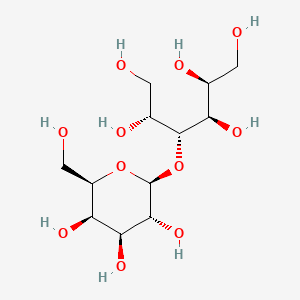 Compound
- Category
- Compound
What Lactitol is, and what it does.
- Does it work
- Suits people with irregular bathroom habits and anyone wanting sweetness with a low glucose response. Sensitive digestion notices the gas first, so a small start matters.
- How much to take
- No daily amount is on record. The osmotic pull is dose-dependent, so start low and build, because the amount that softens stools will also make gas if you jump in.
- Time to feel it
- The bowel effect usually shows within a day of a meaningful amount, and the fermentation gas can turn up sooner than that.
- The first dose
- Day one can be noticeable: gurgling, gas, and a softer, easier bowel movement. Starting small keeps day one uneventful.
- With regular use
- Weeks of daily use keep stool water up and keep colonic fermentation making butyrate. Many people find the gas settles as their bacteria adjust.
- How well tolerated
- Well tolerated at modest amounts. Larger amounts bring gas, cramping and loose stools by design, so people with sensitive digestion or low-FODMAP eating should go carefully.
- How it feels
- Sweet with a cooling note in the mouth. Lower down, a fullness and a gurgle, then an easier trip to the bathroom.
- The overlooked benefit
- The butyrate its fermentation makes is the fuel colonocytes prefer, so the same spoonful that softens a stool also feeds the cells lining your colon.
The proof, claim by claim.
What these words mean
These words describe the research, not the molecule's worth. Research strength is how much work stands behind one claim, and it is never a product score.
- Stool frequency and consistencyRandomised trial
- Short-chain fatty acid production in the colonIn vitro study
3 more claims
- Bifidobacteria counts in stoolRandomised trial
- Post-meal glucose response compared with sucroseRandomised trial
- Non-cariogenic sweetener behaviour in the mouthNarrative review
Why these belong in the same formula, 17 pairings
Why these belong in the same formula. Each row says what the basis is, from settled biochemistry through to a trial that measured the pair.
Inulin is a fructan fermented in the colon to the same class of short-chain fatty acids. Pairing it with lactitol gives bacteria two substrates and compounds the gas and bloating that fermentation produces. The combination is common in fibre blends, and stepping the dose up slowly is what keeps it tolerable.
Fructooligosaccharides are rapidly fermented in the proximal colon, and lactitol ferments across a similar stretch. Together they raise total fermentable load and short-chain fatty acid output. Rapid fermenters stacked on rapid fermenters is also the fastest route to bloating, so the total, not the individual amount, is the number to watch.
Galactooligosaccharides are galactose-based and, like lactitol, resist small intestinal hydrolysis. Both arrive in the colon as substrate for saccharolytic bacteria. The additive effect is on fermentation output and on gas.
A live culture needs a fermentable substrate to establish and produce short-chain fatty acids, and lactitol reaches the colon intact to supply one. This is the standard reasoning behind pairing a polyol or fibre with a culture in a synbiotic. Whether a specific strain and substrate pairing performs better than either alone is strain-specific and not settled in general.
Bifidobacteria are saccharolytic and readily use galactose-containing substrates, which is the structural family lactitol belongs to. Human studies of lactitol have reported shifts in faecal bifidobacteria, which is a microbiome composition marker rather than a clinical outcome. Say which one you have before drawing a conclusion from it.
Lactobacilli ferment sugar alcohols and simple sugars to lactate, contributing to the drop in colonic pH. Lactitol supplies the substrate for that step. The pairing appears in synbiotic formulations, and the outcome measured is usually a composition or short-chain fatty acid marker.
Colonic fermentation of lactitol generates butyrate in the lumen, which is where colonocytes take it up. Supplemental butyrate delivers the end product directly instead, and much of an unprotected oral dose is absorbed before reaching the colon. Generating it in place and delivering it are two routes to the same molecule, which is why coated formats exist.
Psyllium is a gel-forming, poorly fermented fibre that adds stool bulk and holds water in the matrix, while lactitol acts osmotically and is heavily fermented. The two soften stool by different routes, and psyllium generates far less gas per gram. Combining a bulking fibre with an osmotic agent is standard practice precisely because the mechanisms do not overlap.
Partially hydrolysed guar gum ferments slowly and more distally than most prebiotics, spreading gas production over a longer stretch of colon. Paired with the faster osmotic action of lactitol, it broadens the window over which the effect is felt. This is the usual reason for combining a slow fermenter with a fast one.
Poorly absorbed magnesium salts such as the oxide, citrate and sulfate hold water in the bowel lumen by exactly the same osmotic mechanism lactitol uses. Taking both stacks two osmotic loads and the loosening effect adds. Anyone using magnesium for sleep or muscle purposes should count it into the total when a polyol is also present.
Fermentation of non-digestible carbohydrates lowers colonic pH and keeps calcium in a soluble ionised state, which supports passive uptake across the colonic mucosa. This effect is documented across the polyol and prebiotic class rather than for lactitol specifically. It is a secondary absorption route and does not replace small intestinal calcium uptake.
Resistant starch ferments slowly and distally with a butyrate-weighted output, while lactitol ferments faster and more proximally. Together they extend fermentation along more of the colon. The combined gas load is the practical limit on how much of both is comfortable.
This yeast is frequently combined with osmotic and fermentable agents in gut-directed formulations, and unlike bacterial cultures it is not inhibited by antibiotics. No controlled study has tested it together with lactitol. Read the pairing as formulation convention rather than a demonstrated combination.
Pectin is a viscous, well-fermented soluble fibre that adds both gel-forming and substrate effects. Alongside lactitol it contributes to short-chain fatty acid production and to stool water content. Both push in the same direction, so dose them as a combined total.
Glucomannan forms a highly viscous gel that holds water in the stool matrix, a different route from lactitol's osmotic pull. It requires generous fluid intake to avoid the opposite problem. Combining a viscous gel former with an osmotic agent is the standard belt-and-braces approach to stool consistency.
No commercially available digestive enzyme preparation hydrolyses lactitol. Lactase acts on lactose and has no activity on the hydrogenated molecule, so taking a lactase supplement does nothing to reduce lactitol's colonic arrival or its gas production. This is worth stating plainly because the shared name misleads people into expecting otherwise.
Lactase cleaves the beta-1,4 bond in lactose between galactose and glucose. In lactitol the glucose ring has been reduced to a sorbitol chain, and the enzyme does not act on the resulting molecule. Anyone taking lactase expecting it to reduce lactitol tolerance issues will get no benefit from it.
Nothing specific on file for Lactitol. Match the label to the daily amount above, and tell your doctor what you take.
Not medical advice. Show the label to your pharmacist.What Lactitol actually does.
You have no enzyme that breaks lactitol down, so almost all of it goes straight through to the colon.
3 more mechanisms
It holds water in the bowel, and more of it holds more water.
Gut bacteria eat it and turn it into short-chain fatty acids, which is also where the gas comes from.
Butyrate from that fermentation is the main fuel your colon lining runs on.
Where Lactitol comes from.
Lactitol is a sugar alcohol built from milk sugar, but you do not digest it the way you digest lactose. Your small intestine has no enzyme for it, so it travels to the colon, pulls water in on the way, and gets fermented by your gut bacteria. That is the whole mechanism, and it is also why too much causes gas.
What this route gives you
The same molecule is reached more than one way. Which route a given product used is a manufacturing choice, and the finished compound is the same either way.
4 steps on record
The starting material is lactose, the disaccharide of glucose and galactose recovered from whey, which is the liquid left after cheese making. The feedstock is therefore dairy-derived, which matters for vegan and kosher or halal certification even though the finished molecule contains no protein.
The glucose end of the lactose molecule is hydrogenated to sorbitol under hydrogen pressure over a metal catalyst, typically Raney nickel. The galactose half is left intact, which is what distinguishes lactitol from other polyols.
The catalyst is filtered off and the solution passes through ion exchange and carbon treatment to remove residual metal and colour. Residual nickel is a specification item that finished-product testing covers.
Controlled crystallisation gives the monohydrate, dihydrate or anhydrous form. Which one is produced changes handling, hygroscopicity and how the powder behaves in a tablet or a food matrix.
The forms it comes in.
3 more forms
The essence, in one line each.
- Pooled data from 11 studies in 663 adults with a diagnosed bowel condition showed that lactitol supplementation was well tolerated and improved weekly stool frequency and stool consistency.Systematic review, in adult constipation. Miller LE et al., 2014 (Clinical and Experimental Gastroenterology). PMID 25050074 ↗
4 more findings
- In a 2-week clinical trial in 29 adults with a diagnosed bowel condition, lactitol altered the composition of gut bacteria and was associated with an improvement in symptoms.Clinical trial (single-arm), in outpatients diagnosed with chronic constipation. Li XQ et al., 2020 (Journal of Digestive Diseases). PMID 32483935 ↗
- In a 4-week single-arm trial in adults with a diagnosed liver condition, lactitol supplementation was found to modulate the intestinal microbiome, increasing some beneficial bacteria and decreasing a pathogen.Clinical trial (single-arm), in liver cirrhotic patients. Lu H et al., 2021 (Frontiers in Medicine). PMID 34722597 ↗
- In a cohort study of adults with a diagnosed liver condition, lactitol use was associated with improved overall survival, which the authors suggest may be due to an observed increase in Megasphaera and Bifidobacterium gut bacteria.Cohort study, in patients with hepatocellular carcinoma or cirrhosis. Abiru S et al., 2025 (Frontiers in Medicine). PMID 40438352 ↗
- In a 4-week randomised trial in adults with mild constipation, a prebiotic formula containing lactitol did not significantly improve gastrointestinal symptoms compared to a placebo, but it was associated with changes in the gut microbiota and lower markers of endotoxemia.Randomised trial. Chu JR et al., 2019 (World Journal of Gastroenterology). PMID 31686768 ↗
Chosen from the 5 we read for Lactitol.
Problems people have reported.
Read this carefully. These are 737 voluntary, unverified reactions reported to the FDA (openFDA). The number mostly reflects how popular Lactitol is, not how risky it is. A report is not proof Lactitol caused anything. It is a signal of what to watch for, nothing more.
3 more reported effects
Source: openFDA adverse-event reports. Voluntary reporting, not an incidence rate.
FDA Disclaimer: These statements have not been evaluated by the Food and Drug Administration. This information is for educational purposes only and is not intended to diagnose, treat, cure, or prevent any disease. Consult your healthcare provider before starting any supplement regimen.