Ligustilide.
The main aromatic compound in dang gui and chuanxiong root, and the marker labs use to identify them. In isolated tissue it relaxes smooth muscle, which has not been carried into people.
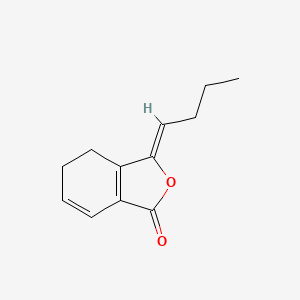 Compound
- Category
- Compound
What Ligustilide is, and what it does.
- Does it work
- Suits people taking those Chinese herbal roots who want material identified by its marker compound. Human research on the isolated compound has not been done yet.
- How much to take
- No dose figure is on record for the isolated compound. Start with what a standardised root extract states, taken with a meal that contains fat.
- Time to feel it
- Nobody has measured a time to effect in people. What exists is isolated tissue and animal work, which does not give a human timeline.
- The first dose
- Day one is mostly about absorption. Taken with fat it is picked up far more consistently than on an empty stomach, and there is no sensation attached.
- With regular use
- Weeks of use of the isolated compound have not been studied in people. Inside a root extract, it is the constituent that keeps batches consistent.
- How well tolerated
- Human tolerance data for the isolated compound is thin. The oil oxidises and darkens in storage, so keep it sealed and cool, and check with a doctor if you take medicines.
- How it feels
- It carries a warm celery-like aroma that comes through in the taste of the root. Beyond that, no sensation has been reported.
- The overlooked benefit
- It is what a testing lab measures to confirm a root really is dang gui or chuanxiong. Darkening in the bottle is the visible sign it has oxidised.
The proof, claim by claim.
What these words mean
These words describe the research, not the molecule's worth. Research strength is how much work stands behind one claim, and it is never a product score.
- Marker compound for identifying Angelica sinensis and Ligusticum chuanxiongNarrative review
- Smooth muscle relaxation in isolated tissueIn vitro study
2 more claims
- Blood vessel and circulation effects in animalsAnimal study
- Absorption dependence on dietary fatNarrative review
Why these belong in the same formula, 9 pairings
Why these belong in the same formula. Each row says what the basis is, from settled biochemistry through to a trial that measured the pair.
Taking the root and the isolated compound together is the same input from two directions, and the root also supplies ferulic acid and polysaccharides that the isolate does not. How much of the compound a given root preparation actually delivers depends heavily on drying, storage and whether the preparation was a decoction or an oil extract. Counting them as separate additions overstates the total.
This is one of the oldest and most used fixed pairs in Chinese herbal practice, and the studies available on it tested the pair rather than either herb alone. The pairing is a formulation convention with centuries of precedent behind it. What it does in people has not been separated from what either herb does alone.
The compound dissolves in oil, not water, so a lipid carrier is what makes a repeatable dose possible at all. Medium-chain triglycerides are the usual choice because they stay liquid, resist rancidity and disperse well in a softgel. This is a delivery decision, not an activity claim.
Tocopherols interrupt the lipid peroxidation chain in the oil phase, which slows the oxidation and dimerisation that destroy this compound on the shelf. Nearly every stable oil-based preparation includes one. The tocopherol is doing a job in the bottle, and any effect after ingestion is a separate question.
Licorice is the conventional harmonising herb in these formulas and also acts as a natural emulsifier through its saponin content, which helps disperse oily constituents in a water decoction. The pairing is formulation convention with a plausible physical basis. Note that licorice carries its own blood pressure and potassium considerations at sustained doses, independent of anything here.
Phospholipids form mixed micelles that carry oil-soluble compounds into a dispersible form, which smooths out the erratic uptake of a compound that otherwise depends on whether a meal contained fat. This is standard formulation practice for volatile oil constituents. The lecithin contributes nothing pharmacologically at these amounts.
Ginger commonly accompanies Angelica in classical preparations, and its own oleoresin fraction shares the lipophilic behaviour that governs delivery here. Whether the two do anything together beyond travelling in the same lipid phase has not been separated out. Regard this as formulation lineage rather than demonstrated interaction.
Angelica and chuanxiong preparations have been reported in preclinical work to reduce platelet aggregation, and nattokinase acts on fibrin. Stacking two agents that both point in the same direction on clotting is worth flagging even though neither effect is well quantified in people for the isolated compound. Anyone on anticoagulant or antiplatelet medication should raise this pairing with their prescriber.
Long-chain polyunsaturated fats are themselves highly oxidisable, so co-formulating them with an oxidation-prone phthalide puts two unstable species in the same oil phase competing for the same antioxidant protection. That is a stability problem before it is anything else. The shared platelet consideration applies here as well.
Nothing specific on file for Ligustilide. Match the label to the daily amount above, and tell your doctor what you take.
Not medical advice. Show the label to your pharmacist.What Ligustilide actually does.
This molecule is a fat-soluble compound with a chemical structure that absorbs UV light and readily oxidizes and pairs up with itself, which is the chemistry behind why the material darkens and forms larger paired compounds in storage.
3 more mechanisms
Because it's fat-soluble, how well it's absorbed depends on having dietary fat present and on bile forming tiny fat droplets around it, without a fat carrier, uptake is unpredictable.
It's the main marker compound labs use to confirm the identity and standardize two specific root materials, an identity check, separate from any claim about what it does in a person.
Phthalides of this class relax smooth muscle in isolated tissue preparations, with L-type calcium channel involvement described in the preclinical literature. This is bench pharmacology in excised tissue and animal models, and it has not been carried through to a human outcome for the isolated compound.
Getting Ligustilide from food.
The whole-food sources on file. A supplement closes the gap, it does not replace dinner.
A gram-for-gram figure (how much of each you would eat to match a dose) will appear here once it is sourced and reviewed. This page will not print a number it cannot cite.
The forms it comes in.
4 more forms
The essence, in one line each.
- Danggui Buxue Decoction and its named constituents reduced drug-induced uterine smooth muscle contraction, with L-type calcium channel involvement identified as the route.Animal study. Liu M et al., 2026 (Pharmaceuticals). PMID 41901365 ↗
2 more findings
- A Danshen-Chuanxiong herb pair altered carnitine metabolism and angiogenesis markers in a model of reduced cerebral blood flow.Animal study. Pang HQ et al., 2026 (Journal of Ethnopharmacology). PMID 42431282 ↗
- A review of immunomodulatory findings reported for Angelica sinensis and its constituents, collating mostly preclinical work.Narrative review. Li T et al., 2026 (Molecules). PMID 41976194 ↗
Chosen from the 3 we read for Ligustilide.
FDA Disclaimer: These statements have not been evaluated by the Food and Drug Administration. This information is for educational purposes only and is not intended to diagnose, treat, cure, or prevent any disease. Consult your healthcare provider before starting any supplement regimen.