Quinic Acid.
The sour compound in coffee. Gut bacteria turn it into benzoic acid, which your liver joins to glycine and clears as hippurate, a standard marker of coffee intake.
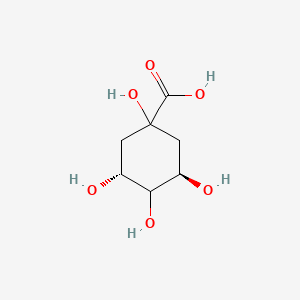 Compound
- Category
- Compound
What Quinic Acid is, and what it does.
- Does it work
- It suits people curious about what coffee polyphenol metabolism actually produces. If you drink coffee or tea and eat fruit, you already take some in every day.
- How much to take
- No dose figure is on record for quinic acid on its own. In food it arrives mostly bound as chlorogenic acid rather than free, so intake tracks what you eat and drink.
- Time to feel it
- Urinary hippurate rises within hours of a coffee. That's where it registers, and no human timeline exists for a purified supplemental form.
- The first dose
- Day one shows up in a urine sample rather than in how you feel: hippurate goes up after intake. Some people find the free acid sour on the tongue.
- With regular use
- Nobody has run a long-term human trial on isolated quinic acid. What is established is that the conversion pathway keeps running as long as intake does.
- How well tolerated
- It's a normal part of coffee, fruit and vegetables, so ordinary dietary amounts are well tolerated. Concentrated amounts haven't been studied, so check with a doctor.
- How it feels
- Sour and slightly astringent, the tang you notice in a darker roast. There's no stimulant effect here. The lift from coffee is caffeine, not this.
- The overlooked benefit
- Researchers use urinary hippurate to check that someone actually drank the coffee they reported, which makes quinic acid a dietary marker as much as an ingredient.
The proof, claim by claim.
What these words mean
These words describe the research, not the molecule's worth. Research strength is how much work stands behind one claim, and it is never a product score.
- conversion to hippuric acid by gut bacteria and the liverRandomised trial
- urinary hippurate as a marker of coffee and plant polyphenol intakeCohort study
2 more claims
- release of free quinic acid from caffeoylquinic esters by gut esterasesNarrative review
- contribution to the sour and astringent character of coffeeNarrative review
Why these belong in the same formula, 10 pairings
Why these belong in the same formula. Each row says what the basis is, from settled biochemistry through to a trial that measured the pair.
Chlorogenic acid is literally 5-O-caffeoylquinic acid, an ester joining quinic acid to caffeic acid. Gut and tissue esterases hydrolyse that bond, releasing both halves. Anyone consuming coffee or mate is therefore consuming quinic acid as a hydrolysis product whether or not the label says so. This is chemistry rather than an interaction to be dosed.
Esterase cleavage of chlorogenic acid liberates quinic acid and caffeic acid in equal molar amounts. They then follow entirely different routes: caffeic acid is a phenolic subject to conjugation and microbial metabolism, while quinic acid is largely converted by gut bacteria to aromatic acids. The two are co-delivered by chemistry, not by formulation choice. Understanding one requires accounting for the other.
Colonic bacteria dehydroxylate and aromatise quinic acid to benzoic acid, which the liver then conjugates with glycine to give hippuric acid. Urinary hippurate rises after quinic acid or coffee intake for this reason, and it is one of the more reliable microbial-conversion markers in nutrition research. The extent depends on the microbiota present. A germ-free or heavily antibiotic-treated gut does not perform this conversion.
The final step in quinic acid clearance is glycine conjugation of benzoic acid in liver mitochondria. Glycine availability can become rate-limiting when benzoate load is high, which is well documented in benzoate handling generally. This makes glycine status a determinant of how quickly the metabolite is cleared. It is a textbook conjugation pathway.
Many plant materials deliver quinic acid bound up in caffeoylquinic and dicaffeoylquinic esters rather than free. Combining sources adds to the same hydrolysis and microbial conversion pool. The result is more hippurate output rather than a distinct effect. Read it as additive load on one pathway.
Quercetin and quinic acid esters travel together in coffee, mate, apple and many other plant foods. Both are handled by gut microbiota and phase II conjugation, and both contribute to the polyphenol metabolite pool measured in plasma. Attributing an effect to one when both were consumed is a persistent problem in the observational literature. This is worth naming as a confounder as much as a synergy.
The antioxidant activity attributed to chlorogenic acid comes from its caffeic acid half, which carries the catechol group. Ascorbate regenerates oxidised catechols back to the reduced form in solution. Quinic acid itself lacks a phenolic ring and is a weak direct antioxidant. The distinction matters because the ram sperm work attributes antioxidant benefit to quinic acid specifically.
Quinic acid is a cyclitol carboxylic acid, and its salts are more water-soluble and less irritating than the free acid. Buffering with an alkaline salt raises pH and shifts the equilibrium toward the quinate anion. This is a formulation and tolerability matter rather than a biological interaction. It is why many commercial preparations are supplied as a salt.
Antioxidant additives in semen extenders are used to limit lipid peroxidation during freeze-thaw, and several are studied in the same ram and bull models. Quinic acid was assessed in that context. Any combination effect is inferred from shared application rather than tested, and none of this is human oral supplementation. Read it as veterinary and in vitro.
Coffee and yerba mate deliver caffeine and caffeoylquinic acids together in fixed proportion. Studies of either beverage cannot separate the two contributions without decaffeinated comparison arms. When a mate extract shows an effect, the quinic acid ester fraction is one candidate among several. Say which you have measured rather than which you assume acted.
Nothing specific on file for Quinic Acid. Match the label to the daily amount above, and tell your doctor what you take.
Not medical advice. Show the label to your pharmacist.What Quinic Acid actually does.
Quinic acid is a ring-shaped acid with several hydroxyl groups but no aromatic ring, so it doesn't count as a polyphenol.
3 more mechanisms
Plants and microbes make quinic acid through a pathway humans don't have, so we only get it from food.
Most of the quinic acid we eat comes attached to other compounds, mainly as chlorogenic acid in coffee, mate, apples, prunes and other plant foods.
Gut enzymes split those attached forms apart, releasing free quinic acid along with its partner compound.
Where Quinic Acid comes from.
It is the sour compound in coffee, and it was first pulled out of cinchona bark, which is where the name comes from. Most of it in food is stuck to another compound as chlorogenic acid, so making the pure version means splitting that bond and then cleaning it up by ion exchange. Some is now made by fermentation instead of extraction.
What this route gives you
The same molecule is reached more than one way. Which route a given product used is a manufacturing choice, and the finished compound is the same either way.
6 steps on record
Historically isolated from cinchona bark, which is where the name originates. Modern material comes from coffee processing streams, other plant sources, or engineered microbial fermentation.
Where the source is chlorogenic acid-rich, alkaline or enzymatic hydrolysis cleaves the caffeoyl ester to free the quinic acid from its phenolic partner.
Quinic acid is highly water-soluble, so hot water extraction pulls it efficiently from plant material along with sugars and other organic acids.
Anion exchange separates the carboxylic acid from neutral sugars, and the acid is then crystallised. Purity is confirmed by HPLC and optical rotation, since the compound is chiral.
Free quinic acid is assayed directly. In plant extracts the declared figure is usually total chlorogenic acids rather than quinic acid content.
Supplied as the free acid or as an alkali salt. In supplements it most often arrives indirectly, inside a green coffee or mate extract.
Getting Quinic Acid from food.
The whole-food sources on file. A supplement closes the gap, it does not replace dinner.
A gram-for-gram figure (how much of each you would eat to match a dose) will appear here once it is sourced and reviewed. This page will not print a number it cannot cite.
The forms it comes in.
4 more forms
The essence, in one line each.
- Quinic acid added to ram semen extender improved measured post-thaw sperm quality parameters relative to control.In vitro study. Denk B et al., 2025 (Frontiers in Veterinary Science). PMID 41560853 ↗
4 more findings
- Quinic acid reduced markers of inflammation and limited skeletal muscle loss in a disuse model.Animal study. Kim MB et al., 2025 (Foods). PMID 41299991 ↗
- In a study comparing adults with a diagnosed blood pressure condition and a specific traditional medicine syndrome to healthy adults, quinic acid was identified as one of 20 metabolites that differed between the groups.Case-control, in hypertensive patients with Yin deficiency and Yang hyperactivity syndrome. Jialiken D et al., 2025 (World Journal of Experimental Medicine). PMID 41523755 ↗
- Fermented sea buckthorn products, which contain quinic acid among their organic acids, altered production and antioxidant measures in laying hens.Animal study. Liu D et al., 2026 (Poultry Science). PMID 41352189 ↗
- Date fruit fortification of almond beverage was characterised compositionally, with quinic acid reported among the organic acids present.In vitro study. Ben Zid M et al., 2026 (Food Technology and Biotechnology). PMID 42328299 ↗
Chosen from the 6 we read for Quinic Acid.
FDA Disclaimer: These statements have not been evaluated by the Food and Drug Administration. This information is for educational purposes only and is not intended to diagnose, treat, cure, or prevent any disease. Consult your healthcare provider before starting any supplement regimen.