Theaflavin.
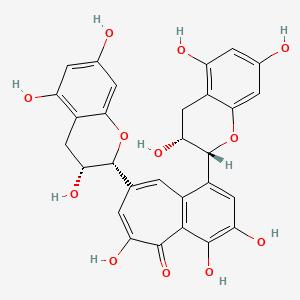
Theaflavins are the orange-red polyphenols that form when tea leaf oxidises into black tea. They're studied for antioxidant activity and for lipids already in the normal range.
 Compound
- Category
- Compound
What Theaflavin is, and what it does.
- Does it work
- It suits black tea drinkers who want the polyphenol without the cup, and anyone building an antioxidant or healthy-lipid formula. Coffee-only households get none from diet.
- How much to take
- No daily amount is on record for theaflavins. Standardised black tea extract is taken daily with food, and steady daily use is what the research is built on.
- Time to feel it
- There's no sensation on a timescale. Where lipid markers move, that shows up on a blood panel after a couple of months of daily use.
- The first dose
- Day one is a strong cup of tea in capsule form. The effects are read on a panel over months rather than felt on the day.
- With regular use
- Weeks of daily use show up as antioxidant activity and, in some trials, movement in lipid markers already in the normal range. It's a marker story rather than a sensation.
- How well tolerated
- Generally well tolerated. Galloylated tea polyphenols bind non-heme iron in the gut, so if you're building iron stores, space it away from an iron serving and iron-rich meals.
- How it feels
- There's nothing you'd point to. Taken as a full-strength tea extract you'd feel the caffeine that rides along with it, not the theaflavin.
- The overlooked benefit
- Theaflavins bind caffeine as tea cools, forming the cloudy layer called tea cream. A caffeine-reduced extract keeps the polyphenol without the stimulant.
The proof, claim by claim.
What these words mean
These words describe the research, not the molecule's worth. Research strength is how much work stands behind one claim, and it is never a product score.
- Cholesterol already in the normal rangeMeta-analysis
- Antioxidant activityIn vitro study
2 more claims
- Muscle soreness after hard trainingRandomised trial
- Reduced uptake of non-heme iron in the gutNarrative review
Why these belong in the same formula, 9 pairings
Why these belong in the same formula. Each row says what the basis is, from settled biochemistry through to a trial that measured the pair.
The relationship is chemical rather than nutritional: no catechin, no theaflavin. Black tea and green tea therefore deliver related molecules at different oxidation states rather than two unrelated actives. Combining the two extracts stacks total polyphenol load, including the parts that bind iron and inhibit digestive enzymes.
The galloyl groups on theaflavin digallate chelate iron in the gut lumen and drop it out of solution before it reaches the transporter. Black tea with a meal is the classic textbook example of this. Anyone supplementing iron or working on low iron status should keep the two apart by a couple of hours.
This is the standard countermeasure to the tea and iron problem: ascorbate reduces ferric iron and competes with the polyphenol for it. It blunts the inhibition rather than removing it. Ascorbate also slows the oxidative browning of tea polyphenols in solution, which is why it shows up in ready-to-drink tea formulation.
The complexation is well described in tea chemistry and is why cold black tea goes cloudy. It changes solubility and therefore what stays dissolved for absorption. The pairing is unavoidable in whole black tea extracts and reduced in decaffeinated ones.
Theaflavin digallate is among the tea polyphenols shown to slow lipase activity in enzyme assays. Taken with a supplemental digestive lipase, the two work against each other. The inhibition is well demonstrated at the enzyme level and much less clear at the level of what a person actually digests.
The chemistry that ties up iron is not selective to iron. Zinc uptake from the same meal can be reduced by a polyphenol-heavy drink. The effect is documented for tea polyphenols as a class rather than for theaflavin specifically, so it is a class inference and should be read as one.
The recycling chemistry is established for polyphenols in lipid systems and is used deliberately in food emulsions. Whether theaflavin does this at achievable concentrations inside a person is not established. Read it as mechanistic rather than clinical.
Both bind proteins through their hydroxyl groups and both show Nrf2-linked activity in cell work. The overlap means their effects on the same targets are not independent, which cuts both ways for benefit and for enzyme interference. No human work on the combination exists.
Plant sterols displace cholesterol from mixed micelles, while galloylated tea polyphenols disrupt micelle formation itself. The mechanisms are compatible on paper. There is no trial of the combination, and the human theaflavin data on blood lipids is limited and mixed.
Nothing specific on file for Theaflavin. Match the label to the daily amount above, and tell your doctor what you take.
Not medical advice. Show the label to your pharmacist.What Theaflavin actually does.
They are not in the fresh leaf. Bruising and oxidising the leaf builds them out of green tea catechins.
3 more mechanisms
The gallate versions are the sticky ones. They grab minerals and proteins far more strongly than plain theaflavin.
Very little of the molecule itself gets into your blood. Your gut bacteria dismantle most of it first.
Push the fermentation further and the orange-red compounds turn into bigger brown ones.
Where Theaflavin comes from.
Green tea and black tea come from the same leaf. Theaflavins are what green tea's catechins turn into when the leaf is bruised and left to oxidise. That reaction is also what makes black tea orange-red.
What this route gives you
Made from a plant. What ends up in the capsule tracks the harvest, so batch testing and a stated marker matter more here than with a made molecule.
7 steps on record
The same plant that makes green tea. The catechins in the fresh leaf are the raw material.
Rolling ruptures cells so polyphenol oxidase meets the catechins. The coupling reaction builds the benzotropolone ring and turns the leaf from green to copper.
Heat denatures the enzyme and locks in the theaflavin to thearubigin ratio. Stop early and theaflavins are higher, run long and they polymerise onward.
Black tea solids are extracted, then concentrated. Caffeine may be removed at this stage.
Polyphenols are captured on adsorbent resin and eluted, which is how concentrations above the native leaf percentage are reached.
Declared percentage is set against the four main theaflavin species. Individual isomer ratios are rarely disclosed.
Sold as a dry extract for capsules or as a soluble concentrate for drinks.
Getting Theaflavin from food.
The whole-food sources on file. A supplement closes the gap, it does not replace dinner.
A gram-for-gram figure (how much of each you would eat to match a dose) will appear here once it is sourced and reviewed. This page will not print a number it cannot cite.
The forms it comes in.
4 more forms
The essence, in one line each.
- Reports that theaflavin limited PLA2G4C-driven lipid remodelling and ferroptotic cell death in a preclinical model of restricted brain blood flow.Animal study. Yang et al., 2026 (Phytomedicine). PMID 42127597 ↗
2 more findings
- Reports that theaflavin-3,3'-digallate reduced senescence markers in cartilage cells via FGF7 and KEAP1/NRF2 signalling.In vitro study. Kou et al., 2026 (Free Radical Biology and Medicine). PMID 42162842 ↗
- Reports that theaflavin-3,3'-digallate improved pig oocyte maturation and early embryo development in culture.In vitro study. Chen et al., 2026 (Reproductive Biology). PMID 42284915 ↗
Chosen from the 3 we read for Theaflavin.
FDA Disclaimer: These statements have not been evaluated by the Food and Drug Administration. This information is for educational purposes only and is not intended to diagnose, treat, cure, or prevent any disease. Consult your healthcare provider before starting any supplement regimen.