Thymoquinone.
It is the yellow quinone that gives black seed oil its character. Rather than acting as an antioxidant itself, it nudges your own antioxidant genes into a higher gear.
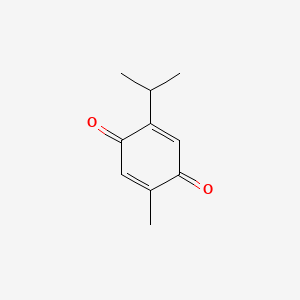 Compound
- Category
- Compound
What Thymoquinone is, and what it does.
- Does it work
- This suits people already using black seed oil who want to know what carries it. Anyone taking thiol compounds like NAC should know it reacts with them directly.
- How much to take
- No daily amount for isolated thymoquinone is on record. Start at the low end of the label, with a meal containing fat, since it dissolves in oil rather than water.
- Time to feel it
- No timeline has been established. The Nrf2 response is a change in gene expression, read over days in lab work rather than felt within an hour.
- The first dose
- Day one is usually uneventful beyond a sharp, peppery aftertaste. The antioxidant genes it switches on show up in laboratory markers rather than in sensation.
- With regular use
- Weeks of daily use keep that mild electrophile signal running, which is how glutathione synthesis and quinone reductase capacity rise in lab work. Human long-term data is limited.
- How well tolerated
- Black seed oil has a long history as a food. Concentrated isolated thymoquinone is far less studied, so check with your doctor if you are pregnant, breastfeeding or on medication.
- How it feels
- The oil tastes sharp and bitter and can repeat on you. The compound itself carries no felt effect. Its work shows up in antioxidant markers.
- The overlooked benefit
- Free thiols consume it. Taken in the same mouthful as NAC or glutathione, some is used up before absorption, so spacing them apart makes sense.
The proof, claim by claim.
What these words mean
These words describe the research, not the molecule's worth. Research strength is how much work stands behind one claim, and it is never a product score.
- activation of the Nrf2 antioxidant responseIn vitro study
- a healthy inflammatory responseAnimal study
2 more claims
- lipids already in the normal range, from black seed oilMeta-analysis
- antioxidant defenceAnimal study
Why these belong in the same formula, 9 pairings
Why these belong in the same formula. Each row says what the basis is, from settled biochemistry through to a trial that measured the pair.
A 2026 laboratory report paired glycine with thymoquinone and found the combination acted on glucose-related endpoints more than either alone in that model. Both molecules independently touch oxidative stress handling, which is the proposed common thread. This was a laboratory model and the endpoints were markers, so it does not carry over to people without human work.
Thymoquinone is lipophilic and concentrates in the lipid phase, the same compartment where alpha-tocopherol does its chain-breaking work. Two chain-breaking antioxidants in one compartment spare each other, so less of each is consumed per unit of oxidative load. The evidence for this specific pair is mechanistic rather than clinical.
The quinone carbonyls accept electrons and the molecule cycles between quinone and hydroquinone forms, consuming reduced glutathione in the process. At low concentrations that cycling activates Nrf2-driven antioxidant enzyme expression, which raises glutathione synthesis over time. At high concentrations the same chemistry depletes the pool instead, so the direction is dose-dependent and not one-way.
N-acetylcysteine supplies cysteine for glutathione synthesis, which offsets the thiol consumption driven by quinone cycling. The flip side is that a free thiol adds directly across the quinone in solution, so mixing them in the same liquid formulation can consume the active before it is swallowed. The interaction is favourable metabolically and unfavourable in the bottle.
As a lipophilic quinone it needs a lipid phase to stay dissolved through the gut and to enter mixed micelles. Medium-chain triglycerides disperse readily and are the common carrier in softgel formats. This is why capsule oil formats and dry powder formats are not interchangeable at the same stated milligram.
Lecithin forms mixed micelles and liposomal structures that hold lipophilic molecules in a dispersible state. Applied to black seed oil formats, it keeps the active from separating and improves how evenly it disperses in gut contents. Formulation reasoning, with black seed oil delivery data still limited.
Both compounds activate Nrf2-driven antioxidant response elements and both damp NF-kB signalling in laboratory systems. Combining them broadens the phenolic profile without stacking a single molecule. Nearly all of the supporting work is in cells and animals, and both molecules absorb poorly without a lipid or delivery aid.
Lipoic acid moves between water and lipid compartments and helps regenerate oxidised glutathione and tocopherol. That supports the thiol pool that quinone cycling draws down. The pairing is mechanistically coherent and has not been tested together in people.
A redox-cycling quinone in the presence of free iron can generate hydroxyl radicals rather than scavenge them, flipping an antioxidant into a pro-oxidant in the same test system. The chemistry is well described for quinones as a class. Taking a high-dose iron and a quinone-rich oil at the same moment is worth spacing on that basis alone.
Nothing specific on file for Thymoquinone. Match the label to the daily amount above, and tell your doctor what you take.
Not medical advice. Show the label to your pharmacist.What Thymoquinone actually does.
Thymoquinone is the main aromatic compound in black seed oil. Because of its chemical structure it can accept and give up electrons, cycling back and forth between two related forms.
3 more mechanisms
Its structure reacts with free sulfur-containing groups on proteins. That's why it binds certain regulatory proteins, and it's also why it reacts if consumed alongside solutions containing free sulfur compounds.
By modifying one regulatory protein, thymoquinone releases another protein called Nrf2, which turns on genes for the body's own antioxidant defenses, including glutathione production. This is the standard way a mild reactive compound can raise the body's own antioxidant capacity.
The compound doesn't dissolve well in water, breaks down when exposed to light or alkaline conditions, and is unstable at high heat. That's why it's kept in amber glass, cool storage and an oil carrier, not for marketing reasons.
Where Thymoquinone comes from.
It is the yellow compound that gives black seed oil its character. You can get it by pressing black cumin seeds, or you can make it in a plant by oxidising thymol, the same compound found in thyme. Either way it breaks down in light and heat, which is why it comes in dark bottles.
What this route gives you
The same molecule is reached more than one way. Which route a given product used is a manufacturing choice, and the finished compound is the same either way.
6 steps on record
The botanical route starts with black cumin seed. A synthetic route starts from thymol, the phenol also found in thyme oil.
Thymol is oxidised to the para-quinone. This gives a single defined molecule with no seed co-constituents attached.
Cold pressing yields the whole seed oil at low temperature. Supercritical carbon dioxide extraction selectively enriches the volatile fraction where the quinone concentrates, without solvent residue.
For isolated material, the volatile fraction is distilled or chromatographed and the quinone crystallised. Light and heat are controlled at every step because the molecule degrades under both.
Oils are assayed by HPLC against a thymoquinone reference and labelled to a declared percentage. A peroxide value on the fixed oil is the other number worth seeing.
Filled under nitrogen where possible and packed in light-blocking containers.
The forms it comes in.
4 more forms
The essence, in one line each.
- In a 15-day randomised trial in 65 adults with diagnosed seasonal allergy symptoms, a supplement of Nigella sativa oil (standardised for thymoquinone) with piperine taken twice daily significantly reduced nasal and eye symptoms compared to a placebo.Randomised trial, in participants aged 18 to 60 years having 2 or more allergic symptoms like sneezing, rhinorrhoea, nasal obstruction, and nasal itching for a cumulative period gre. Majeed A et al., 2024 (Medicine). PMID 39121267 ↗
8 more findings
- A review linking altered brain function in adults carrying excess body weight to proposed neurological actions of thymoquinone, drawing on laboratory and preclinical work.Narrative review. Mostafa MD et al., 2026 (Metabolic Brain Disease). PMID 41920373 ↗
- Thymoquinone supplementation reduced markers of cellular and genetic damage in liver tissue from rats exposed to arsenic.Animal study. Alam T et al., 2022 (Journal of Trace Elements in Medicine and Biology). PMID 36155422 ↗
- Supplementation reduced markers of liver injury in a laboratory model of cisplatin exposure.Animal study. Shahid F et al., 2021 (Human and Experimental Toxicology). PMID 33832332 ↗
- In rats, thymoquinone reduced markers of cerebellar and liver cell damage after high-dose statin exposure.Animal study. Ouies SM et al., 2026 (Scientific Reports). PMID 42185405 ↗
- Combining glycine with thymoquinone acted on glucose-related markers more than either component alone in the model used.Animal study. Bash NN et al., 2026 (Scientific Reports). PMID 42156484 ↗
- Black cumin oil showed activity against bacterial isolates in culture, with molecular docking used to propose which constituents bind which targets.In vitro study. Kanıcı Tarhane A et al., 2026 (International Journal of Molecular Sciences). PMID 42278598 ↗
- Dietary Nigella sativa was assessed as a growth promoter and health support in challenged broiler birds.Animal study. Manjunatha V et al., 2023 (Poultry Science). PMID 37356299 ↗
- Nigella sativa meal was characterised and assessed in a rumen fermentation system, a feed-science context rather than a human one.In vitro study. Juandita KN et al., 2026 (Animals). PMID 41976070 ↗
Chosen from the 10 we read for Thymoquinone.
The studies, linked.
12 sources behind our Thymoquinone verdict, every one linked to PubMed, the journal or ClinicalTrials.gov.
- Clinical trialAmelioration of Polycystic Ovary Syndrome Related Disorders by Supplementation of Thymoquinone and MetforminClinicalTrials.gov ↗Phase 2, 253 participants, Completed
11 more linked trials
- Clinical trialEvaluation of the Efficacy of a Nigella Sativa Extract Standardized to 10% Thymoquinone (Nisatol®) in Improving Metabolic and Blood Pressure Parameters and Quality of Life in Perimenopausal Women With Metabolic Syndrome: A Prospective, Multicenter, Randomized Controlled Clinical TrialClinicalTrials.gov ↗50 participants, Completed
- Clinical trialEfficacy of Thymoquinone as an Adjuvant Treatment With Pregabalin for the Treatment of Neuropathy in Diabetic Patients: A Randomized Clinical Trial of 65 mg of Thymoquinone and 75 mg Pregabalin Daily for Two MonthsClinicalTrials.gov ↗Phase 4, 50 participants, Completed
- Clinical trialClinical And Immunohistochemical Evaluation Of The Cancer Chemopreventive Effect Of Thymoquinone Compared To A Placebo On Oral Potentially Malignant Lesions Among An Egyptian Population : A Randomized Clinical TrialClinicalTrials.gov ↗Phase 2, 48 participants, Completed
- ClinicalTrials.gov ↗
- Clinical trialA Randomized Controlled Clinical Trial for the Assessment of Clinical Efficacy of Topical Application of 5% Thymoquinone Gel for Gingivitis PatientsClinicalTrials.gov ↗Early phase 1, 70 participants, Unknown
- Clinical trialEffect of Thymoquinone and Olive Oil on Wound Healing After Endoscopic Sinus Surgery in Patients With Nasal PolyposisClinicalTrials.gov ↗50 participants, Unknown
- Clinical trialEvaluation of the Effect of Thymoquinone Hydrogel With Bone Graft in Comparison to Bone Graft Only Around Immediate Implant (Randomized Controlled Clinical Trials)ClinicalTrials.gov ↗44 participants, Not yet recruiting
- Clinical trialEffect of Thymoquinone Extracted From Nigella Sativa in the Treatment of Arsenical KeratosisClinicalTrials.gov ↗34 participants, Unknown
- Clinical trialThe Effect of 2 Grams Daily Supplementation of Thymoquinone -Containing Sativa Nigra Oil on Blood Glucose Levels of Adults: A Placebo-controlled Double-blinded Randomized Controlled TrialClinicalTrials.gov ↗30 participants, Unknown
- Clinical trialClinical and Radiographic Evaluation of the Effect of Thymoquinone 0.2% Gel on Bone Density, Bone Width, and Socket Preservation After Tooth ExtractionClinicalTrials.gov ↗30 participants, Recruiting
- Clinical trialEfficacy and Safety of Thymoquinone Ointment as a Potential New Therapeutic Modality of Psoriasis Vulgaris.ClinicalTrials.gov ↗30 participants, Unknown
From clinical trials and PubMed, ranked by study type and citation weight, not cherry-picked.
Problems people have reported.
Read this carefully. These are 25 voluntary, unverified reactions reported to the FDA (openFDA). The number mostly reflects how popular Thymoquinone is, not how risky it is. A report is not proof Thymoquinone caused anything. It is a signal of what to watch for, nothing more.
3 more reported effects
Source: openFDA adverse-event reports. Voluntary reporting, not an incidence rate.
FDA Disclaimer: These statements have not been evaluated by the Food and Drug Administration. This information is for educational purposes only and is not intended to diagnose, treat, cure, or prevent any disease. Consult your healthcare provider before starting any supplement regimen.