Viniferin.
A stilbene from grapevine wood, closely related to resveratrol. It's taken to support the body's own antioxidant defences against everyday oxidative stress.
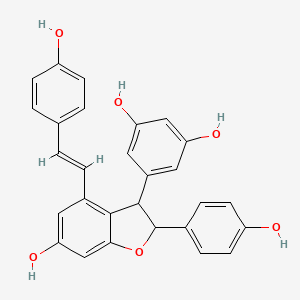 Compound
- Category
- Compound
What Viniferin is, and what it does.
- Does it work
- Suits people already interested in resveratrol and grape polyphenols who want the oligomer form. Human data is early, so it's an exploratory addition rather than a staple.
- How much to take
- No daily amount is on record for viniferin, so we won't invent one. Human dosing hasn't been settled in the published work yet.
- Time to feel it
- Nobody has measured a time course for viniferin in people. Like other stilbenes, any effect would sit in lab markers rather than in sensation.
- The first dose
- Day one is quiet. Stilbenes act on antioxidant signalling, so the first day shows up in biochemistry rather than in how you feel.
- With regular use
- Weeks of daily use haven't been tracked in people. What's known sits in cell and animal work on antioxidant signalling, not in long human trials.
- How well tolerated
- No safety signal has surfaced in the human literature, though there is little of it. Grapevine extracts are eaten in food form. Check with your doctor if you take medication.
- How it feels
- Most people report no sensation at all, which is normal for a polyphenol. It's an ingredient you take on mechanism, not on feel.
- The overlooked benefit
- It comes from pruned canes, the part of the vine usually discarded, so the material rides on a by-product stream the wine industry already generates.
The proof, claim by claim.
What these words mean
These words describe the research, not the molecule's worth. Research strength is how much work stands behind one claim, and it is never a product score.
- antioxidant activityIn vitro study
- vascular and endothelial signallingAnimal study
2 more claims
- stilbene absorption and metabolismNarrative review
- healthy inflammatory signallingIn vitro study
Why these belong in the same formula, 8 pairings
Why these belong in the same formula. Each row says what the basis is, from settled biochemistry through to a trial that measured the pair.
Epsilon-viniferin is a resveratrol dimer formed by oxidative coupling of two resveratrol units, and alpha-viniferin is the corresponding trimer. Grapevine extracts therefore deliver both the monomer and its oligomers together, and the ratio shifts with plant part and processing. The chemistry is settled, but sharing a backbone does not mean the two behave the same once absorbed.
Both come from Vitis vinifera, and grapevine cane or shoot extracts commonly carry stilbenes alongside the proanthocyanidins that dominate seed extracts. Formulators pair them to widen the polyphenol profile from a single plant source. This is compositional overlap, not a demonstrated combined effect.
Pterostilbene is a dimethylated stilbene that resists phase II conjugation better than resveratrol does, so it is often stacked with grapevine stilbene extracts. The pairing is built on class chemistry and pharmacokinetic reasoning rather than on a trial of the combination. No human study has tested viniferin plus pterostilbene together.
Stilbenes are cleared fast by glucuronidation and sulfation in the gut wall and liver, which is why unmodified plasma levels stay low. Piperine slows glucuronidation, and that is the stated reason it appears in stilbene formulas. The same inhibition is not selective, so it can raise exposure to co-administered medicines as well.
Quercetin is itself a heavy substrate for sulfotransferases and glucuronosyltransferases, the same enzymes that clear stilbenes. Co-ingestion at high doses can slow conjugation of both, raising unconjugated levels of each. That is a pharmacokinetic prediction from shared enzymology, not a measured outcome in people taking viniferin.
Viniferins are larger and more lipophilic than resveratrol and dissolve poorly in water, which limits how much ever leaves a dry capsule. Phospholipid dispersions and lecithin-based carriers are the standard workaround for this class. Better dispersion is a formulation gain and does not by itself demonstrate a physiological effect.
A medium-chain triglyceride vehicle keeps stilbene oligomers in solution in a softgel and supports dispersion in the gut. This is the same rationale used for other poorly soluble polyphenols. It changes delivery, not activity.
Stilbene oligomers form through oxidative coupling in the plant, and the same oxidative chemistry continues in a finished product exposed to air, light and metal traces. Ascorbate is used as a formulation antioxidant to slow that drift. The relevance here is shelf chemistry, and no human data links the pair to any measured endpoint.
Nothing specific on file for Viniferin. Match the label to the daily amount above, and tell your doctor what you take.
Not medical advice. Show the label to your pharmacist.What Viniferin actually does.
Viniferins are larger stilbene compounds built from multiple linked resveratrol units, some pairs, some in threes or fours.
3 more mechanisms
Grapevines produce these compounds by linking resveratrol molecules together as a defense response, so the woody parts of the vine carry far more of them than the grape itself does.
These stilbenes get heavily processed by the gut and liver before reaching circulation, so blood levels of the unaltered compound stay low even after a large dose.
Because viniferins are bigger and have more phenolic rings than resveratrol, they dissolve and cross membranes less easily, which limits how well any oral form of them can work.
Where Viniferin comes from.
Think of it as resveratrol stuck together in twos and threes. The vine makes it in its wood and stems as a defence chemical, which is why the material comes from pruned canes rather than from grapes.
What this route gives you
The same molecule is reached more than one way. Which route a given product used is a manufacturing choice, and the finished compound is the same either way.
6 steps on record
Pruning waste from Vitis vinifera is the main commercial source because vine wood carries far more stilbene oligomer than the fruit
Peroxidase-driven dimerisation happens in the plant as a defence response, and the same coupling is used semi-synthetically from resveratrol
Solvent choice sets the oligomer-to-monomer ratio in the crude extract
Needed to separate epsilon-viniferin from resveratrol and the higher oligomers
Labels vary between total stilbenes and specified epsilon-viniferin percentage, which are not the same number
Format is chosen around the solubility problem more than around taste or convenience
Getting Viniferin from food.
The whole-food sources on file. A supplement closes the gap, it does not replace dinner.
A gram-for-gram figure (how much of each you would eat to match a dose) will appear here once it is sourced and reviewed. This page will not print a number it cannot cite.
The forms it comes in.
4 more forms
The essence, in one line each.
- A review of the viniferin family maps the structural variants and collects the preclinical pharmacology reported for them to date.Narrative review. El-Dessouki et al., 2026 (Naunyn-Schmiedeberg's Archives of Pharmacology). PMID 41317193 ↗
1 more finding
- A computational target-prediction analysis of Gnetum gnemon constituents proposed receptor interactions for its stilbene compounds, which are predictions requiring laboratory confirmation.In vitro study. Chatatikun et al., 2024 (Scientific Reports). PMID 39468096 ↗
Chosen from the 3 we read for Viniferin.
The studies, linked.
1 source behind our Viniferin verdict, every one linked to PubMed, the journal or ClinicalTrials.gov.
- Clinical trialStudy of the Oral Bioavailability of Trans-epsilon-viniferin and Trans-resveratrol From Native and Micellar Solubilized vineatrol30 Vine ExtractClinicalTrials.gov ↗Early phase 1, 12 participants, Completed
From clinical trials and PubMed, ranked by study type and citation weight, not cherry-picked.
FDA Disclaimer: These statements have not been evaluated by the Food and Drug Administration. This information is for educational purposes only and is not intended to diagnose, treat, cure, or prevent any disease. Consult your healthcare provider before starting any supplement regimen.