Vitexin.
A flavone from hawthorn leaf, passionflower and mung bean coats. It carries antioxidant activity, and its sugar is welded on with a carbon bond your gut enzymes cannot cut.
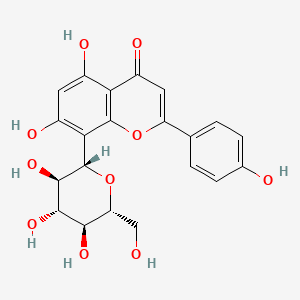 Compound
- Category
- Compound
What Vitexin is, and what it does.
- Does it work
- Suits people building a botanical calm or hawthorn formula, or anyone standardising a plant extract to a marker they can measure. Real dietary intake exists alongside it.
- How much to take
- No dose figure is on record, so we are not going to invent one. What is settled is that most of an oral amount reaches the colon before anything is freed up.
- Time to feel it
- Nobody has measured a human time course for isolated vitexin. Hawthorn and passionflower preparations that carry it are typically assessed over weeks.
- The first dose
- Day one is quiet. What is happening is transit: the intact C-glycoside travelling to the colon, where your bacteria decide how much aglycone gets released.
- With regular use
- Long-term human data on vitexin alone has not been collected. Steady intake changes which microbial populations are doing that release, which varies between people.
- How well tolerated
- No serious safety signal is recorded at food-level intake. Like other polyphenols it binds iron in the gut, so keep it away from an iron serving.
- How it feels
- Nothing distinct is described. Any subjective effect reported for hawthorn or passionflower belongs to those whole extracts, not to vitexin on its own.
- The overlooked benefit
- Labs that cannot separate the C-glycoside isomers report vitexin and isovitexin as one number, so a stated percentage can be a mixture of two compounds.
The proof, claim by claim.
What these words mean
These words describe the research, not the molecule's worth. Research strength is how much work stands behind one claim, and it is never a product score.
- Antioxidant activity in assay conditionsIn vitro study
- Resistance to small-intestinal hydrolysisNarrative review
3 more claims
- Calm and relaxation, within passionflower preparationsRandomised trial
- Cardiovascular marker changes, within hawthorn extractsRandomised trial
- Metal ion binding and non-heme iron interactionIn vitro study
Why these belong in the same formula, 6 pairings
Why these belong in the same formula. Each row says what the basis is, from settled biochemistry through to a trial that measured the pair.
Vitexin is apigenin carrying a glucose attached through a carbon-carbon bond at position 8. That linkage is the whole story of how the two differ in the body, because a C-glycoside cannot be cleaved by the intestinal beta-glucosidases that release O-glycosides. Anything measured for apigenin should not be assumed for vitexin without checking which molecule was dosed.
Because human enzymes do not cleave the carbon-carbon glycosidic bond, vitexin arrives largely intact in the colon, where specific gut bacteria can carry out C-deglycosylation to release the aglycone. This makes the size of the response partly a function of which organisms a person carries. Which strains do it, and how reliably, is not settled, so this is mechanism rather than a dosing instruction.
Flavonoids bind non-heme iron in the gut lumen and lower how much of it is absorbed, which is the same effect seen with tea polyphenols at a meal. A vitexin-rich extract taken with an iron supplement or an iron-containing meal falls under the same chemistry. Separating the two by a couple of hours removes the overlap.
Ascorbate reduces ferric iron to the ferrous form and competes with polyphenol chelation, which is the standard way of offsetting flavonoid interference with iron at a meal. It is relevant when a flavone-rich extract sits in the same formula as iron. The effect is on iron status, not on vitexin itself.
Passiflora incarnata extracts carry vitexin and isovitexin among their C-glycosyl flavones, and several suppliers use vitexin content as the standardisation marker. The same overlap applies as with hawthorn. Stacking a passionflower extract on top of an isolated vitexin product raises total flavone intake beyond what either label shows.
Whatever aglycone is released from vitexin is handled by the same glucuronosyltransferases and sulfotransferases that clear quercetin. High-dose quercetin can occupy those enzymes and slow conjugation of other flavonoids taken alongside it. This is predicted from shared enzymology and has not been measured for vitexin in people.
Nothing specific on file for Vitexin. Match the label to the daily amount above, and tell your doctor what you take.
Not medical advice. Show the label to your pharmacist.What Vitexin actually does.
Vitexin is a flavone with a sugar attached through an unusually stable carbon-to-carbon bond, rather than the more common oxygen-linked bond.
3 more mechanisms
The digestive enzymes in your small intestine can't break that particular kind of bond, so vitexin doesn't get converted to its free form there the way a more typical sugar-linked flavonoid would.
Because it resists that breakdown, most vitexin taken by mouth reaches the colon still intact, where gut bacteria are the main way it eventually gets its sugar removed.
Vitexin naturally occurs in a range of foods and plants, like hawthorn leaf, passionflower, mung bean skins, bamboo leaf, pearl millet and buckwheat, so people get some from diet, not just from supplements.
Where Vitexin comes from.
It is apigenin with a sugar welded on, and the weld is the point. Your gut enzymes cannot snap that bond, so most of it travels to the colon and depends on gut bacteria to be freed up.
What this route gives you
Made from a plant. What ends up in the capsule tracks the harvest, so batch testing and a stated marker matter more here than with a made molecule.
5 steps on record
Source choice sets the isomer mix, since each plant carries a different vitexin to isovitexin to orientin ratio
C-glycosyl flavones are moderately polar and come across well in 50 to 70 percent ethanol
The step that separates vitexin from its positional isomer isovitexin, which many commodity extracts skip
Methods differ in whether they resolve the isomers, so labels are not directly comparable between suppliers
Most retail exposure comes through a standardised hawthorn or passionflower extract rather than an isolate
Getting Vitexin from food.
The whole-food sources on file. A supplement closes the gap, it does not replace dinner.
A gram-for-gram figure (how much of each you would eat to match a dose) will appear here once it is sourced and reviewed. This page will not print a number it cannot cite.
The forms it comes in.
4 more forms
The essence, in one line each.
- A mung bean ethanol extract, in which vitexin is a named constituent, reduced markers of alcohol-related liver injury and shifted gut microbial composition in the exposed animals.Animal study. Liu et al., 2025 (Food & Function). PMID 41090451 ↗
2 more findings
- A combined mung bean, red bean and fennel extract improved intestinal barrier markers in a cultured colon cell line.In vitro study. Lee et al., 2025 (Current Issues in Molecular Biology). PMID 41614862 ↗
- Analytical profiling of Chinese large-leaf congou black teas identified vitexin among the flavone glycosides that distinguish sample groups.In vitro study. Zhang et al., 2026 (Food Chemistry). PMID 42442105 ↗
Chosen from the 3 we read for Vitexin.
Problems people have reported.
Read this carefully. These are 33 voluntary, unverified reactions reported to the FDA (openFDA). The number mostly reflects how popular Vitexin is, not how risky it is. A report is not proof Vitexin caused anything. It is a signal of what to watch for, nothing more.
3 more reported effects
Source: openFDA adverse-event reports. Voluntary reporting, not an incidence rate.
FDA Disclaimer: These statements have not been evaluated by the Food and Drug Administration. This information is for educational purposes only and is not intended to diagnose, treat, cure, or prevent any disease. Consult your healthcare provider before starting any supplement regimen.