
The people it speaks toFieldwork 2005 to 2016
15% of US adults
had a usual zinc intake below the Estimated Average Requirement, up from 11% in an earlier survey period, across NHANES data from 2005 to 2016.
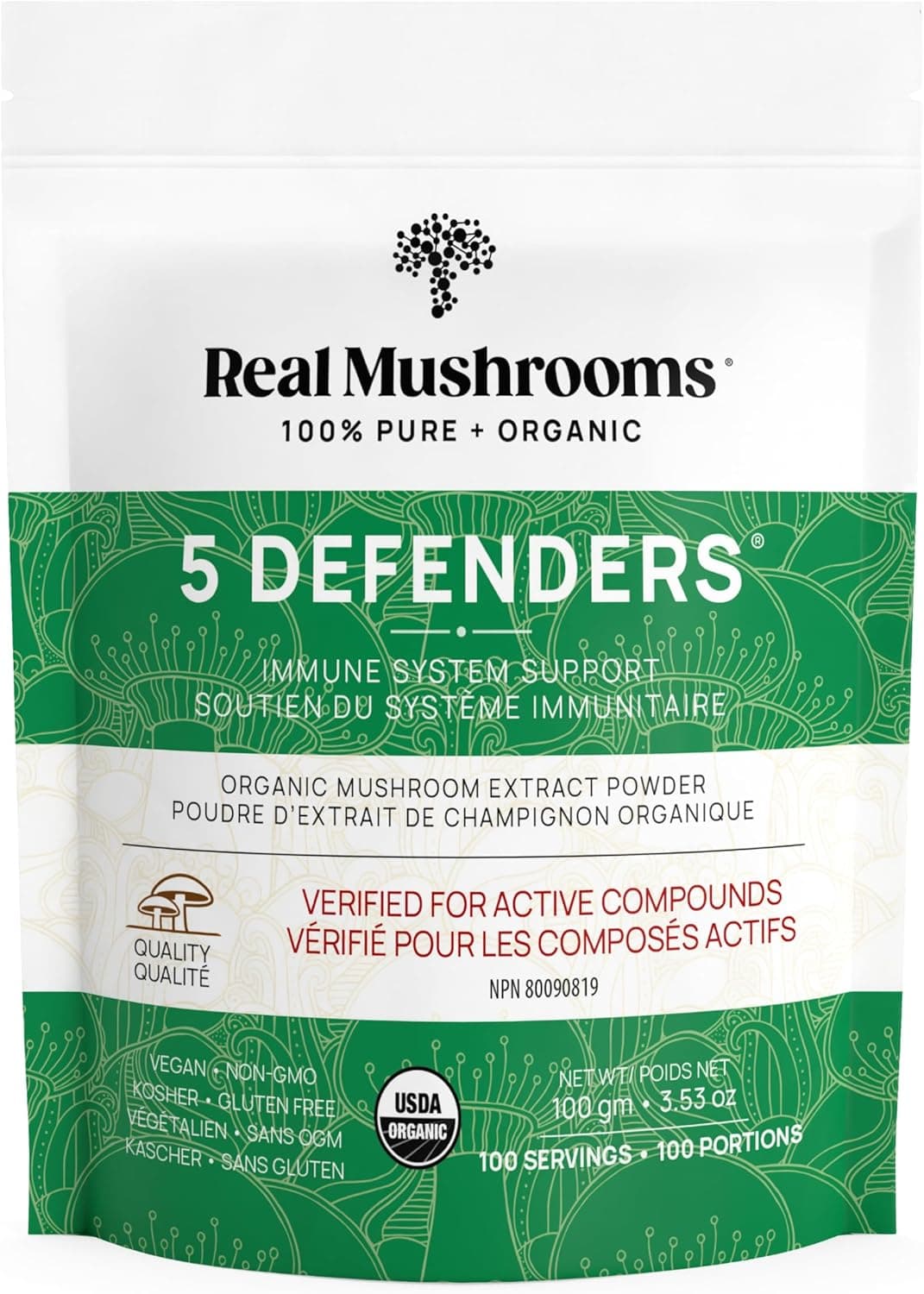
Peer-reviewed NHANES analysis, 2020Turkey Tail mushroom extract is the lead active here, studied most for immune resilience. In the 1000 mg 5 Defenders Extract Blend with four others, listed first. Reishi mushroom extract is the most studied active here, with 6 human studies behind it, each one cited. Who it fits: for everyone, adults.
 Verified by IngredientMD
The panel on the left is the one we evaluated, line by line.
All 6 actives checked against the clinical evidence: dose, form, and what the research actually shows.
Doses, ratios, and how the ingredients work together. That assessment is the verdict above: "Stronger in a pair".
The verdict is public and identical whether or not a brand pays. A formula that does not clear the bar gets nothing.
Read by the engine against 2.1 million data points from clinical trials, PubMed and more than a hundred vetted sources. No individual reviewer is named or implied.
Cross-checked against 3 documented interactions for these actives.
Public health figures the engine matched to this formula's ingredients. Reported by their source, cited and dated, never written by the brand.
15% of US adults
had a usual zinc intake below the Estimated Average Requirement, up from 11% in an earlier survey period, across NHANES data from 2005 to 2016.
Peer-reviewed NHANES analysis, 202057.6%
During 2017 to 2018, 57.6% of US adults aged 20 and over reported using a dietary supplement in the past 30 days.
CDC National Center for Health Statistics30% of US supplement users
name immune health as a reason they take a supplement, second only to general health and wellness, in the Council for Responsible Nutrition's 2024 Consumer Survey.
Council for Responsible Nutrition, 202460.2% of US adults age 20 and over
took a dietary supplement of any kind in the past 30 days, with use higher among women at 66.1% than men at 53.9%, in NHANES data covering August 2021 to August 2023.
CDC National Center for Health Statistics, 202446% of US adults
had a usual vitamin C intake below the Estimated Average Requirement from food alone, falling to 33% once supplement intake is counted, across NHANES data from 2005 to 2016.
Peer-reviewed NHANES analysis, 202043.5% of employed US women
and 37.0% of employed US men aged 18 and over missed at least one day of work in the past 12 months because of illness or injury, in the 2017 National Health Interview Survey.
CDC National Center for Health Statistics, 201948% of US adults
admit they forget or choose not to wash their hands at key moments, and one in five say they actively choose not to, in the 2025 State of Handwashing Report.
National Foundation for Infectious Diseases, 202530.5% of US adults
slept less than 7 hours on average in a 24 hour period in 2024, short of the amount the American Academy of Sleep Medicine recommends, in the National Health Interview Survey.
CDC National Center for Health Statistics, 202559 to 66 days
was the median time it took adults to make a new daily health habit automatic across the studies a 2024 review pooled, with individuals ranging from 4 to 335 days.
Systematic review and meta-analysis, 202461% to 74%
About 61 to 74 percent of adults refilling a long-term medicine on their own stopped within a year, versus 33 to 44 percent on one set pickup day.
Cohort study, 2015Randomised trial, 2004
Four months of a mushroom extract combined with another herb raised immune cell markers in 100 healthy adults, so turkey tail's effect stays unclear.
International ImmunopharmacologyRandomised trial, 2026
A double-blind trial of a mushroom blend containing reishi reported lower self-rated stress and fatigue and better sleep quality scores than placebo. The blend was tested as a whole.
Brain and behaviorRandomised trial, 2024
Adults taking Ganoderma lucidum reported better scores on self-rated psychological wellbeing measures than those on placebo.
International journal of medicinal mushroomsRandomised trial, 2026
A randomized trial gave polypore mushroom mycelium, Trametes versicolor included, alongside vaccination and compared antibody and immune cell responses against placebo.
BMC immunologySystematic review, 2009
A systematic search of ten databases found the human research on maitake to be limited and clustered around glucose handling and immune stimulation, with the authors calling for randomised trials.
Journal of the Society for Integrative OncologyRandomised trial, 2014
In 24 healthy volunteers, eight weeks of a mushroom polysaccharide from Trametes versicolor shifted gut bacteria in a pattern typical of a prebiotic, a much smaller shift than an antibiotic comparator produced.
Gut MicrobesRandomised trial, 2024
Older women taking 2,000 mg a day of a Ganoderma lucidum dry extract for eight weeks showed greater lymphocyte proliferation to a laboratory stimulus and a shift in T cell markers toward an anti-inflammatory profile compared with placebo.
British Journal of NutritionMeta-analysis, 2015
Across small trials giving adults with raised blood sugar 1.4 to 3 g a day for 12 to 16 weeks, no change in HbA1c was detected (mean difference -0.10 percent, 95% CI -1.05 to 0.85), and total and LDL cholesterol were also unchanged.
Cochrane Database of Systematic ReviewsNarrative review, 2026
A review links mushroom intake, mainly as a source of vitamin D2 from UV light and trace minerals, to bone-related blood markers, but it's a summary, not a controlled trial.
PharmaceuticalsRandomised trial, 2025
In 110 adults with elevated blood lipids, 12 weeks of Ganoderma lucidum spore oil left total cholesterol, triglycerides and LDL cholesterol lower and HDL cholesterol higher than placebo.
NutrientsPopulation figures from public health data. Context for the category, not a statement about any individual and not a claim about this product.
Each line below was derived from this formula's own record at the time of verification. Nothing here was written by the brand, and nothing can be added that the evidence does not carry.
Five ingredients, from each one's own page.
Digestive changes tend to show in the first two to four weeks. Immune measures are a laboratory readout across a longer stretch rather than a feeling.
For the changes trials measure. The settled evening feeling some people describe tends to show up inside the first fortnight.
Not an acute ingredient. Colonic fermentation starts within a day, while immune and glucose markers are read across four to eight weeks of daily use.
Immune measures in studies move across roughly four to eight weeks of daily use, which is where any change shows up rather than in a daily sensation.
Antioxidant and immune work with chaga reads on lab markers across four to eight weeks rather than as anything on the day.
How each ingredient usually behaves over time, from its own page on IngredientMD. General timing for the ingredient, not a measurement of this product.
It is a powder, so the serving scales to the amount you want and mixes into something you already drink.
Where two of this brand's products carry actives the literature has read together, the pairing and its basis are below. The evidence word is the corpus row's own confidence, never a score.
Reishi fruiting body extract carries branched beta-1,3/1,6-glucan as a major cell wall constituent, the same structural class recognised by innate immune lectin receptors. Stacking a mushroom extract with a purified glucan means the glucan doses add, which formulators frequently miss when they read the two as separate actives. Total beta-glucan across the formula is the number worth checking.
Established cell wall chemistry: medicinal mushroom extracts are themselves beta-1,3/1,6-glucan sources.. No combination trial has tested this exact pairing.
Maitake supplies branched beta-1,3/1,6-glucan from its cell wall, structurally closer to yeast glucan than to the linear cereal type. Combining it with a purified glucan raises total intake of the branched class. Whether that produces more receptor engagement depends on particle size and solubility of each preparation, which differ widely between extracts.
Established cell wall chemistry.. No combination trial has tested this exact pairing.
Turkey tail extracts are characterised by protein-bound beta-glucan fractions, so a formula pairing them with a purified glucan is delivering two preparations of one structural class. The bound protein fraction changes solubility and is why extracts are standardised differently from cereal glucan. Read the combination as additive on total glucan rather than as two distinct actives.
Established cell wall chemistry.. No combination trial has tested this exact pairing.
Put an earned verification on your own product page.
These statements have not been evaluated by the Food and Drug Administration. This product is not intended to diagnose, treat, cure, or prevent any disease. This record is not medical advice. Always consult your healthcare provider before starting any supplement regimen.