Aescin.
Aescin is the saponin fraction of horse chestnut seed. It raises tone in the vein wall and cuts fluid leaking out of small vessels, so legs feel less heavy by evening.
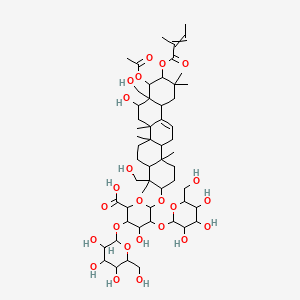 Compound
- Category
- Compound
What Aescin is, and what it does.
- Does it work
- Most useful if you stand or sit all day and notice puffy ankles and heavy legs by evening. If your legs feel fine after a long day, it has less to offer you.
- How much to take
- No dose figure is on record here, so we won't invent one. Oral products are standardised to their aescin content, so the amount per capsule on the label is the number to read.
- Time to feel it
- Studies of the seed extract run for weeks, and changes in leg heaviness and ankle measurement show up across that span rather than overnight.
- The first dose
- Day one is quiet. Some people notice mild stomach warmth if it's taken without food, while the vein wall effects are building before anything registers.
- With regular use
- Weeks of daily use keep capillary leak lower. That shows up as measured ankle and calf circumference, and as legs that feel lighter at the end of a long day.
- How well tolerated
- Generally well tolerated by mouth, with stomach upset the usual complaint, which is why enteric coating exists. Check with a clinician if you take anticoagulants or have reduced kidney function.
- How it feels
- Little in the way of sensation. The read-out is your legs at 6pm: less of that tight, full, heavy feeling after hours on your feet or at a desk.
- The overlooked benefit
- The same anti-swelling action is why aescin turns up in topical gels for knocks and bruising, not only in capsules aimed at tired legs.
The proof, claim by claim.
What these words mean
These words describe the research, not the molecule's worth. Research strength is how much work stands behind one claim, and it is never a product score.
- Leg heaviness and evening lower-leg swellingMeta-analysis
- Ankle and calf circumferenceRandomised trial
4 more claims
- Capillary fluid leakageAnimal study
- Venous smooth muscle toneAnimal study
- Swelling after minor knocks and bruisingRandomised trial
- Lysosomal enzyme activity in the capillary wallIn vitro study
Why these belong in the same formula, 8 pairings
Why these belong in the same formula. Each row says what the basis is, from settled biochemistry through to a trial that measured the pair.
Aescin reduces capillary filtration by acting on venous tone and endothelial permeability, while rutin acts on the same endothelial barrier from the flavonoid side. A rodent study gave the two together and reported additive effects on antioxidant and inflammatory markers. Those were markers measured in animals, not outcomes measured in people. The pairing is common in European vein formulas and rests mostly on mechanism.
Ascorbate is a required cofactor for the prolyl and lysyl hydroxylases that build stable collagen, which is the structural backbone of the capillary and venous wall. Aescin works on the same wall from a different angle, reducing permeability and lysosomal enzyme activity. The two are combined on structural grounds rather than on head to head trial data. Read it as mechanistic support, not as a demonstrated additive clinical effect.
Grape seed proanthocyanidins bind to collagen and elastin and slow their enzymatic breakdown. Aescin reduces the fluid leak across the capillary bed. Formulators pair them because they act at different points of the same vascular problem. Human data for the combination itself is thin, so the confidence sits on the mechanism.
Pine bark proanthocyanidins and aescin have each been studied separately for lower leg swelling and heaviness, and they act through partly different routes, endothelial nitric oxide handling versus capillary permeability. Combining them is plausible and common in commercial vein products. No large trial has compared the pairing against either alone. What exists is separate evidence for each, which is not the same thing.
Bromelain is a proteolytic enzyme complex used alongside aescin in topical and oral products aimed at bruising and post exertion swelling. The rationale is that one reduces capillary leak while the other acts on fibrin and inflammatory peptides. The pairing is long standing in European practice. Evidence for the combination as such is limited to small and older work.
Aescin has been reported to have mild antithrombotic and platelet effects, and high intakes of EPA and DHA lengthen bleeding time. Stacking the two adds in the same direction. Anyone on an anticoagulant or facing surgery should raise the combination with a prescriber first. This is a caution flag rather than a benefit pairing.
Nattokinase has fibrinolytic activity and aescin carries mild antithrombotic activity of its own. Used together the effects point the same way, which matters more for people already on blood thinning medication. There is no trial of the combination. The flag is mechanistic and precautionary.
Quercetin reduces histamine release from mast cells and influences endothelial junction proteins, both of which affect how much fluid leaks out of small vessels. Aescin lowers that leak by a different route. The overlap is mechanistic and drawn from cell and animal work. Human evidence for the pair does not exist.
Nothing specific on file for Aescin. Match the label to the daily amount above, and tell your doctor what you take.
Not medical advice. Show the label to your pharmacist.What Aescin actually does.
It is a soap like plant compound from the horse chestnut seed.
3 more mechanisms
It makes the smallest blood vessels leak less fluid into the surrounding tissue.
Raw saponins irritate tissue, so oral forms are usually coated.
It makes leg veins squeeze a little harder, which helps blood move back upward.
Where Aescin comes from.
It comes from the seed of the horse chestnut tree. The seed is milled, washed with alcohol and water to pull out the active soap like compounds, then measured so each capsule carries a known amount.
What this route gives you
Made from a plant. What ends up in the capsule tracks the harvest, so batch testing and a stated marker matter more here than with a made molecule.
5 steps on record
Ripe seeds of Aesculus hippocastanum, mostly harvested in Central and Eastern Europe
Dried and milled seed is extracted with ethanol and water to pull the saponin fraction away from starch and fibre
Resin or precipitation steps concentrate the triterpene glycosides and remove the seed's high starch load
The concentrate is assayed by HPLC and adjusted so the label percentage of triterpene glycosides calculated as aescin is met
Blended with carriers, then either encapsulated, coated for gastric protection, or dispersed into a topical base
The forms it comes in.
3 more forms
The essence, in one line each.
- Aescin and rutin given together lowered oxidative and inflammatory markers in a rodent model of thyroid hormone excess.Animal study. Makadi et al., 2026 (Scientific Reports). PMID 41917239 ↗
Chosen from the 1 we read for Aescin.
The studies, linked.
3 sources behind our Aescin verdict, every one linked to PubMed, the journal or ClinicalTrials.gov.
- Clinical trialThe Efficacy of Aescin in Combination With Micronized Purified Flavonoid Fraction (MPFF) in the Control of Bleeding and Prevent Recurrence of Acute Internal Hemorrhoids, A Randomized Controlled Trial, A Pilot StudyClinicalTrials.gov ↗Early phase 1, 120 participants, Enrolling by invitation
2 more linked trials
- Clinical trialEvaluation of Aescin-Based Herbal Extracts for Managing Postoperative Sequelae Following Impacted Mandibular Third Molar Surgery: A Randomized, Single-Blind, Controlled TrialClinicalTrials.gov ↗100 participants, Recruiting
- Clinical trialThe Efficacy of Aescin in Combination With Micronized Purified Flavonoid Fraction (MPFF) in the Early Control of Bleeding From Acute Internal Hemorrhoids, A Randomized Controlled TrialClinicalTrials.gov ↗60 participants, Unknown
From clinical trials and PubMed, ranked by study type and citation weight, not cherry-picked.
Problems people have reported.
Read this carefully. These are 117 voluntary, unverified reactions reported to the FDA (openFDA). The number mostly reflects how popular Aescin is, not how risky it is. A report is not proof Aescin caused anything. It is a signal of what to watch for, nothing more.
3 more reported effects
Source: openFDA adverse-event reports. Voluntary reporting, not an incidence rate.
FDA Disclaimer: These statements have not been evaluated by the Food and Drug Administration. This information is for educational purposes only and is not intended to diagnose, treat, cure, or prevent any disease. Consult your healthcare provider before starting any supplement regimen.