Daidzein.
Daidzein is a soy compound shaped enough like oestradiol to sit weakly on oestrogen receptors, mostly the beta type. It's studied for bone support and midlife temperature comfort.
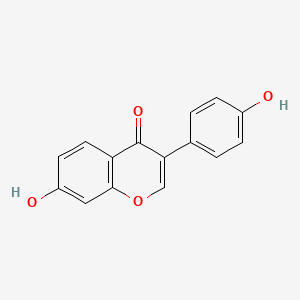 Compound
- Category
- Compound
What Daidzein is, and what it does.
- Does it work
- Suits women through the midlife hormonal shift and anyone eating little soy who wants that intake measured. How much you get from it depends on your gut bacteria.
- How much to take
- No daily amount is on record here. Form matters as much as any number, because the sugar-bound version needs your gut to cut that sugar off before absorption starts.
- Time to feel it
- Isoflavone trials generally run for several months before differences appear, so think in weeks to months rather than days.
- The first dose
- Nothing dramatic on day one. Blood isoflavones peak within hours, mostly in a conjugated form, which is a lab observation rather than a feeling.
- With regular use
- Weeks of steady intake keep circulating isoflavones topped up. Bone markers and temperature comfort are where the longer trials looked for change.
- How well tolerated
- Generally well tolerated, with mild digestive upset the most common report. Anyone whose care involves hormone-receptor-targeting medicines should speak to their prescriber first.
- How it feels
- Most people feel nothing directly. Where women do report change it tends to be in temperature comfort across the day, and it builds slowly.
- The overlooked benefit
- Only some people carry the gut bacteria that turn daidzein into equol, the more active metabolite. That producer status is stable, and it explains why results split.
The proof, claim by claim.
What these words mean
These words describe the research, not the molecule's worth. Research strength is how much work stands behind one claim, and it is never a product score.
- Midlife temperature comfort in womenMeta-analysis
- Bone mineral density support in women after their cycles endMeta-analysis
3 more claims
- Weak partial agonism at oestrogen receptor betaIn vitro study
- Equol production determined by an individual's gut bacteriaCohort study
- Blood lipids already in the normal rangeMeta-analysis
Why these belong in the same formula, 9 pairings
Why these belong in the same formula. Each row says what the basis is, from settled biochemistry through to a trial that measured the pair.
The conversion of daidzein to equol depends on specific anaerobes, and equol-producer status is a property of a person's gut community rather than of the dose taken. Introducing an equol-competent strain is the mechanistic route to changing that status. Whether an ordinary commercial probiotic actually converts a non-producer into a producer is not settled.
Fermentable fibre shifts the colonic environment toward the anaerobes that carry out isoflavone reduction, and lowers luminal pH in the process. This is a plausible route to more consistent equol output rather than a demonstrated one. Read it as mechanistic support, not as a way to guarantee conversion.
Both compounds are cleared largely by UGT and SULT conjugation in the gut wall and liver, so taken together they compete for the same limited conjugating capacity. In practice that can raise free aglycone levels of whichever one is present in the smaller amount. The interaction is documented in vitro and in animals, and the size of it in people who take both has not been established.
Isoflavones act on oestrogen receptor beta, which is expressed in osteoblasts and involved in the balance of bone formation and resorption. Calcium supplies the mineral substrate for that process, so the two act on different halves of the same system. Bone density outcomes for isoflavones remain mixed, and no dose of daidzein substitutes for adequate calcium and vitamin D.
Vitamin D governs intestinal calcium uptake and the renal handling that follows, which is upstream of anything an isoflavone does at the receptor. Pairing them addresses supply and signalling separately rather than doubling one effect. Bone density is a marker, not an outcome, and the isoflavone contribution to it is not consistent across trials.
Both compounds interact with oestrogen receptors as weak partial agonists and both are heavily conjugated before reaching circulation. Combining them raises total receptor-level activity without either one reaching endogenous hormone potency. The combination has been examined mostly in cell work, so read it as mechanistic.
Isoflavones and the phytate that travels with soy protein both bind non-heme iron in the gut lumen and reduce its uptake. Isolated daidzein carries far less of this effect than a whole soy protein isolate does, because most of the binding is phytate driven. Separating an iron supplement from a soy-based product by a couple of hours is the practical response.
Soy-derived isoflavone material often carries residual phytate, which binds zinc as an insoluble complex that the small intestine does not take up. Purified daidzein aglycone largely avoids this. Crude soy germ extracts do not. Check what the ingredient actually is before assuming the interaction applies.
Daidzein aglycone is poorly water soluble, and dissolution is the rate-limiting step for its absorption. Phospholipid dispersion and cyclodextrin complexation are both used in formulation to get around that. These raise measured plasma exposure. They do not by themselves demonstrate a larger effect.
Nothing specific on file for Daidzein. Match the label to the daily amount above, and tell your doctor what you take.
Not medical advice. Show the label to your pharmacist.What Daidzein actually does.
Daidzein is a soy plant compound shaped a bit like the hormone oestradiol. It attaches weakly to one type of oestrogen receptor more than the other, but its effect there is far, far weaker than the body's own hormone.
3 more mechanisms
In soy foods, daidzein is mostly bound to a sugar as daidzin. Your gut needs to break that sugar off, either with an enzyme in your intestinal lining or with help from gut bacteria, before it can be absorbed.
Once absorbed, most daidzein gets tagged by the liver before it circulates, so measuring total isoflavone in blood overstates how much is actually free to act on a receptor.
Gut bacteria break daidzein down along one of two paths, and which path dominates depends on a person's own gut microbes, a trait that tends to stay consistent over time and gets called producer status.
Where Daidzein comes from.
It comes from soy, usually from the germ of the bean or from a by-product of making soy protein. It exists in the plant with a sugar attached, and processing decides whether that sugar comes off before you swallow it or after.
What this route gives you
The same molecule is reached more than one way. Which route a given product used is a manufacturing choice, and the finished compound is the same either way.
6 steps on record
Soy germ carries the highest isoflavone concentration of the bean. Soy molasses is a by-product of protein isolate manufacture. Kudzu root supplies the C-glycoside puerarin instead.
Pulls out the glycoside forms along with sugars and phenolics. Solvent ratio sets how much of the malonyl ester fraction survives intact.
Optional. Beta-glucosidase or dilute acid removes the sugar to give daidzein itself. Fermentation-based routes do the same step microbially.
Macroporous resin separates isoflavones from sugars and protein residues. Repeated crystallisation is what takes a crude extract to a single-compound grade.
Grades run from around 40 percent total isoflavones to above 98 percent daidzein. The distinction matters because a total-isoflavone figure says nothing about the daidzein share.
Also produced synthetically for reference-standard use, which is chemically identical but rarely the supplement source.
Getting Daidzein from food.
The whole-food sources on file. A supplement closes the gap, it does not replace dinner.
A gram-for-gram figure (how much of each you would eat to match a dose) will appear here once it is sourced and reviewed. This page will not print a number it cannot cite.
The forms it comes in.
2 more forms
The essence, in one line each.
- In a 6-month trial in adults with high cholesterol, daily daidzein supplements (40 mg or 80 mg) lowered blood levels of triglycerides and uric acid more than a placebo did.Randomised trial, in hypercholesterolemic adults. Qin et al., 2014 (The Journal of Nutrition). PMID 24225450 ↗
9 more findings
- Dietary daidzein improved reproductive output in sows, which the authors attribute to changes in ovarian oxidative stress and inflammatory signalling.Animal study. Xie et al., 2022 (The Journal of Nutritional Biochemistry). PMID 36049671 ↗
- Daidzein supplementation was associated with higher embryo survival alongside shifts in hormone levels, antioxidant capacity and metabolic profile.Animal study. Xie et al., 2020 (Food and Function). PMID 33196069 ↗
- Dietary daidzein reduced markers of inflammatory injury in heart tissue, with the effect linked to oestrogen receptor beta signalling.Animal study. Gai et al., 2026 (The Journal of Nutritional Biochemistry). PMID 41786056 ↗
- Daidzein given during pregnancy was associated with greater fetal growth in rats.Animal study. Zhang et al., 2018 (Molecular Nutrition and Food Research). PMID 30365232 ↗
- Dietary daidzein altered reproductive performance, serum hormone concentrations and expression of reproduction-related genes.Animal study. Zhang et al., 2018 (Nutrients). PMID 29899203 ↗
- Quercetin and daidzein were compared directly for effects on production performance, antioxidant status, hormones and caecal microbiota, with differing profiles between the two.Animal study. Liu et al., 2023 (Poultry Science). PMID 37104906 ↗
- A Bacillus velezensis intervention shifted the microbiota toward greater isoflavone production, which the authors link to the observed reduction in lung inflammatory markers. Daidzein appears as part of the isoflavone pathway rather than as the intervention.Animal study. Zhang et al., 2026 (Journal of Animal Science and Biotechnology). PMID 42093011 ↗
- A review of soy isoflavone biological activity, covering the receptor and signalling pathways attributed to the class. Daidzein is discussed within the class rather than assessed on its own.Narrative review. Kwiecinski et al., 2026 (Molecular Biology Reports). PMID 42133114 ↗
- Maternal bile acid elevation altered gut microbiota and metabolome in adult female offspring, with isoflavone metabolites among the profiled compounds.Animal study. Ovadia et al., 2026 (Experimental Biology and Medicine). PMID 41694266 ↗
Chosen from the 10 we read for Daidzein.
The studies, linked.
7 sources behind our Daidzein verdict, every one linked to PubMed, the journal or ClinicalTrials.gov.
- Clinical trialDaidzein-rich Isoflavone-aglycones for Menopausal SymptomsClinicalTrials.gov ↗Phase 2, 210 participants, Completed
6 more linked trials
- Clinical trialThe Effect of Increased Soy Protein Intake on Bone MetabolismClinicalTrials.gov ↗203 participants, Completed
- Clinical trialThe Study of the Effects of Soy Isoflavones on the Metabolism of Glucose and Lipids in Postmenopausal Chinese Women With Impaired Glucose RegulationClinicalTrials.gov ↗165 participants, Completed
- Clinical trialEffect of Two Different Isoflavone Supplement Preparations on Gene-expression in Postmenopausal WomenClinicalTrials.gov ↗72 participants, Completed
- Clinical trialA Phase II Trial of a Combination Herbal Therapy for Men With Biochemical Recurrence of Prostate Cancer After Initial Local TherapyClinicalTrials.gov ↗Phase 2, 43 participants, Completed
- Clinical trialA Double-blind Randomized Controlled Trial on Whole Soy and Daidzein Supplementation on Reduction of Blood Pressure in Prehypertensive Postmenopausal Chinese WomenClinicalTrials.gov ↗270 participants, Unknown
- ClinicalTrials.gov ↗
From clinical trials and PubMed, ranked by study type and citation weight, not cherry-picked.
FDA Disclaimer: These statements have not been evaluated by the Food and Drug Administration. This information is for educational purposes only and is not intended to diagnose, treat, cure, or prevent any disease. Consult your healthcare provider before starting any supplement regimen.