Eriocitrin.
The main flavonoid of lemon peel. It's a polyphenol your gut bacteria have to unwrap before you absorb anything, so how much you get depends partly on your own microbiome.
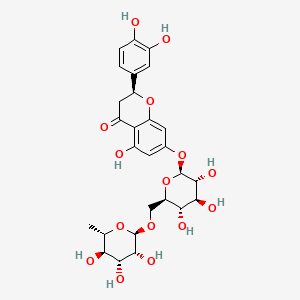 Compound
- Category
- Compound
What Eriocitrin is, and what it does.
- Does it work
- It suits people building a citrus polyphenol habit alongside vitamin C, and anyone drawn to lemon peel chemistry. Human research is early, at 1,067 records in Europe PMC.
- How much to take
- No dose figure is on record. Start with the eriocitrin-assayed amount the extract's own documentation gives, taken daily, since exposure builds through repeated dosing.
- Time to feel it
- There is no acute effect to time. Antioxidant markers in blood are what the trials read, and those move over weeks of daily intake.
- The first dose
- Day one is quiet by design. Colonic bacteria have to cut the rutinose sugar off before anything crosses into you, so absorption is slow and spread out.
- With regular use
- Weeks of daily use raise the circulating phenolic metabolites that come from it. Whether that turns into something a person notices has not been well measured.
- How well tolerated
- Well tolerated as a food-derived flavonoid at the sort of amounts a lemon habit provides. Long-term work at concentrated intakes has not been published, so keep to label amounts.
- How it feels
- No sensation to report. This one lives at the marker level: what it does shows up in blood chemistry rather than in how your day goes.
- The overlooked benefit
- It is a peel compound, not a juice one. Juice a lemon, bin the skin, and most of the eriocitrin goes in the bin with it.
The proof, claim by claim.
What these words mean
These words describe the research, not the molecule's worth. Research strength is how much work stands behind one claim, and it is never a product score.
- antioxidant status markers in bloodRandomised trial
- oxidative stress markers around exerciseRandomised trial
3 more claims
- free radical quenching and metal chelationIn vitro study
- healthy glucose metabolismAnimal study
- microbial conversion to absorbable eriodictyolNarrative review
Why these belong in the same formula, 6 pairings
Why these belong in the same formula. Each row says what the basis is, from settled biochemistry through to a trial that measured the pair.
Eriocitrin is eriodictyol carrying a rutinose sugar, and human intestinal enzymes cannot cleave the rhamnose bond. Colonic bacteria do the cleaving, which is why the aglycone and its phenolic metabolites appear in plasma late rather than soon after a dose. People differ substantially in how much they convert, and that difference tracks with which bacteria they carry rather than with the dose taken.
Hesperidin and eriocitrin are structurally near-identical apart from one hydroxyl position, and both depend on the same gut bacterial rhamnosidase step before absorption. Combining them raises total flavanone load through one shared bottleneck rather than adding an independent route. Citrus extracts commonly contain both, so the combination is usually already in the raw material.
Ascorbate regenerates phenoxyl radicals formed when a flavonoid quenches an oxidant, returning the flavonoid to its reduced form. Lemon delivers both compounds together, so the pairing reflects the natural matrix rather than a formulation invention. The chemistry is well described in vitro. What it amounts to in a person eating a normal diet is a separate question.
Flavonoid aglycones are glucuronidated and sulfated in the intestinal wall and liver, and the enzymes doing it are a shared and saturable resource. A large simultaneous dose of a second flavonoid can shift how much of each circulates as free rather than conjugated. The direction of that shift depends on the doses involved and is a pharmacokinetic point, not an efficacy claim.
Flavanone aglycones are poorly water-soluble, and phospholipid complexes are the conventional way to improve wetting and dispersion. The approach has been characterised for several citrus flavonoids. It is formulation engineering rather than a biological interaction.
Eriocitrin has been studied for effects on glucose handling and incretin signalling, and berberine is taken for overlapping reasons. Combining them means the glycaemic effects may add up rather than sit side by side. Anyone already on glucose-lowering medication should raise the combination with their prescriber before stacking.
Nothing specific on file for Eriocitrin. Match the label to the daily amount above, and tell your doctor what you take.
Not medical advice. Show the label to your pharmacist.What Eriocitrin actually does.
Eriocitrin is a flavonoid compound with a sugar attached, concentrated in lemon and lime peel and juice.
3 more mechanisms
Human gut enzymes can't break the specific sugar bond in this compound. It's gut bacteria that carry the enzymes needed to release the active part, which is why absorption is delayed and varies a lot from person to person.
Once released, the active compound gets heavily tagged by enzymes in the gut wall and liver, so what circulates in your blood is mostly the tagged form rather than the free compound.
Gut bacteria further break this compound down into smaller phenolic acids, and these bacterial breakdown products make up a large share of what your body is actually exposed to after you eat it.
Where Eriocitrin comes from.
Most eriocitrin comes from lemon peel left over after juicing. The peel is extracted, run over a resin that grabs the flavonoids and lets the sugars through, then dried into a standardised powder. Scientists have also now built yeast that makes the molecule from scratch, which could eventually take citrus harvests out of the supply chain.
What this route gives you
The same molecule is reached more than one way. Which route a given product used is a manufacturing choice, and the finished compound is the same either way.
6 steps on record
Citrus limon by-products from juicing are the dominant commercial source. Peel carries markedly more flavanone than juice.
Warm water or ethanol-water pulls the glycoside fraction along with hesperidin, narirutin, pectin and sugars.
Macroporous resin binds the phenolics and lets sugars and acids wash through. Ethanol elution recovers a concentrated flavonoid fraction.
Commercial lemon flavonoid preparations are specified on eriocitrin percentage, with the companion flavanones reported alongside.
Rhamnosidase and glucosidase treatment converts the rutinoside to the eriodictyol aglycone when the aglycone is the target.
Usually on a maltodextrin or citrus fibre carrier, which affects both the assay basis and the scoop weight.
Getting Eriocitrin from food.
The whole-food sources on file. A supplement closes the gap, it does not replace dinner.
A gram-for-gram figure (how much of each you would eat to match a dose) will appear here once it is sourced and reviewed. This page will not print a number it cannot cite.
The forms it comes in.
3 more forms
The essence, in one line each.
- In a 12-week randomised crossover trial in 30 adults with a diagnosed blood-sugar condition, 200 mg of a lemon flavonoid preparation daily lowered blood glucose by 5% and raised glucagon-like peptide 1 by 17%.Randomised crossover trial, in prediabetic and diabetic patients. Cesar TB et al., 2022 (Journal of Medicinal Food). PMID 35796695 ↗
6 more findings
- The authors report that the standardised lemon flavonoid preparation suppressed pituitary-adrenal axis activity in aged animals.Animal study. Trifunovic S et al., 2025 (International Journal of Molecular Sciences). PMID 40565281 ↗
- The authors report that eriocitrin reduced markers of cadmium-induced liver injury and shifted Nrf2/Keap1 signalling in the exposed animals.Animal study. Hayat MF et al., 2024 (Journal of Trace Elements in Medicine and Biology). PMID 38613902 ↗
- The authors report that eriocitrin limited sodium iodate-induced copper-dependent cell death and barrier disruption in retinal pigment epithelium.In vitro study. Wang X et al., 2025 (Journal of Translational Medicine). PMID 41361469 ↗
- The review lists eriocitrin among natural flavonoids with proposed mechanisms relevant to age-related muscle loss.Narrative review. Yoon YE et al., 2025 (International Journal of Molecular Sciences). PMID 40806581 ↗
- The authors report constructing a yeast strain that produces eriocitrin de novo, using computational enzyme selection to complete the pathway.In vitro study. Lu Q et al., 2026 (Synthetic and Systems Biotechnology). PMID 41696525 ↗
- The authors characterise a standardised natural extract and its effect on gut microbiota composition in the animals studied.Animal study. Cisse S et al., 2023 (Journal of Animal Science). PMID 36881787 ↗
Chosen from the 7 we read for Eriocitrin.
The studies, linked.
3 sources behind our Eriocitrin verdict, every one linked to PubMed, the journal or ClinicalTrials.gov.
- Clinical trialEvaluation of Metabolic Parameters in Subjects With Intermediate Hyperglycemia Supplemented With Eriocitrin: A Parallel, Double-blind, Randomized, Placebo-controlled Clinical TrialClinicalTrials.gov ↗120 participants, Completed
2 more linked trials
- Clinical trialTherapeutic Intervention of Eriocitrin in Reducing Hyperglycemia in Pre-diabetic Subjects: Double-blind, Randomized, Placebo-controlled Crossover Clinical TrialClinicalTrials.gov ↗40 participants, Completed
- Clinical trialEffect of Chronic Eriocitrin Supplementation on the Intestinal Microbiota of Pre-diabetic and Insulin Resistant IndividualsClinicalTrials.gov ↗40 participants, Terminated
From clinical trials and PubMed, ranked by study type and citation weight, not cherry-picked.
FDA Disclaimer: These statements have not been evaluated by the Food and Drug Administration. This information is for educational purposes only and is not intended to diagnose, treat, cure, or prevent any disease. Consult your healthcare provider before starting any supplement regimen.