Ginsenosides.
The saponins that make ginseng ginseng. Standardising to them is how a maker states how much active material a root carries, and they are what the research measures against.
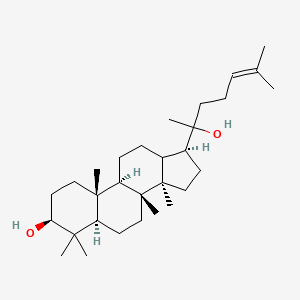 Compound
- Category
- Compound
What Ginsenosides is, and what it does.
- Does it work
- Useful for anyone comparing ginseng products, because a ginsenoside percentage tells you more than a plain root weight. Different profiles suit different intentions.
- How much to take
- No daily amount is on record for isolated ginsenosides. Products state them as a percentage of an extract, so the extract amount is the figure to follow.
- Time to feel it
- Studies on ginsenoside standardised extracts report change across two to four weeks. Single doses have been measured but are not what people describe.
- The first dose
- Day one usually passes without much sensation. Gut bacteria have to strip the sugars first, which takes hours before anything reaches circulation.
- With regular use
- Weeks of daily intake are studied for mental fatigue and subjective energy. Steaming to red ginseng shifts the mix toward Rg3 and Rg5, so form changes what goes in.
- How well tolerated
- Generally well tolerated at the amounts extracts deliver. Lighter sleep and headache are the usual reports, and check with a clinician if you take medication.
- How it feels
- A gradual steadiness rather than a hit. Some people notice warmth, and a few find an evening dose keeps them up.
- The overlooked benefit
- Species matters more than labels suggest. Panax ginseng, American ginseng and notoginseng carry different ginsenoside mixes, so a substitution changes the compound profile.
The proof, claim by claim.
What these words mean
These words describe the research, not the molecule's worth. Research strength is how much work stands behind one claim, and it is never a product score.
- gut bacterial conversion to compound K and related metabolitesNarrative review
- mental fatigue and subjective energy with ginsenoside standardised extractsRandomised trial
3 more claims
- ginsenoside profile change with steam processingNarrative review
- membrane and receptor interactions in cell systemsIn vitro study
- species differences in ginsenoside compositionNarrative review
Why these belong in the same formula, 9 pairings
Why these belong in the same formula. Each row says what the basis is, from settled biochemistry through to a trial that measured the pair.
Every ginsenoside product traces back to Panax root material, and the ginsenoside profile is what a ginseng extract is standardised on. Species and processing set the profile: Asian ginseng runs a different Rg1 to Rb1 ratio than American ginseng, which is Rb1 dominant. Reading a ginseng label without reading its ginsenoside percentage and profile tells you very little.
Major ginsenosides such as Rb1 are large glycosides that are absorbed poorly intact. Intestinal bacteria strip sugar groups to give smaller metabolites, compound K among them, and those metabolites are what reach circulation in quantity. People differ substantially in how well their microbiota do this, which is one explanation offered for inconsistent responses. Co-administered bacteria are a plausible route to the same conversion but the human data on deliberately pairing them is thin.
Fermented ginseng products are made by letting beta-glucosidase-producing lactic acid bacteria convert the parent glycosides before the extract is dried. That moves the conversion out of the consumer's gut and into the factory, giving a more consistent metabolite profile. The mechanism is well characterised in fermentation science. Whether the fermented material outperforms the parent in people is a separate question with limited human data.
Ginseng preparations shift postprandial glucose in some trial settings, and berberine acts on the same endpoint through separate routes. Combining them stacks two glucose-lowering inputs. Anyone already on glucose-lowering medication should have that combination checked, since the additive direction is the point rather than a side note.
Ginseng shows up in energy formulas next to caffeine because both target subjective fatigue, though by unrelated routes. The evidence for the pairing is formulation convention rather than trial data. Judge the stimulant load from the caffeine content alone, since that is the part with a predictable dose response.
Ginsenosides and ginkgolides have each been described as reducing platelet aggregation in laboratory work. Stacking them, or stacking either with fish oil or garlic, points the same direction. Anyone on anticoagulant or antiplatelet therapy, or facing surgery, should raise the combination with their clinician rather than assume the effects are too small to matter.
High-dose marine omega-3 has a described effect on platelet aggregation, and saponin fractions from ginseng have been reported to act in the same direction in laboratory preparations. The combination is common in general wellness stacks and is worth flagging around any bleeding risk. This is a mechanistic caution, not a documented clinical event rate.
Deglycosylated ginsenoside metabolites are considerably more lipophilic than their parents, and lipid-based carriers are used to raise the absorbed fraction of poorly soluble saponins generally. Self-emulsifying and liposomal ginsenoside formats build on that logic. The supporting work is formulation science rather than clinical comparison.
Both plants sit in the adaptogen grouping and appear together in stress and fatigue formulas. Mechanistic reviews of plant adaptogens describe overlapping stress-axis and cellular stress-response targets. The pairing itself has not been separated from its parts in controlled work, so it is formulation convention.
Nothing specific on file for Ginsenosides. Match the label to the daily amount above, and tell your doctor what you take.
Not medical advice. Show the label to your pharmacist.What Ginsenosides actually does.
Ginsenosides are a family of plant saponins built on a shared core structure, split into a couple of main groups based on where their sugar chains attach, plus a smaller third group.
3 more mechanisms
The original ginsenosides aren't absorbed well as is, your gut bacteria have to strip off sugar groups first to make smaller compounds like compound K, and those are what actually end up circulating in your body.
Steaming raw ginseng root to make red ginseng chemically transforms its sugar chains, creating different ginsenosides, like Rg3 and Rg5, that are barely present in the raw root.
The ginsenoside mix differs by ginseng species, so swapping one Panax species for another changes what compounds you're actually getting.
Where Ginsenosides comes from.
Ginsenosides are the active saponins in ginseng root. Your gut bacteria have to chop the sugars off before much gets into you, which is a big part of why two people can take the same ginseng and report different things.
What this route gives you
Made from a plant. What ends up in the capsule tracks the harvest, so batch testing and a stated marker matter more here than with a made molecule.
6 steps on record
Ginsenoside content rises with root age, which is why cultivation runs several years before harvest. Species and growing region set the starting profile.
Air drying gives white ginseng and preserves the native glycosides. Steaming at around 100 degrees gives red ginseng and generates the less polar species.
Saponins move into water and into aqueous ethanol. Ethanol fraction shifts which ginsenosides are pulled preferentially.
Macroporous resin removes sugars and polysaccharides to raise the saponin percentage. Isolates go through further chromatography.
Declared as a percentage of total ginsenosides, sometimes with named markers. Two extracts at the same total percentage can have quite different profiles.
Sold as standardised extract, fermented extract, or purified single compound.
The forms it comes in.
2 more forms
The essence, in one line each.
- In a meta-analysis of 30 studies in animal models of a diagnosed liver condition, ginsenosides improved several markers related to liver fat and inflammation compared to control.Animal study. Hao L et al., 2025 (Frontiers in Pharmacology). PMID 40495888 ↗
10 more findings
- In a meta-analysis of 29 trials, ginseng supplementation did not have a statistically significant influence on blood lipid measures, including triglycerides, total cholesterol, LDL-C, and HDL-C.Meta-analysis. Arabi SM et al., 2024 (Current Pharmaceutical Design). PMID 38877862 ↗
- Effects on postprandial glucose tolerance depended on how long before the meal the ginseng preload was taken.Randomised trial. Nilsson A et al., 2026 (Frontiers in Nutrition). PMID 41798830 ↗
- In a 3-week randomised trial in 149 adults with moderate stress, taking 200 mg of hydroponically grown red ginseng (with 24 mg of ginsenosides) daily was linked to larger decreases in perceived stress and negative affect scores compared to a placebo.Randomised trial. Dormal V et al., 2025 (Nutrients). PMID 40289951 ↗
- In a randomised trial in physically active men, American ginseng supplementation was associated with lower markers of lipid peroxidation and inflammation after eccentric exercise.Randomised trial. Lin CH et al., 2021 (Nutrients). PMID 35010953 ↗
- Review of ginseng in exercise training and recovery covering composition, proposed mechanisms and dosage ranges used in the literature.Narrative review. Zhang Q et al., 2026 (Nutrition Research). PMID 41921254 ↗
- Ginseng bioactives are described as acting on gut-brain axis signalling, with microbial conversion of ginsenosides presented as a central step.Narrative review. Liu S et al., 2026 (Nutrients). PMID 42280421 ↗
- Review of system-level, molecular and cellular mechanisms proposed for selected plant adaptogens, ginseng included.Narrative review. Such S et al., 2026 (Nutrients). PMID 41901106 ↗
- Panax ginseng extract was associated with bone density measures in animal models of reduced bone density.Animal study. Tang R et al., 2026 (Frontiers in Nutrition). PMID 42317874 ↗
- Fermented red ginseng shifted insulin handling and gut microbiome composition in aged mice.Animal study. Lee DY et al., 2026 (Biology). PMID 41677682 ↗
- Ginsenoside exposure combined with aerobic conditioning altered molecular resilience markers differently from either input alone.Animal study. Noubari ZO et al., 2026 (Biomedicine and Pharmacotherapy). PMID 42435534 ↗
Chosen from the 11 we read for Ginsenosides.
The studies, linked.
1 source behind our Ginsenosides verdict, every one linked to PubMed, the journal or ClinicalTrials.gov.
- Clinical trialDissolution and Pharmacokinetic of Ginsenosides Released From Cyclodextrin Based Chewable Tablets: a Comparative, Randomized, Crossover, Open-label Study in Healthy Human Subjects.ClinicalTrials.gov ↗Phase 1, 3 participants, Suspended
From clinical trials and PubMed, ranked by study type and citation weight, not cherry-picked.
FDA Disclaimer: These statements have not been evaluated by the Food and Drug Administration. This information is for educational purposes only and is not intended to diagnose, treat, cure, or prevent any disease. Consult your healthcare provider before starting any supplement regimen.