Tectochrysin.
A minor flavonoid from bee propolis and galangal. In cells and rodents it behaves like other flavones, with antioxidant and signalling activity. No human data exists.
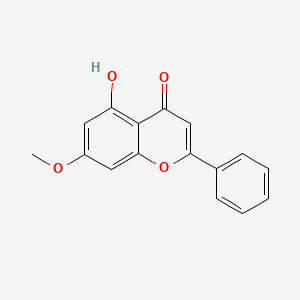 Compound
- Category
- Compound
What Tectochrysin is, and what it does.
- Does it work
- Suits people who follow early flavonoid research and already use propolis or galangal. The human work simply has not been published yet.
- How much to take
- No dose figure is on record and no human study has set one. What reaches labels comes through propolis or galangal extracts rather than as the isolated flavone.
- Time to feel it
- Nobody has measured this in people. Related flavones peak in blood within a couple of hours, and mostly as conjugates rather than the free compound.
- The first dose
- No human day-one data exists. Inside a propolis extract, the resinous taste is the part people actually register.
- With regular use
- No human study has run for weeks. What is known about longer exposure comes from rodent and cell work, not from people.
- How well tolerated
- No human tolerability study exists for the isolated compound. Propolis is a recognised allergen for people sensitive to bee products, and that is the practical caution.
- How it feels
- No published subjective account exists. Taken inside propolis, the taste is resinous and the compound itself brings nothing you would notice.
- The overlooked benefit
- It is chrysin with a methyl group at the 7 position. That blocks one conjugation site, so it tends to survive first-pass metabolism better than chrysin does.
The proof, claim by claim.
What these words mean
These words describe the research, not the molecule's worth. Research strength is how much work stands behind one claim, and it is never a product score.
- antioxidant and signalling activity in cell modelsIn vitro study
- effects observed in rodent modelsAnimal study
2 more claims
- occurrence in bee propolis and Alpinia speciesNarrative review
- greater metabolic stability than unmethylated chrysinIn vitro study
Why these belong in the same formula, 8 pairings
Why these belong in the same formula. Each row says what the basis is, from settled biochemistry through to a trial that measured the pair.
Bee propolis carries tectochrysin alongside chrysin, pinocembrin, galangin and caffeic acid esters. Anyone taking propolis is already taking a small quantity of it. Isolated tectochrysin as a standalone supplement ingredient is uncommon, and most human exposure comes through the matrix rather than the isolate.
Flavonoids taken together compete for a limited pool of intestinal and hepatic conjugating capacity. That competition raises the unconjugated fraction of whichever one is present. The same crowding applies to medicines cleared by those enzymes, which is the practical caution.
Flavones with free hydroxyl groups are heavily glucuronidated at the intestinal wall before reaching circulation. Piperine slows that step, which raises measured plasma exposure of similar flavonoids. Whether it does so for tectochrysin specifically has not been measured. The inhibition is not selective, so it affects other co-ingested compounds too.
The 7-methoxy group on tectochrysin raises lipophilicity and lowers water solubility compared with its parent flavone. Dissolution then becomes the rate-limiting step for absorption. Phospholipid or lipid-based delivery is the conventional way around that for this class.
Taking a lipophilic flavone with fat gives it a vehicle into mixed micelles rather than leaving it undissolved in the lumen. This is a general property of the compound class rather than a tested pairing for this molecule. Dosing with a fat-containing meal is the simple version of the same idea.
An animal study of tectachrysin against a chemical toxin reported restoration of tissue antioxidant enzyme activity and glutathione content alongside histological changes. That is a marker-level result in rats, not an outcome in people. It supports a mechanistic pairing with cysteine and glutathione supply and nothing more.
If a flavone upregulates glutathione-dependent enzymes, the cell still needs cysteine to build the glutathione. N-acetylcysteine supplies that precursor directly. The logic is established biochemistry. There is no human work testing the two together.
Flavones sit near membranes while ascorbate works in the water phase, and each can regenerate oxidised species at the interface. This network behaviour is documented for the flavonoid class in model systems. Extending it to tectochrysin specifically is inference rather than measurement.
Nothing specific on file for Tectochrysin. Match the label to the daily amount above, and tell your doctor what you take.
Not medical advice. Show the label to your pharmacist.What Tectochrysin actually does.
It is chrysin with a methyl group attached at one position. That small change alters how it dissolves and how the body clears it.
3 more mechanisms
You'd normally encounter this through bee propolis or certain Alpinia plants, not as a standalone ingredient.
Flavones like this get heavily processed by the gut wall and liver before reaching the bloodstream, so levels of the unaltered compound in circulation after a dose stay low.
Swapping in that methyl group makes the molecule more fat-soluble and typically more stable in the body than the unmethylated parent flavone.
Where Tectochrysin comes from.
A minor flavonoid from propolis and galangal. Almost everything known about it comes from rats and cell dishes. Nobody has published what it does in a person.
What this route gives you
The same molecule is reached more than one way. Which route a given product used is a manufacturing choice, and the finished compound is the same either way.
5 steps on record
Collected propolis from hives, or dried rhizome of Alpinia species, are the two ordinary natural sources
Raw propolis or milled rhizome is extracted with ethanol, which pulls the flavone fraction along with waxes and phenolic acids
Propolis extract is chilled and filtered to drop waxes, then chromatographed if a single flavone is wanted
The isolate is also prepared synthetically, including by selective 7-O-methylation of chrysin, which is how most research-grade material is made
Supplied as a dry isolate for research, or far more commonly as part of a standardised propolis or rhizome extract
Getting Tectochrysin from food.
The whole-food sources on file. A supplement closes the gap, it does not replace dinner.
A gram-for-gram figure (how much of each you would eat to match a dose) will appear here once it is sourced and reviewed. This page will not print a number it cannot cite.
The forms it comes in.
3 more forms
The essence, in one line each.
- Tectochrysin administration was associated with improved biochemical and histological measures in rats exposed to a herbicide toxin.Animal study. Ijaz et al., 2024 (Heliyon). PMID 38356568 ↗
1 more finding
- Network pharmacology and metabolomics of a multi-herb mixture in calves named tectochrysin among the predicted active constituents.Animal study. Ji et al., 2026 (Journal of Animal Science and Biotechnology). PMID 42218547 ↗
Chosen from the 2 we read for Tectochrysin.
FDA Disclaimer: These statements have not been evaluated by the Food and Drug Administration. This information is for educational purposes only and is not intended to diagnose, treat, cure, or prevent any disease. Consult your healthcare provider before starting any supplement regimen.