Threonic acid.
Threonic acid is a small sugar acid your body makes as vitamin C breaks down. In supplements it's the carrier attached to magnesium or calcium so the mineral dissolves readily.
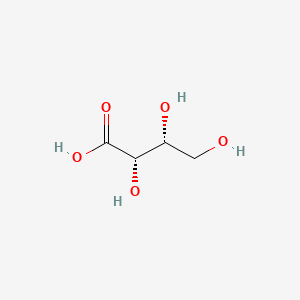 Compound
- Category
- Compound
What Threonic acid is, and what it does.
- Does it work
- It matters most if you take magnesium or calcium threonate. The threonate is the carrier, and the elemental mineral per serving is the number you're actually counting.
- How much to take
- No daily amount for threonic acid itself is on record. With a threonate salt the figure that counts is the elemental magnesium or calcium per serving, not the salt weight.
- Time to feel it
- The threonate part isn't something you feel. Any change belongs to the mineral it carries, and mineral status shifts over weeks and reads on a blood panel.
- The first dose
- Day one is the mineral's day one. Threonate salts dissolve readily in water, so they go down easily, and the threonate itself doesn't register.
- With regular use
- Weeks of daily use build the mineral's status, which shows on a panel. The threonate is broken down and cleared along ordinary vitamin C turnover routes.
- How well tolerated
- Well tolerated at supplemental amounts. Watch the elemental mineral rather than the threonate: too much magnesium loosens stools, and calcium totals are worth a word with your doctor.
- How it feels
- Nothing is attributable to the threonate itself. What you notice comes from the mineral, and with magnesium that's often a settled, easy feeling in the evening.
- The overlooked benefit
- Threonic acid already circulates in you as a routine marker of vitamin C turnover, which is why it appears on metabolomic panels whether or not you supplement.
The proof, claim by claim.
What these words mean
These words describe the research, not the molecule's worth. Research strength is how much work stands behind one claim, and it is never a product score.
- Carrier for highly water-soluble magnesium and calcium saltsNarrative review
- Plasma and urine marker of vitamin C turnoverCohort study
1 more claim
- Memory and recall studied with magnesium L-threonateRandomised trial
Why these belong in the same formula, 8 pairings
Why these belong in the same formula. Each row says what the basis is, from settled biochemistry through to a trial that measured the pair.
The threonate is doing the job of the anion, the same structural role sulfate or citrate plays in other magnesium salts. Because threonate is a light molecule, a gram of the salt carries a relatively small amount of elemental magnesium, so label doses of the salt and of the mineral are easy to confuse. Anyone comparing this to other magnesium forms should compare elemental milligrams, not salt milligrams.
This is settled ascorbate chemistry, and it means measurable threonate in a person is partly a signature of vitamin C turnover rather than of anything supplemental. It also means commercial threonate is usually made from ascorbic acid rather than isolated from a natural source. The relationship runs one way: ascorbate makes threonate, and threonate does not make ascorbate.
Threonate salts on the market are made from ascorbate feedstock through controlled oxidation, then neutralised with the desired cation. That is why the L stereochemistry is specified. It is a manufacturing relationship, not a nutritional one, and it should not be read as vitamin C and threonate working together in the body.
Threonate serves the same counter-ion role for calcium as it does for magnesium, and calcium threonate has its own use history as a soluble calcium source. Solubility is the practical property being bought. Claims about the threonate portion adding something of its own beyond solubility need their own evidence.
Calcitriol drives the transcellular calcium transport machinery in the small intestine, so calcium arriving without adequate vitamin D status is handled less efficiently. This applies to a threonate salt exactly as it does to carbonate or citrate. The counter-ion is not the variable here.
B6 and magnesium are combined by convention, with some support for the pairing in older work on magnesium status. The rationale is not specific to threonate as the counter-ion. Read it as formulation practice carried over from other magnesium salts.
Metabolomic work on probiotic supplementation lists threonic acid among the metabolites that move, which places it in the gut microbial and host ascorbate turnover picture. A metabolite that changes is a marker, not an outcome, and a shift of this kind says nothing about whether anyone felt different. It is included because it is where the molecule shows up in human data at all.
The counter-ion approach generalises across divalent minerals, and zinc threonate is sold on that basis. Evidence specific to the zinc salt is thin compared to the magnesium version. The soluble-salt rationale is chemistry, and the rest is extrapolation.
Nothing specific on file for Threonic acid. Match the label to the daily amount above, and tell your doctor what you take.
Not medical advice. Show the label to your pharmacist.What Threonic acid actually does.
It is one of the pieces left over when vitamin C breaks down in your body.
3 more mechanisms
The threonate is the passenger, the mineral is the point. Two grams of the salt is nowhere near two grams of magnesium.
It dissolves easily, which is the main thing this form has going for it as a delivery salt.
It shows up in metabolic testing in everyone, because everyone processes vitamin C.
Where Threonic acid comes from.
It is a leftover piece of vitamin C. Manufacturers make it from vitamin C on purpose, then attach it to magnesium or calcium as a way of getting that mineral to dissolve well.
What this route gives you
The same molecule is reached more than one way. Which route a given product used is a manufacturing choice, and the finished compound is the same either way.
6 steps on record
Commercial threonate starts from vitamin C, itself made industrially from glucose by the Reichstein or two-step fermentation route.
Controlled oxidation, typically with hydrogen peroxide under alkaline conditions, cleaves the ascorbate ring and yields L-threonic acid alongside oxalate.
This step matters. Oxalate is the co-product of the same reaction, so residual oxalate is a real specification concern for a finished salt.
Magnesium, calcium, sodium or zinc hydroxide or carbonate is added to form the corresponding threonate salt.
The L configuration is specified because the D form is a different molecule. Elemental mineral content per gram is the number that governs dosing.
Highly hygroscopic in most salt forms, so it needs moisture-controlled packaging.
Getting Threonic acid from food.
The whole-food sources on file. A supplement closes the gap, it does not replace dinner.
A gram-for-gram figure (how much of each you would eat to match a dose) will appear here once it is sourced and reviewed. This page will not print a number it cannot cite.
The forms it comes in.
4 more forms
The essence, in one line each.
- In an open-label pilot study in adults with a diagnosed attention condition, magnesium L-threonate was associated with changes on attention rating scales, with the authors framing the result as preliminary and calling for more research.Open-label trial, in adults with ADHD of moderate severity. Surman et al., 2021 (Journal of Dietary Supplements). PMID 32162987 ↗
2 more findings
- A trial of a multi-strain probiotic formula on bowel regularity reported accompanying shifts in gut microbiome and metabolite profiles, with threonic acid among the metabolites named.Randomised trial. Jin et al., 2025 (Journal of Microbiology and Biotechnology). PMID 40223270 ↗
- Untargeted metabolomics of rumen fluid and plasma in cows given a direct-fed microbial listed threonic acid among the metabolites that shifted.Animal study. Oyebade et al., 2024 (Journal of Dairy Science). PMID 37939839 ↗
Chosen from the 3 we read for Threonic acid.
The studies, linked.
3 sources behind our Threonic acid verdict, every one linked to PubMed, the journal or ClinicalTrials.gov.
- Clinical trialL-Threonic Acid Magnesium Salt (L-TAMS) in ADHD: An Open-label Pilot Study of Cognitive and Functional EffectsClinicalTrials.gov ↗Phase 2, 20 participants, Completed
2 more linked trials
- Clinical trialClinical Trial to Test the Efficacy and Safety of MMFS-205 in Early Alzheimer's Disease PatientsClinicalTrials.gov ↗Phase 2, 10 participants, Completed
- Clinical trialComparison of MMFS Dosages for Improving Cognition, Mood, and Sleep Quality in Older AdultsClinicalTrials.gov ↗Phase 2, 9 participants, Completed
From clinical trials and PubMed, ranked by study type and citation weight, not cherry-picked.
FDA Disclaimer: These statements have not been evaluated by the Food and Drug Administration. This information is for educational purposes only and is not intended to diagnose, treat, cure, or prevent any disease. Consult your healthcare provider before starting any supplement regimen.