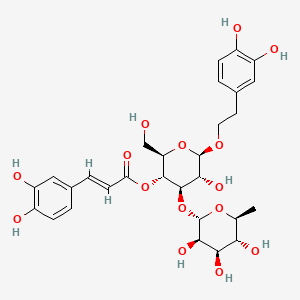
Verbascoside.
A polyphenol from olive leaf, mullein and plantain. Gut bacteria break most of it down into hydroxytyrosol, and that metabolite is what circulates and does the antioxidant work.
 Compound
- Category
- Compound
What Verbascoside is, and what it does.
- Does it work
- Suits people building an olive polyphenol habit. It also doubles as the marker compound brands use to standardise olive leaf, mullein and plantain extracts.
- How much to take
- No dose figure is on record. It arrives as a declared percentage of an extract, so the verbascoside content on the label tells you more than the extract weight.
- Time to feel it
- Nothing acute. Hydroxytyrosol metabolites appear in blood within hours, while any shift in antioxidant markers takes weeks of daily intake to read on a panel.
- The first dose
- No sensation on day one. Absorption of the intact glycoside is low, and the useful part happens once gut bacteria have taken the molecule apart.
- With regular use
- Weeks of daily use keep hydroxytyrosol and caffeic acid conjugates circulating. The change lands on oxidative stress markers rather than in how you feel.
- How well tolerated
- Generally well tolerated in extract form. The catechol groups bind iron and copper, so space it away from a mineral serving if you're working on iron status.
- How it feels
- Bitter if you taste the raw extract, and nothing subjective after that. The effect sits in markers rather than in sensation.
- The overlooked benefit
- It turns up as a marker compound across botanically unrelated extracts, from olive leaf to mullein to plantain, so two very different labels can deliver the same molecule.
The proof, claim by claim.
What these words mean
These words describe the research, not the molecule's worth. Research strength is how much work stands behind one claim, and it is never a product score.
- antioxidant capacity markersRandomised trial
- transition metal chelationIn vitro study
4 more claims
- healthy inflammatory responseAnimal study
- skin healthNarrative review
- endothelial functionNarrative review
- hydrolysis to hydroxytyrosol after oral intakeRandomised trial
Why these belong in the same formula, 8 pairings
Why these belong in the same formula. Each row says what the basis is, from settled biochemistry through to a trial that measured the pair.
Verbascoside is a phenylethanoid glycoside built from hydroxytyrosol and caffeic acid joined through a glucose and rhamnose core. Gut bacteria and mucosal esterases cleave it, so much of what reaches the circulation is hydroxytyrosol and caffeic acid metabolites rather than the intact molecule. The two are effectively the same exposure at different points on one pathway. A product containing both is delivering overlapping chemistry rather than two independent actives.
Intact verbascoside is absorbed poorly because of its glycosidic bulk, so systemic exposure depends on microbial cleavage to smaller phenolics. That makes the composition of a person's gut flora a major source of between-person variation. Whether adding a specific live culture reliably shifts that conversion in people has not been shown. The dependence on microbial processing is well established. The ability to steer it is not.
Olive leaf and olive mill byproduct extracts contain oleuropein and verbascoside side by side, and both release hydroxytyrosol on hydrolysis. Any effect attributed to one in a whole extract may be carried partly by the other. Formulations should declare both rather than assuming a single marker represents the extract. The compositional link is a matter of extract chemistry.
The catechol group in the hydroxytyrosol part of verbascoside is what donates a hydrogen to a radical, and once oxidised it becomes a quinone. Ascorbate can reduce that quinone back, extending how many radicals one phenolic molecule handles. This recycling is standard antioxidant chemistry across catechol phenolics. It has not been quantified for verbascoside specifically in people.
Lipid peroxidation is interrupted inside the membrane by tocopherol, while water-soluble phenolics scavenge in the surrounding aqueous space and help regenerate the tocopheroxyl radical. The compartments are complementary rather than redundant. This is why olive polyphenols and tocopherols occur together in olive oil and behave as a system. The pairing is mechanistic. It is not a tested clinical combination.
Verbascoside is amphiphilic because of its sugar core, so a lipid vehicle changes how it disperses and how quickly it moves through the small intestine. Olive polyphenols are naturally consumed in an oil matrix, which is the argument for reproducing that in a supplement. Whether the lipid raises absorption of the intact glycoside or simply of its metabolites is unresolved. Read it as a formulation rationale.
Glycosylated polyphenols are handled by a shared set of brush border hydrolases and then by UGT and SULT conjugation enzymes with finite capacity. Taking large doses of two at once means they compete at the same step. The practical consequence is that exposure to each is lower than either would be alone. This is a dosing consideration, not a reason to avoid the combination.
A polyphenol-rich olive byproduct nutraceutical containing verbascoside was examined for effects on muscle measures in adults with metabolic risk factors. Protein supply is the separate and better-established input for the same endpoint. Combining them addresses different limbs of muscle maintenance. The verbascoside contribution is one component of a multi-polyphenol preparation, so it cannot be isolated from the result.
Nothing specific on file for Verbascoside. Match the label to the daily amount above, and tell your doctor what you take.
Not medical advice. Show the label to your pharmacist.What Verbascoside actually does.
Verbascoside, also called acteoside, is a plant compound made of two smaller phenolic pieces attached to a pair of sugars.
3 more mechanisms
It carries two pairs of adjacent hydroxyl groups, one from each phenolic piece, and those are the structural reason for its radical-scavenging and metal-binding behavior.
The whole compound is poorly absorbed intact, and after taking it by mouth most of what circulates in the body is its breakdown products and their liver-modified forms, not the original compound.
Verbascoside shows up across a wide range of unrelated plants, including olive leaf, mullein, plantain and others, which is why it turns up as a marker compound in several different botanical extracts.
Where Verbascoside comes from.
It is a plant compound found in olive leaves and in the pulp left over after pressing olive oil, and also in mullein and plantain. It gets pulled out with hot water, cleaned up on a resin column, and dried into a powder. In the gut it mostly gets broken down into hydroxytyrosol, so that is what the body actually sees.
What this route gives you
Made from a plant. What ends up in the capsule tracks the harvest, so batch testing and a stated marker matter more here than with a made molecule.
5 steps on record
Olive leaf and pomace from oil pressing are the largest commercial sources, with mullein, ribwort plantain and Acanthus used regionally.
Hot water or subcritical water pulls the glycoside efficiently because the sugar core makes it water soluble, avoiding organic solvent in many processes.
Macroporous resin captures the phenolic fraction, and preparative chromatography separates verbascoside from oleuropein and the other phenylethanoids.
Material is assayed by HPLC against a verbascoside reference standard and diluted with a carrier to a declared percentage.
Spray dried, usually onto maltodextrin, and blended into capsules or functional food matrices.
Getting Verbascoside from food.
The whole-food sources on file. A supplement closes the gap, it does not replace dinner.
A gram-for-gram figure (how much of each you would eat to match a dose) will appear here once it is sourced and reviewed. This page will not print a number it cannot cite.
The forms it comes in.
2 more forms
The essence, in one line each.
- Dietary verbascoside supplementation altered the milk fatty acid profile and serum biochemistry of lactating donkeys.Animal study. D'Alessandro AG et al., 2017 (Animal). PMID 28264745 ↗
5 more findings
- Verbascoside restored GABAergic signalling markers in the prefrontal cortex and reduced low mood behaviours in a chronic stress rodent model.Animal study. Pan J et al., 2026 (Psychopharmacology). PMID 40938419 ↗
- In a single-arm pilot study in adults with metabolic risk factors, taking a polyphenol-rich olive oil byproduct containing verbascoside for 30 days was associated with modest increases in skeletal muscle mass and other muscle-related measures.Clinical trial (single-arm). Morelli D et al., 2026 (Nutrients). PMID 42197011 ↗
- An Acanthus ebracteatus aqueous extract, a plant source of verbascoside, was assessed as a functional feed additive for growth and health measures.Animal study. Prisingkorn W et al., 2026 (Animals). PMID 42353452 ↗
- A subcritical water extract of olive pomace, characterised as containing verbascoside among its phenolics, affected lipid measures in an animal model.Animal study. Ochoa-Acosta A et al., 2026 (Molecules). PMID 41900093 ↗
- The review maps proposed multi-target mechanisms for olive oil polyphenols in the brain, listing verbascoside among the compounds discussed.Narrative review. Wei L et al., 2025 (Frontiers in Nutrition). PMID 41393957 ↗
Chosen from the 6 we read for Verbascoside.
FDA Disclaimer: These statements have not been evaluated by the Food and Drug Administration. This information is for educational purposes only and is not intended to diagnose, treat, cure, or prevent any disease. Consult your healthcare provider before starting any supplement regimen.