Artepillin-C.
The marker compound of Brazilian green propolis, a prenylated cinnamic acid. You take it inside a standardised propolis extract, for antioxidant and everyday immune support.
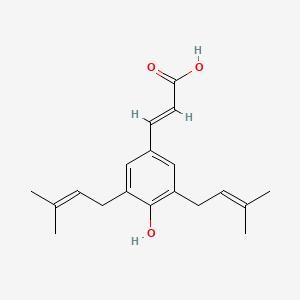 Compound
- Category
- Compound
What Artepillin-C is, and what it does.
- Does it work
- Suits people already buying green propolis who want the active measured rather than assumed. The stated percentage is what separates one extract from another.
- How much to take
- No dose figure is on record for artepillin C. Start from the standardised percentage on the extract, since raw propolis weight tells you very little about content.
- Time to feel it
- Nobody has established an onset in people. Propolis extracts are used across a season rather than for anything that arrives the same day.
- The first dose
- A sharp, resinous taste that lingers, and a slight numbing edge from an alcohol extract. The chemistry itself does not announce its arrival.
- With regular use
- Weeks of daily use through the colder months is the usual pattern in propolis studies. What moves shows up in laboratory markers rather than in sensation.
- How well tolerated
- Propolis is a bee product and a genuine allergen for some people, especially anyone reactive to bee products or poplar resin. Stop at any rash and check with a clinician.
- How it feels
- Resinous and bitter, with a numbing edge in the mouth. Past the taste there is no reliable sensation anyone has documented.
- The overlooked benefit
- Its two prenyl side chains make it fat-loving, so it slips into membranes instead of staying in water. That is why it acts unlike plain caffeic acid, and why fat helps.
The proof, claim by claim.
What these words mean
These words describe the research, not the molecule's worth. Research strength is how much work stands behind one claim, and it is never a product score.
- antioxidant activity in laboratory assaysIn vitro study
- immune signalling in cell and animal modelsAnimal study
3 more claims
- chemical marker of Brazilian green propolis originNarrative review
- gum comfort with propolis extractsRandomised trial
- extensive glucuronidation and sulfation after absorptionNarrative review
Why these belong in the same formula, 8 pairings
Why these belong in the same formula. Each row says what the basis is, from settled biochemistry through to a trial that measured the pair.
Green propolis extracts are standardised by their artepillin C content because it is the compound that distinguishes them from European poplar propolis. Buying the isolated molecule is uncommon, so in practice the delivery vehicle is the whole extract with its other cinnamic acids and flavonoids. Anyone comparing products should compare the declared artepillin C percentage rather than the raw extract weight.
The two prenyl groups on artepillin C make it strongly lipophilic and poorly dispersible in water. Phospholipid carriers and phytosome style complexes are the standard answer for compounds in this class, keeping them in a micelle-compatible form until the small intestine. The result is on dispersion and delivery, which is a marker rather than a clinical outcome. It is formulation practice, not evidence of a larger effect.
Medium chain triglycerides give a lipid phase that a prenylated acid can partition into, and they stimulate bile flow that supports micelle formation. Softgel green propolis products commonly use an oil base for exactly this reason. The reasoning is physical chemistry, not a comparative absorption trial in people.
When a cinnamic acid derivative quenches a radical it becomes a phenoxyl radical itself, and ascorbate can hand back an electron to restore the parent phenol. This recycling is textbook antioxidant network chemistry and applies to the whole polyphenol class. It describes behaviour in a chemical system and does not by itself say anything about a health outcome.
Tocopherol handles chain-breaking work inside membranes while phenolic acids act at the aqueous interface, so the two cover different compartments. In model lipid systems the pairing slows oxidation more than either alone. Read it as chemistry in a test system rather than a measured benefit in people.
Both compounds are handled by sulfotransferases and UDP-glucuronosyltransferases in the gut wall and liver. Loading two substrates of the same conjugation machinery at once can raise the free fraction of either, which cuts both ways: more circulating parent compound, and a less predictable dose. The direction of the net effect in a person has not been measured. Flagging it is more useful than assuming a boost.
EGCG and prenylated cinnamic acids compete for the same conjugating enzymes and for the same micellar space during absorption. Stacking them in one capsule is common in antioxidant blends but the interaction has not been characterised for this pair. It is worth noting rather than assuming additivity.
Zinc appears alongside propolis in throat sprays and lozenges because both are long-standing components of that category. There is no shared pathway that links them, and the pairing is a category convention rather than a biochemical synergy. The combination is formulation practice.
Nothing specific on file for Artepillin-C. Match the label to the daily amount above, and tell your doctor what you take.
Not medical advice. Show the label to your pharmacist.What Artepillin-C actually does.
It is a plant acid with two greasy tails stuck on, so it behaves like an oil-loving molecule.
3 more mechanisms
It mops up reactive fragments by handing over a hydrogen.
The body tags most of it for disposal on the way in, so blood levels of the raw molecule stay low.
If a propolis contains it, the bees were working Brazilian green vegetation.
Where Artepillin-C comes from.
A Brazilian shrub makes it, bees collect the sticky resin, and the resin is washed out with alcohol and measured. The bees are couriers, not chemists.
What this route gives you
The same molecule is reached more than one way. Which route a given product used is a manufacturing choice, and the finished compound is the same either way.
6 steps on record
The plant source is the resinous apical buds of Baccharis dracunculifolia, a shrub of the Brazilian cerrado. The prenylated cinnamic acids are made by the plant, not by the bee.
Foraging bees collect the resin and mix it with wax and salivary secretions to make green propolis, which is scraped from hive collectors.
Raw propolis is extracted with ethanol, with a hydroalcoholic mix, or with supercritical CO2 to release the phenolic fraction from wax.
Chilling and filtration drop out the wax fraction, which otherwise dominates the mass and carries no phenolics.
Batches are quantified against an artepillin C reference standard and labelled as a percentage of the dry extract.
Dried onto a carrier for capsules, kept liquid as a tincture, or suspended in oil for softgels.
The forms it comes in.
3 more forms
The essence, in one line each.
- In resistance-trained young women, supplementation with an artepillin C-rich propolis extract was associated with faster recovery of performance and lower muscle damage markers after damaging exercise.Randomised trial. Ramos Junior OJF et al., 2025 (Journal of the International Society of Sports Nutrition). PMID 41074544 ↗
3 more findings
- Chemical characterisation of Brazilian propolis processing residue found meaningful residual artepillin C and other prenylated phenolics, supporting recovery of the material rather than discarding it.In vitro study. Santanatoglia A et al., 2025 (Plants). PMID 40647998 ↗
- A botanical bioactive blend containing propolis-derived phenolics shifted inflammatory and immune markers in birds. Artepillin C appears among the characterised constituents.Animal study. Guerrini A et al., 2025 (Poultry Science). PMID 39919558 ↗
- A review of clinical evidence on dietary polyphenols concluded that human data across this compound class remains limited and heterogeneous. Artepillin C is named among the compounds discussed rather than tested.Systematic review. López-Gómez L et al., 2024 (Nutrients). PMID 39203871 ↗
Chosen from the 4 we read for Artepillin-C.
FDA Disclaimer: These statements have not been evaluated by the Food and Drug Administration. This information is for educational purposes only and is not intended to diagnose, treat, cure, or prevent any disease. Consult your healthcare provider before starting any supplement regimen.