Asiaticoside.
A triterpene from gotu kola studied for skin firmness and connective tissue. Gut bacteria strip its sugar chain to release asiatic acid, the form that gets into tissue.
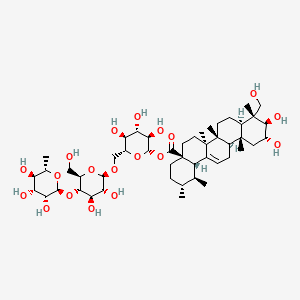 Compound
- Category
- Compound
What Asiaticoside is, and what it does.
- Does it work
- Suits people building a skin and collagen routine, or already taking gotu kola. Most human work applied it to skin, so an oral serving asks more of your digestion.
- How much to take
- No dose figure is on record for the isolated compound. Titrated gotu kola extracts are standardised to the total of four triterpenes rather than to this one alone.
- Time to feel it
- Skin and connective tissue move slowly: weeks to a couple of months, and the change reads in measurements and photographs before it reads as sensation.
- The first dose
- Day one is quiet. Gut bacteria have to cut the sugar chain off before the active form reaches tissue, so nothing lands on the first day.
- With regular use
- Over weeks, the research interest is collagen turnover and small-vessel flow in skin and legs, tracked with skin instruments and imaging.
- How well tolerated
- Gotu kola preparations are generally well tolerated over short courses. Stomach upset gets reported occasionally. Check with your clinician if you're pregnant or on medication.
- How it feels
- There's no day-to-day sensation to it. What changes is measured on the skin over weeks, with instruments rather than by feel.
- The overlooked benefit
- How much you get from a dose depends on your own gut bacteria, since they do the conversion. That's a large part of why responses vary so much between people.
The proof, claim by claim.
What these words mean
These words describe the research, not the molecule's worth. Research strength is how much work stands behind one claim, and it is never a product score.
- skin firmness and collagen supportRandomised trial
- leg comfort and capillary strengthRandomised trial
4 more claims
- tissue repair and connective tissue turnoverAnimal study
- calm and everyday stressRandomised trial
- a healthy inflammatory responseIn vitro study
- antioxidant activityIn vitro study
Why these belong in the same formula, 11 pairings
Why these belong in the same formula. Each row says what the basis is, from settled biochemistry through to a trial that measured the pair.
Centella triterpenes are studied for their effect on collagen expression, but the newly made procollagen chains cannot be hydroxylated and cross-linked without ascorbate keeping the hydroxylase iron in its reduced state. Without adequate vitamin C the upstream signal has nowhere useful to go. This is settled biochemistry and needs no trial to state. It describes a requirement, not a boost.
Collagen has an unusual amino acid composition dominated by glycine, proline and hydroxyproline. Any programme aimed at collagen turnover depends on the substrate being available, and proline is the residue that gets hydroxylated in place. The pairing is about supplying raw material for a process, not about adding a second active. Substrate availability is rarely limiting in a normal diet.
The tight packing of the collagen triple helix only works because the smallest amino acid sits at each interior position. That makes glycine a non-negotiable building block for any new collagen laid down. Pairing it with a triterpene studied for collagen signalling is a substrate-plus-signal logic. It is a mechanism statement, not a measured outcome.
Collagen peptide products supply glycine, proline and hydroxyproline-containing di- and tripeptides after digestion. Centella extracts are added to these formulas on the reasoning that one supplies material and the other is studied for the signal. Nobody has run a head to head separating the two contributions in people. The pairing is formulation convention with a plausible rationale.
Connective tissue remodelling depends on zinc-dependent proteinases that clear old matrix so new matrix can be laid down. Zinc is also required by numerous enzymes in wound repair generally. Low zinc status limits the machinery regardless of what signalling compound is present. This is a permissive requirement rather than an additive effect.
Hyaluronan is the water-binding glycosaminoglycan of the dermal matrix, while Centella triterpenes are studied for fibroblast behaviour in that same matrix. The two act on different components of one tissue compartment. Products combine them for that reason. The combination has not been isolated in a controlled human comparison.
Asiaticoside is a large glycoside with poor membrane permeability, which is the main reason oral doses deliver so little intact compound. Phospholipid complexes are the standard workaround for this class, improving wetting and micelle association. What improves is a delivery measure, not a clinical endpoint. State it as such.
Asiaticoside itself is poorly absorbed as the intact glycoside. Colonic bacteria strip the trisaccharide to release asiatic acid, which crosses membranes far more readily. That makes an individual's microbiota a real source of between-person variation in what actually reaches circulation. Whether adding specific strains changes this conversion in people has not been demonstrated.
Asiatic acid, the deglycosylated form, is markedly lipophilic and depends on micelle formation for uptake. A lipid vehicle taken with the dose supports that step. The glycoside itself gains less from an oil base than the aglycone does. This is chemistry rather than a comparative human study.
Tocopherol protects membrane lipids from oxidation while the Centella triterpene fraction is studied for its effects on fibroblast signalling and inflammatory tone. The pairing covers different aspects of the same tissue. It reflects category convention and mechanistic reasoning rather than a trial of the combination.
Bromelain is a proteolytic enzyme complex used in formulas aimed at tissue recovery, and Centella extracts appear in the same category. There is no shared pathway linking them and no combination study. The pairing is category convention and should be labelled that way.
Nothing specific on file for Asiaticoside. Match the label to the daily amount above, and tell your doctor what you take.
Not medical advice. Show the label to your pharmacist.What Asiaticoside actually does.
It is a fat-like scaffold with a sugar chain bolted on. The sugar is why it does not slip across membranes easily.
3 more mechanisms
The body clips off the sugars, and what is left is the part that actually gets into cells.
Very little of the swallowed molecule gets through intact, so lab results do not translate one for one.
Products are measured on the group of four, not on this one alone.
Where Asiaticoside comes from.
It comes from a low creeping wetland herb. The leaves are soaked in alcohol and water, the extract is cleaned up, and the useful compounds are measured before it is sold.
What this route gives you
Made from a plant. What ends up in the capsule tracks the harvest, so batch testing and a stated marker matter more here than with a made molecule.
5 steps on record
Harvested leaf and stem of Centella asiatica, a creeping wetland herb grown across South and Southeast Asia and Madagascar. Triterpene content varies with region, season and plant age.
Dried herb is extracted with ethanol and water mixtures that pull the glycosides out of the plant matrix. Newer work uses deep eutectic and other green solvent systems for the same fraction.
Macroporous resin steps strip sugars, pigments and chlorophyll, raising the triterpene share. Preparative chromatography is used when a single glycoside is the target.
Batches are assayed by HPLC against reference standards and labelled by total triterpene percentage, with asiaticoside quantified individually in higher-grade material.
Dried to a free-flowing powder for capsules, complexed with phospholipids for softgels, or dispersed into a topical base.
The forms it comes in.
5 more forms
The essence, in one line each.
- Asiaticoside reduced markers of mesothelial cell senescence and fibrotic remodelling by acting on macrophage to mesothelial signalling in a laboratory model.Animal study. You Y et al., 2026 (Phytomedicine). PMID 42208108 ↗
3 more findings
- Orally given Centella asiatica extract lessened UVB-driven skin changes through antioxidant and anti-inflammatory routes. Asiaticoside is named among the standardised constituents.Animal study. Choi YJ et al., 2025 (International Journal of Molecular Sciences). PMID 41516082 ↗
- A review of Centella asiatica and cellular ageing concluded that the triterpene fraction, asiaticoside included, shows consistent signals in preclinical models while human data remains thin.Narrative review. Borowicz KK et al., 2026 (Nutrients). PMID 42280293 ↗
- Green extraction methods recovered the Centella triterpene fraction, asiaticoside included, with yields depending strongly on solvent and technique.In vitro study. Razzaq W et al., 2026 (Molecules). PMID 41683503 ↗
Chosen from the 4 we read for Asiaticoside.
The studies, linked.
3 sources behind our Asiaticoside verdict, every one linked to PubMed, the journal or ClinicalTrials.gov.
- Clinical trialEffectiveness of Asiaticoside as Intracanal Medication on Infectious/Inflammatory Contents in Teeth With Apical PeriodontitisClinicalTrials.gov ↗Phase 2, 36 participants, Unknown
2 more linked trials
- Clinical trialA Clinical Efficacy Study of Asiaticoside for Treating Overweight/ObesityClinicalTrials.gov ↗30 participants, Recruiting
- Clinical trialEfficiency of Asiaticoside as Intracanal Medication in Revascularization Process : Randomized Clinical TrialClinicalTrials.gov ↗20 participants, Recruiting
From clinical trials and PubMed, ranked by study type and citation weight, not cherry-picked.
Problems people have reported.
Read this carefully. These are 1,611 voluntary, unverified reactions reported to the FDA (openFDA). The number mostly reflects how popular Asiaticoside is, not how risky it is. A report is not proof Asiaticoside caused anything. It is a signal of what to watch for, nothing more.
3 more reported effects
Source: openFDA adverse-event reports. Voluntary reporting, not an incidence rate.
FDA Disclaimer: These statements have not been evaluated by the Food and Drug Administration. This information is for educational purposes only and is not intended to diagnose, treat, cure, or prevent any disease. Consult your healthcare provider before starting any supplement regimen.