Dihydromyricetin.
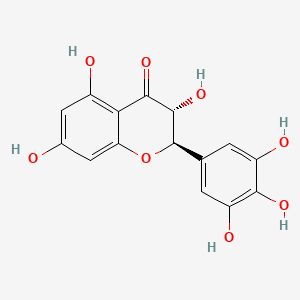
Dihydromyricetin is the main flavonoid in vine tea leaf. It's a strong hydrogen donor, which is the chemistry behind the antioxidant activity labs measure in it.
 Compound
- Category
- Compound
What Dihydromyricetin is, and what it does.
- Does it work
- Suits people who drink socially and want plant antioxidant support around it. Human work is limited, so it sits as a supporting player rather than the centre of a formula.
- How much to take
- No daily amount is on record for dihydromyricetin, so we won't invent one. Start with what the label directs, with a meal containing fat, since it dissolves poorly in water.
- Time to feel it
- Anything noticeable lands within hours of a dose rather than building over weeks, though nobody has measured a reliable time to effect in people.
- The first dose
- Day one is quiet. The antioxidant chemistry runs in the background, and the only thing people tend to report is how a social evening settles afterwards.
- With regular use
- Weeks of daily use haven't been mapped in people. Most repeated-dosing work sits in pigs and poultry fed it as an additive, which doesn't transfer straight across.
- How well tolerated
- Well tolerated in short human use, with occasional stomach upset reported. Check with a clinician if you take medicines cleared by the liver, or you're pregnant or breastfeeding.
- How it feels
- Most people describe no direct sensation from the compound itself. What gets reported is a steadier morning after a social evening rather than any lift at the time.
- The overlooked benefit
- It's poorly soluble and heavily conjugated on first pass, which is exactly why phospholipid and cyclodextrin versions exist: they change how much gets past the gut wall.
The proof, claim by claim.
What these words mean
These words describe the research, not the molecule's worth. Research strength is how much work stands behind one claim, and it is never a product score.
- support for how the body processes a drinkRandomised trial
- antioxidant activity in chemical and cell assaysIn vitro study
2 more claims
- liver and lipid markersAnimal study
- growth and tissue quality in production animalsAnimal study
Why these belong in the same formula, 11 pairings
Why these belong in the same formula. Each row says what the basis is, from settled biochemistry through to a trial that measured the pair.
The only structural difference is saturation of the C2 to C3 bond in the C ring, which changes planarity, colour and solubility. Vine tea material contains both, with dihydromyricetin usually far more abundant. Because the two are not identical in behaviour, data generated on myricetin should not be read across to dihydromyricetin without saying so.
Phospholipid complexes increase the apparent solubility and membrane permeability of poorly soluble polyphenols, and the approach has been applied across the flavonoid class. Whether a given dihydromyricetin phytosome delivers measurably more into blood depends on the specific preparation and should be shown, not assumed. Higher plasma levels would be a pharmacokinetic marker rather than a clinical result.
Flavonoid radicals formed after scavenging can be reduced back by ascorbate, which is why polyphenols and vitamin C are often studied and formulated together. The interaction is well characterised in chemical and cell systems. Measured antioxidant capacity in a test tube is not the same as an effect in a person, and this should be read as chemistry.
Flavonoids taken together compete for glucuronidation and sulfation capacity in the gut wall and liver, which can raise the free fraction of one or both. That is a plausible route to higher exposure, and it is equally a route to unexpected interactions with medicines cleared the same way. Anyone stacking several high-dose flavonoids alongside prescription medicines should raise it with their prescriber.
Dihydrolipoic acid can reduce oxidised forms of several antioxidants, which places it upstream of the flavonoid regeneration cycle. The pairing rests on redox chemistry rather than on a study of the two together. Both have also been examined separately in relation to glucose and lipid handling, so overlapping effects on those markers is a reasonable thing to watch for.
Polyphenol quinone metabolites are conjugated with glutathione, and NAC supplies the rate-limiting cysteine for glutathione synthesis. The two therefore touch the same handling pathway from different sides. No study has tested the combination, so this is mechanistic reasoning only.
Silymarin and dihydromyricetin have each been studied against liver enzyme and liver fat measures, so the pairing is thematically coherent. They also compete for the same conjugating enzymes, which cuts both ways. The combination itself has not been tested, and liver enzyme values are markers rather than outcomes.
Both are described as nudging inhibitory signalling, so an additive effect on alertness is worth flagging rather than assuming it is absent. The receptor work behind dihydromyricetin is animal and cell data, not human data. Anyone combining this with other sedating substances should assume additivity until shown otherwise.
A receptor modulator changes how the receptor responds to its own agonist rather than activating it directly, so the two are not simply additive in a mechanistic sense. Oral GABA crosses into the brain poorly in the first place, which limits how much this can matter in practice. The receptor claim comes from rodent and cell studies, not human trials.
Melatonin works on circadian timing while dihydromyricetin is described in animal work as acting on GABA-A signalling, so combining them stacks two different sedating inputs. This is flagged as a caution rather than as a recommended pairing. Next-morning grogginess is the practical thing to watch.
Stacking two high-dose polyphenol extracts loads the same glucuronidation and sulfation capacity, which can raise systemic exposure to both. High-dose green tea catechin extracts already carry documented reports of liver enzyme elevations, so the combination is not a free addition. Keep total polyphenol extract dose in mind rather than looking at each product separately.
Nothing specific on file for Dihydromyricetin. Match the label to the daily amount above, and tell your doctor what you take.
Not medical advice. Show the label to your pharmacist.What Dihydromyricetin actually does.
This is a specific flavonoid, the main one found in the leaves of the plant sold as vine tea.
3 more mechanisms
It doesn't dissolve well in water and gets heavily modified by the liver on its first pass, which together give it low and inconsistent absorption when taken by mouth.
Its molecular structure gives it several spots that readily donate hydrogen atoms, which is the chemical basis for the antioxidant activity seen in lab and cell tests.
Most of the published studies on giving this as a supplement were done in farm animals like pigs and poultry, fed to improve growth and meat quality, not tested as a human supplement.
Getting Dihydromyricetin from food.
The whole-food sources on file. A supplement closes the gap, it does not replace dinner.
A gram-for-gram figure (how much of each you would eat to match a dose) will appear here once it is sourced and reviewed. This page will not print a number it cannot cite.
The forms it comes in.
3 more forms
The essence, in one line each.
- In a randomised trial in 60 adults with a diagnosed liver condition, taking dihydromyricetin for three months improved measures of glucose and lipid metabolism and markers of inflammation compared to a placebo.Randomised trial, in adult nonalcoholic fatty liver disease patients. Chen S et al., 2015 (Pharmacological Research). PMID 26032587 ↗
10 more findings
- A systematic review of preclinical studies reporting effects of food-derived dihydromyricetin on measures of elevated liver fat and associated metabolic markers.Systematic review, in animals. Jin D et al., 2026 (Frontiers in Nutrition). PMID 42022551 ↗
- Supplementation with Ampelopsis grossedentata, the plant that dihydromyricetin comes from, improved measures of blood sugar control and kidney function in a one-month randomised trial in adults with a diagnosed blood-sugar condition.Randomised trial, in patients with type 2 diabetes mellitus. Ran L et al., 2019 (European Journal of Clinical Nutrition). PMID 30089792 ↗
- Dihydromyricetin supplementation was reported to reduce ethanol-induced lipid accumulation and inflammatory markers in the model used.Animal study. Janilkarn-Urena I et al., 2023 (Frontiers in Nutrition). PMID 37680900 ↗
- Dietary dihydromyricetin was associated with higher measured antioxidant capacity and altered lipid metabolism markers in the animals studied.Animal study. Guo Z et al., 2021 (Food and Function). PMID 34132271 ↗
- Dihydromyricetin supplementation was associated with changes in skeletal muscle fibre type distribution and meat quality measures, with AMPK signalling proposed as the pathway.Animal study. Guo Z et al., 2022 (Food and Function). PMID 35262136 ↗
- Dietary dihydromyricetin was reported to affect intestinal barrier markers and humoral immune measures in the animals studied.Animal study. Wei C et al., 2022 (Animal Biotechnology). PMID 35838495 ↗
- Dietary dihydromyricetin was associated with changes in lipid metabolism markers, antioxidant capacity and muscle fibre characteristics.Animal study. Guo Z et al., 2022 (Animal Biotechnology). PMID 34866549 ↗
- Dihydromyricetin reduced measures of platelet hyperactivity in the model used, with inhibition of intraplatelet reactive oxygen species proposed as the mechanism.Animal study. Song F et al., 2026 (Food and Function). PMID 42187340 ↗
- Adding dihydromyricetin to the culture medium was reported to improve developmental competence markers in the cells studied.In vitro study. Wang J et al., 2023 (Journal of Reproduction and Development). PMID 36403957 ↗
- Water extract of the source plant Ampelopsis grossedentata was associated with changes in reproductive performance and gut microbial measures in the birds studied.Animal study. Xiao Y et al., 2026 (Poultry Science). PMID 41494226 ↗
Chosen from the 11 we read for Dihydromyricetin.
The studies, linked.
2 sources behind our Dihydromyricetin verdict, every one linked to PubMed, the journal or ClinicalTrials.gov.
- Clinical trialEffect of Dihydromirycetin Administration on Glycemic Control, Insulin Sensitivity and Insulin Secretion in Patients With Type 2 Diabetes MellitusClinicalTrials.gov ↗Phase 2, 24 participants, Unknown
1 more linked trial
- Clinical trialPhase I, Dose-Escalation Study of Dihydromyricetin (DHM) to Treat Alcohol-Associated Liver DiseaseClinicalTrials.gov ↗Phase 1, 12 participants, Unknown
From clinical trials and PubMed, ranked by study type and citation weight, not cherry-picked.
FDA Disclaimer: These statements have not been evaluated by the Food and Drug Administration. This information is for educational purposes only and is not intended to diagnose, treat, cure, or prevent any disease. Consult your healthcare provider before starting any supplement regimen.