Dimethylglycine.
Dimethylglycine is what betaine becomes after handing a methyl group to homocysteine. Your liver makes it daily, and it moves on into the one-carbon folate pathway.
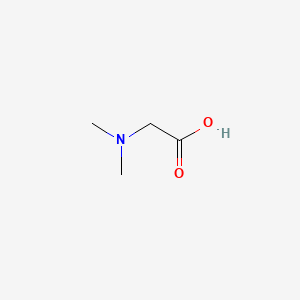 Compound
- Category
- Compound
What Dimethylglycine is, and what it does.
- Does it work
- Suits people mapping their methylation pathway who want the full picture on paper. Your own body makes it from choline and betaine, so most people already carry a steady supply.
- How much to take
- No daily amount is on record for dimethylglycine, so we won't invent one. Start with what the label directs, taken as part of a daily routine rather than in bursts.
- Time to feel it
- Nobody has measured a reliable time to effect in people. What it touches sits in one-carbon metabolism, which reads on a blood panel rather than as a same-day sensation.
- The first dose
- Day one is quiet. It joins the one-carbon pathway your liver already runs, and there's no acute signal attached to that step.
- With regular use
- Weeks of daily use haven't been mapped to a measured outcome in people. Plasma dimethylglycine itself is measurable, and it tracks riboflavin status closely.
- How well tolerated
- Well tolerated at the amounts sold. Historic pangamic acid products were inconsistent mixtures, so a single named ingredient matters. Check with a clinician if pregnant or breastfeeding.
- How it feels
- Most people report nothing distinct, which is normal for a metabolite the body already makes. The effect belongs to a methylation panel, not to how the afternoon goes.
- The overlooked benefit
- It isn't a methyl donor. It has already given its methyl group away, which is why it can't do what betaine does and why the two aren't interchangeable on a label.
The proof, claim by claim.
What these words mean
These words describe the research, not the molecule's worth. Research strength is how much work stands behind one claim, and it is never a product score.
- one-carbon and methylation metabolismNarrative review
- plasma marker of riboflavin statusCohort study
2 more claims
- homocysteine metabolism through the betaine routeCohort study
- exercise performanceRandomised trial
Why these belong in the same formula, 10 pairings
Why these belong in the same formula. Each row says what the basis is, from settled biochemistry through to a trial that measured the pair.
Dimethylglycine is what betaine becomes after betaine-homocysteine methyltransferase hands one methyl group to homocysteine. Supplementing betaine raises circulating dimethylglycine as a direct consequence, which is why dimethylglycine shows up as a marker in betaine trials. The two are one reaction apart, not independent ingredients.
Choline is oxidised to betaine in liver and kidney mitochondria, and betaine is then demethylated to dimethylglycine. So choline intake sits upstream of dimethylglycine by two steps. Anyone loading choline is already generating dimethylglycine endogenously.
Dimethylglycine is demethylated to sarcosine, then sarcosine to glycine, by two flavin-dependent mitochondrial dehydrogenases. Glycine is the terminal product of that route. This is settled pathway biochemistry rather than a supplement effect.
Dimethylglycine dehydrogenase and sarcosine dehydrogenase are both flavoproteins that need FAD, which the body builds from riboflavin. Poor riboflavin status slows that clearance step, and raised plasma dimethylglycine is a recognised biochemical signature of it. This is the most direct nutrient dependency dimethylglycine has.
The methyl groups stripped from dimethylglycine and sarcosine are handed to tetrahydrofolate, generating 5,10-methylene-THF. Folate is therefore the acceptor that lets the demethylation run. Without adequate folate the one-carbon units have nowhere to go.
The folate-dependent and betaine-dependent routes for remethylating homocysteine run in parallel, and dimethylglycine is the exhaust of the betaine route. Methylfolate supports the other arm. Homocysteine is a biochemical marker, and moving a marker is not the same as changing a clinical outcome.
Methionine synthase needs B12 to run the folate arm of homocysteine remethylation. When that arm is limited the betaine arm carries more of the load, and dimethylglycine output rises accordingly. Plasma dimethylglycine consequently reads as a metabolic marker of how the two arms are sharing the work.
Methionine is the product when homocysteine takes betaine's methyl group and dimethylglycine is left behind. High methionine intake raises homocysteine flux, which pulls harder on the betaine route and increases dimethylglycine formation. The three sit in one loop.
B6 drives the transsulfuration branch that disposes of homocysteine rather than recycling it. That branch competes with the betaine route that produces dimethylglycine, so B6 status changes how much flux the dimethylglycine-producing arm sees. It is a shared node, not a direct reaction partner.
Endogenous creatine synthesis consumes a large share of the body's labile methyl groups through guanidinoacetate methyltransferase. Supplemental creatine reduces that demand and eases pressure on the methyl pool that betaine and dimethylglycine sit in. The interaction is on methyl-group supply rather than on either compound's own action.
Nothing specific on file for Dimethylglycine. Match the label to the daily amount above, and tell your doctor what you take.
Not medical advice. Show the label to your pharmacist.What Dimethylglycine actually does.
When betaine donates a methyl group, what is left over is dimethylglycine.
3 more mechanisms
An enzyme that needs riboflavin strips a methyl off it and hands that carbon to folate.
Low riboflavin backs the pathway up and dimethylglycine accumulates in blood.
Your body makes it already. It is not an essential nutrient.
Where Dimethylglycine comes from.
It is made in a factory from a simple amine and an acetic acid derivative. Your own liver also makes it every time betaine donates a methyl group.
What this route gives you
Chemically synthesised. The molecule is identical to the one a plant or an animal makes, and building it deliberately means a known purity, a fixed dose and no crop contaminants. For several nutrients this is the only route that reaches a usable amount.
5 steps on record
Industrial dimethylglycine is normally made by alkylating dimethylamine with monochloroacetic acid or its sodium salt.
The amine displaces chloride to give the N,N-dimethyl glycine skeleton, then the mixture is neutralised to the free base, hydrochloride or sodium salt as required.
Sodium chloride from the reaction is removed by crystallisation or ion exchange, since residual salt otherwise carries into the finished powder.
Identity and purity are confirmed against a reference standard, with the counter-ion declared so the dimethylglycine content per gram is unambiguous.
Sublingual tablets are common in the legacy trade even though the molecule is small, water soluble and absorbed from the gut without difficulty.
Labels frequently omit which salt is used, which changes how much actual dimethylglycine a stated milligram figure represents.
Getting Dimethylglycine from food.
The whole-food sources on file. A supplement closes the gap, it does not replace dinner.
A gram-for-gram figure (how much of each you would eat to match a dose) will appear here once it is sourced and reviewed. This page will not print a number it cannot cite.
The forms it comes in.
3 more forms
The essence, in one line each.
- Dimethylglycine supplementation restored growth performance in reduced-energy diets, with improved nutrient digestibility offered as the explanation.Animal study. Chalvatzi S et al., 2020 (Animals). PMID 32370175 ↗
4 more findings
- Dietary dimethylglycine affected laying performance and egg quality measures in late-phase hens.Animal study. Yao H et al., 2022 (Poultry Science). PMID 34936951 ↗
- Dietary dimethylglycine reduced markers of cyclic heat-stress jejunal injury, with the authors attributing the effect to inhibition of an inflammatory signalling route.Animal study. Shao D et al., 2026 (Poultry Science). PMID 42184641 ↗
- Dimethylglycine sodium salt altered immune, intestinal morphology and antioxidant measures in the animals studied.Animal study. Wang Y et al., 2026 (Animals). PMID 42072024 ↗
- A published commentary questioning aspects of the interpretation in the dimethylglycine heat-stress study, which is worth reading alongside the original.Narrative review. Sati DM et al., 2026 (Poultry Science). PMID 42235150 ↗
Chosen from the 7 we read for Dimethylglycine.
Problems people have reported.
Read this carefully. These are 40 voluntary, unverified reactions reported to the FDA (openFDA). The number mostly reflects how popular Dimethylglycine is, not how risky it is. A report is not proof Dimethylglycine caused anything. It is a signal of what to watch for, nothing more.
3 more reported effects
Source: openFDA adverse-event reports. Voluntary reporting, not an incidence rate.
FDA Disclaimer: These statements have not been evaluated by the Food and Drug Administration. This information is for educational purposes only and is not intended to diagnose, treat, cure, or prevent any disease. Consult your healthcare provider before starting any supplement regimen.