Formic Acid.
In the body it exists as formate, a one-carbon unit your folate system uses to build purines, the bases that go into DNA and RNA. That is its role, not a felt effect.
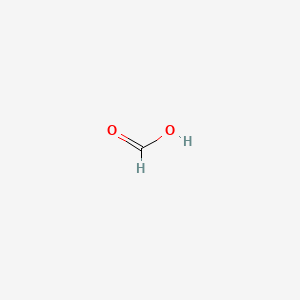 Compound
- Category
- Compound
What Formic Acid is, and what it does.
- Does it work
- Your own metabolism supplies formate, so nobody takes it for an effect. It appears as calcium or sodium formate in some formulas, where the mineral is the point.
- How much to take
- No supplemental daily amount is on record and none has been set, because one-carbon metabolism produces formate continuously. Follow the label of the salt it arrives in.
- Time to feel it
- There is no timeline to feel. Formate turns over inside the one-carbon pool within hours and leaves as carbon dioxide.
- The first dose
- Day one passes without sensation. Formate joins the folate pool, donates carbons to purine synthesis, or is oxidised away.
- With regular use
- Weeks of ordinary intake stay inside routine one-carbon metabolism. Nobody has measured a long-term outcome from supplemental formate in people.
- How well tolerated
- Concentrated formic acid is corrosive and handled as an industrial chemical, which is nothing like the trace formate your body makes. Clearance leans on folate status.
- How it feels
- No subjective experience at all. Its footprint is biochemical, in purine synthesis and the folate cycle, rather than anything you sense.
- The overlooked benefit
- Folate is what clears formate. It is a rare case of a vitamin acting as the disposal route for a metabolite rather than a cofactor for making one.
The proof, claim by claim.
What these words mean
These words describe the research, not the molecule's worth. Research strength is how much work stands behind one claim, and it is never a product score.
- one-carbon metabolism and purine synthesisNarrative review
- folate-dependent oxidation as the clearance routeNarrative review
1 more claim
- inhibition of cytochrome c oxidase at high concentrationsIn vitro study
Why these belong in the same formula, 10 pairings
Why these belong in the same formula. Each row says what the basis is, from settled biochemistry through to a trial that measured the pair.
Formate is condensed with tetrahydrofolate to form 10-formyl-THF, the folate species that donates carbons in purine synthesis. Folate availability therefore sets whether a formate load is routed into biosynthesis or accumulates. This is core one-carbon biochemistry, not a supplement pairing anyone needs to buy.
Formate entering the one-carbon pool is handled by formyl-THF synthetase and downstream folate-dependent enzymes. When folate status is low, formate clearance slows because the accepting cofactor is scarce. The relationship runs one way: folate governs formate handling, not the other way round.
The major route clearing formate from the body is the folate-dependent pathway that oxidises it stepwise to carbon dioxide. Capacity in that pathway is proportional to folate status. The relationship is the basis of long-standing clinical management of formate accumulation.
B12 deficiency traps folate as methyl-THF, which reduces the pool of tetrahydrofolate available to accept formate. So a B12 gap can constrain formate handling indirectly, without folate intake being low. This is a pathway relationship, not an effect anyone dosed formic acid to demonstrate.
The glycine cleavage system releases a one-carbon unit onto tetrahydrofolate, the same acceptor formate competes for. Both are inputs to the same limited pool. Loading one changes the flux available to the other.
Serine hydroxymethyltransferase moves a carbon from serine onto tetrahydrofolate, supplying most of the one-carbon units used in nucleotide synthesis. Formate enters that same pool from a different direction. In cells the two inputs are partly interchangeable, which is why formate can support purine synthesis when serine flux is limited.
Formic acid has a pKa near 3.75, so at body pH it exists almost entirely as formate with a proton released. A meaningful acid load is buffered by bicarbonate, which is consumed in the process. This describes acid-base chemistry, not a supplement combination to formulate.
Calcium formate is the neutralised salt used where the free acid would be too corrosive to handle or too damaging to equipment. Neutralisation changes the handling properties without changing the formate anion delivered. This is manufacturing convention.
Organic acid acidifiers lower gut pH and suppress acid-sensitive bacteria, which is why they were adopted as antibiotic alternatives in animal production. That same suppression does not distinguish target organisms from deliberately supplied ones. The direction of the interaction is expected from the mechanism. It has not been quantified in people.
Analytical chemistry work uses dilute formic acid in HPLC mobile phases to characterise thiamine degradation. The co-occurrence is a laboratory method artefact rather than a nutritional relationship. It is listed here so the association is not mistaken for a combination worth formulating.
Nothing specific on file for Formic Acid. Match the label to the daily amount above, and tell your doctor what you take.
Not medical advice. Show the label to your pharmacist.What Formic Acid actually does.
Formic acid is a simple acid that, at normal body pH, exists almost entirely in its ionized form, called formate.
3 more mechanisms
Formate is a normal part of the body's one-carbon metabolism, feeding into the folate pathway.
This folate-linked form of formate supplies carbon atoms at two steps in building new purines, which is its main biological use in the body.
The body clears formate mainly by using folate to break it down to carbon dioxide, so how well someone clears it depends on their folate status.
Where Formic Acid comes from.
The simplest acid there is, one carbon atom. It is made industrially from carbon monoxide and methanol. Your body also makes small amounts of it as part of normal metabolism, where folate handles it. Ant venom is where the name comes from.
What this route gives you
The same molecule is reached more than one way. Which route a given product used is a manufacturing choice, and the finished compound is the same either way.
5 steps on record
The dominant industrial route starts from carbon monoxide and methanol. Fermentation and biomass-derived routes exist and are the subject of ongoing process work.
Carbon monoxide is carbonylated with methanol to methyl formate, which is then hydrolysed to formic acid and methanol. The methanol is recycled.
An alternative route reduces carbon dioxide with hydrogen over a metal catalyst, often palladium or ruthenium based. It is a research and pilot-scale route rather than the bulk supply.
Formic acid forms an azeotrope with water, so concentration above roughly 77 percent requires extractive or azeotropic distillation.
Sold as a graded aqueous solution, or neutralised with calcium, sodium or potassium hydroxide to the corresponding formate salt.
Getting Formic Acid from food.
The whole-food sources on file. A supplement closes the gap, it does not replace dinner.
A gram-for-gram figure (how much of each you would eat to match a dose) will appear here once it is sourced and reviewed. This page will not print a number it cannot cite.
The forms it comes in.
4 more forms
The essence, in one line each.
- Dietary formic acid supplementation altered growth, health indicators, gut transcriptome and microbiota composition in the species studied.Animal study. Huang Z et al., 2026 (Marine Biotechnology). PMID 41779190 ↗
4 more findings
- Formic acid was compared with a herbal mixture and spirulina powder as antibiotic alternatives in broiler diets.Animal study. Ashour EA et al., 2026 (Veterinary Medicine and Science). PMID 42087212 ↗
- A validated HPLC-UV method characterised thiamine hydrochloride degradation, with formic acid used as an analytical mobile-phase component.In vitro study. Klapper S et al., 2026 (Journal of Pharmaceutical and Biomedical Analysis). PMID 42105595 ↗
- Formate served as a one-carbon driver for pyruvate biosynthesis in an engineered bacterial system.In vitro study. Deng W et al., 2026 (Synthetic and Systems Biotechnology). PMID 41938124 ↗
- Microbial interactions in natural whey starters, where organic acids including formic acid shape which species remain cultivable.In vitro study. Cristofolini M et al., 2026 (Frontiers in Microbiology). PMID 41859451 ↗
Chosen from the 5 we read for Formic Acid.
Problems people have reported.
Read this carefully. These are 1,385 voluntary, unverified reactions reported to the FDA (openFDA). The number mostly reflects how popular Formic Acid is, not how risky it is. A report is not proof Formic Acid caused anything. It is a signal of what to watch for, nothing more.
3 more reported effects
Source: openFDA adverse-event reports. Voluntary reporting, not an incidence rate.
FDA Disclaimer: These statements have not been evaluated by the Food and Drug Administration. This information is for educational purposes only and is not intended to diagnose, treat, cure, or prevent any disease. Consult your healthcare provider before starting any supplement regimen.