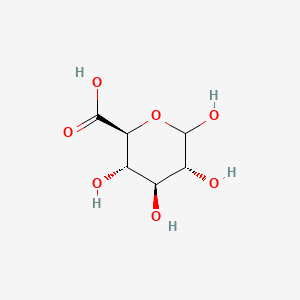
Glucuronic acid.
Glucuronic acid is what your liver attaches to compounds it wants to send out in bile or urine. It's also a building block of the cushioning sugars in cartilage and skin.
 Compound
- Category
- Compound
What Glucuronic acid is, and what it does.
- Does it work
- It suits people interested in the liver's clearance chemistry and in connective tissue building blocks. Your body already makes its own supply from glucose, continuously.
- How much to take
- No daily amount is on record for glucuronic acid itself. Start with the amount stated on the product you have, since forms differ widely from free acid to lactone.
- Time to feel it
- Nobody has measured a timeline for this. Its work happens in conjugation chemistry rather than in a sensation you could put a clock on.
- The first dose
- Day one is quiet. Anything happening sits in the phase two conjugation chemistry of the liver and gut wall, not in how you feel.
- With regular use
- Weeks of daily use of the free acid have not been measured. The active donor form is made continuously from glucose whether or not you take any.
- How well tolerated
- It's a normal human metabolite and generally well tolerated. Check with your doctor first if you take prescription medicines, since glucuronidation clears many of them.
- How it feels
- No distinct sensation goes with it. The action sits in liver clearance and connective tissue chemistry, which is read on a panel rather than noticed in the day.
- The overlooked benefit
- In most mammals this sugar acid feeds their own vitamin C production. Humans carry a broken gene at the last step, which is why we have to eat vitamin C instead.
The proof, claim by claim.
What these words mean
These words describe the research, not the molecule's worth. Research strength is how much work stands behind one claim, and it is never a product score.
- Phase two conjugation and clearance of compoundsNarrative review
- Structural monomer of hyaluronan, chondroitin sulfate and heparan sulfateNarrative review
2 more claims
- Water binding in connective tissue through carboxyl chargeIn vitro study
- Alertness in multi-ingredient energy drinks containing glucuronolactoneRandomised trial
Why these belong in the same formula, 12 pairings
Why these belong in the same formula. Each row says what the basis is, from settled biochemistry through to a trial that measured the pair.
Hyaluronan is built from alternating glucuronic acid and N-acetylglucosamine, and chondroitin from glucuronic acid and N-acetylgalactosamine. Supplying either building block feeds the same synthetic route. Whether oral building blocks raise tissue glycosaminoglycan synthesis in people is a separate question from the biochemistry, and the biochemistry alone does not settle it.
Every second sugar along a hyaluronan chain is glucuronic acid, contributed by the cell as UDP-glucuronic acid. That is the structural relationship. Taking free glucuronic acid orally is not the same as taking hyaluronan, since the polymer's behaviour comes from its chain length and charge density, not from the monomer.
Chondroitin chains are built on the same uronic acid unit, with sulfate groups added afterwards. Some of the glucuronic acid residues are later epimerised to iduronic acid in dermatan sulfate. Understanding the shared monomer explains why these ingredients cluster in joint comfort and mobility formulas.
Glucuronidation attaches glucuronic acid to a compound to make it water soluble for excretion. Calcium D-glucarate releases D-glucaro-1,4-lactone, which inhibits bacterial beta-glucuronidase, the enzyme that cuts that link in the gut and allows reabsorption. The two therefore act on opposite ends of the same cycle. Human outcome data for deliberately manipulating this is limited.
Glucuronide conjugates excreted in bile reach the colon, where bacterial beta-glucuronidase can cleave them and free the parent compound for reabsorption. How much of that happens depends on which organisms are present, since strains differ enormously in that enzyme activity. This is why microbiome composition affects the systemic exposure of many polyphenols and medicines.
Quercetin is glucuronidated so heavily in the gut wall and liver that almost none of it circulates as the free aglycone. What is measured in plasma is largely quercetin glucuronides. This is the central reason plasma concentrations after oral dosing sit far below what cell studies use, and it should temper any read-across from in vitro potency.
Oral resveratrol is absorbed well but conjugated almost completely before it reaches systemic circulation, mostly as glucuronides and sulfates. Free resveratrol in plasma is a small fraction of the dose. Any formulation claiming better outcomes needs to show it changed that conjugation picture, not just that it dissolved better.
Silybin and its relatives are rapidly glucuronidated and sulfated after absorption, which is why free plasma concentrations stay low and why phospholipid complexes were developed. The conjugates are also subject to bacterial deconjugation in the colon and partial reabsorption. Both steps shape how long anything stays around.
Curcumin glucuronide and sulfate dominate what circulates after an oral dose, with free curcumin barely detectable at ordinary intakes. This is the pharmacokinetic problem every enhanced curcumin format is working around. It is also why piperine is added, since it slows the same conjugation step.
Piperine reduces glucuronidation of co-administered compounds in the gut wall and liver, which raises how much of the parent survives first pass. That is the documented basis for pairing it with curcumin and several other polyphenols. The same mechanism means it can raise exposure to medicines cleared by the same route, which is worth checking rather than ignoring.
In most mammals the glucuronic acid route runs on to L-gulonolactone and then to ascorbate. Humans carry an inactivated gulonolactone oxidase gene, so that final step does not happen and dietary intake is required. This is a textbook comparative-biochemistry point, and it explicitly does not mean glucuronic acid contributes to human vitamin C status.
Myo-inositol oxygenase opens the inositol ring to give D-glucuronic acid, linking inositol metabolism directly into the uronic acid route. The pathway is well characterised in the kidney. It is a metabolic connection, not evidence that either ingredient changes the other's effect in people.
Nothing specific on file for Glucuronic acid. Match the label to the daily amount above, and tell your doctor what you take.
Not medical advice. Show the label to your pharmacist.What Glucuronic acid actually does.
Glucuronic acid is a modified form of glucose that carries a negative charge at body pH, which makes it acidic and highly water soluble.
3 more mechanisms
The form the body actually uses is UDP-glucuronic acid, made from UDP-glucose, and it's the only source the body draws on for every glucuronidation reaction.
Liver enzymes attach glucuronic acid to substances like bilirubin, steroid hormones, bile acids, many drugs and plant polyphenols, turning them water soluble so the body can excrete them. This is the main detox conjugation pathway in humans.
Glucuronic acid is a building block of hyaluronan and other joint and skin tissue polymers, and its charge is part of what lets those molecules hold onto water.
Where Glucuronic acid comes from.
Glucuronic acid is glucose with an acid group on the end. Your liver sticks it onto things it wants out of the body, which is how a lot of medicines and plant compounds get cleared. It is also every second sugar in hyaluronic acid and chondroitin.
What this route gives you
The same molecule is reached more than one way. Which route a given product used is a manufacturing choice, and the finished compound is the same either way.
6 steps on record
Synthetic and fermentation routes start from glucose. Extraction routes start from uronic acid-rich plant or animal polysaccharides.
Chemical oxidation with a catalyst, or microbial and enzymatic oxidation, converts the primary alcohol of glucose to a carboxylic acid.
An alternative route liberates the monomer from glucuronoxylan or from glycosaminoglycan sources by controlled hydrolysis.
The acidic monomer is separated on ion exchange resin and crystallised, or converted to the lactone for easier handling.
Purity and the acid-to-lactone ratio are the two figures that matter, since they shift with moisture and pH.
Sold as a powder ingredient, as glucuronolactone in beverage formats, or present bound inside a glycosaminoglycan product.
Getting Glucuronic acid from food.
The whole-food sources on file. A supplement closes the gap, it does not replace dinner.
A gram-for-gram figure (how much of each you would eat to match a dose) will appear here once it is sourced and reviewed. This page will not print a number it cannot cite.
The forms it comes in.
4 more forms
The essence, in one line each.
- Using male jelly fig by-product as a fermentation substrate raised both glucuronic acid and bacterial cellulose yield in kombucha.In vitro study. Chou YC et al., 2026 (Foods). PMID 42073178 ↗
1 more finding
- Plasma metabolomic profiling distinguished participant subgroups, with glucuronic acid appearing among the discriminating metabolites.Case-control. Jialiken D et al., 2025 (World Journal of Experimental Medicine). PMID 41523755 ↗
Chosen from the 3 we read for Glucuronic acid.
FDA Disclaimer: These statements have not been evaluated by the Food and Drug Administration. This information is for educational purposes only and is not intended to diagnose, treat, cure, or prevent any disease. Consult your healthcare provider before starting any supplement regimen.