Hyperforin.
Hyperforin is the alcohol-soluble constituent of St John's wort. It slows how fast nerve cells reclaim serotonin, noradrenaline and dopamine, which is why it appears in mood formulas.
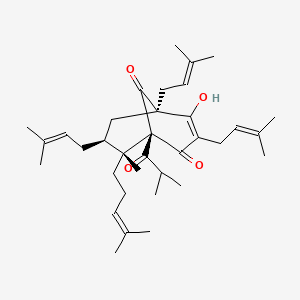 Compound
- Category
- Compound
What Hyperforin is, and what it does.
- Does it work
- It suits adults supporting steady everyday mood who take no other medicine. If you take anything prescribed, including hormonal contraception, talk to your prescriber first.
- How much to take
- No daily amount is on record for hyperforin itself. Labels state it as a percentage of a standardised St John's wort extract, so start from the maker's stated serving.
- Time to feel it
- Mood-related change with these extracts builds over two to four weeks of daily use. The enzyme induction side starts sooner, over roughly one to two weeks.
- The first dose
- Day one is quiet on the mood side. What does begin immediately is the slow build of enzyme activity that changes how other medicines are handled.
- With regular use
- Weeks of daily use is where trials measured mood differences. The same weeks raise CYP3A4 and P-glycoprotein activity, which fades over a similar period after stopping.
- How well tolerated
- Most people tolerate it well, but the medicine interaction list is long and includes hormonal contraception. Speak to your prescriber before starting anything with it.
- How it feels
- People describe a gradual evening out rather than a lift. Sun sensitivity is sometimes reported and is attributed to hypericin, a different constituent.
- The overlooked benefit
- Two St John's wort extracts can behave very differently. Hyperforin level is a manufacturing choice, and low-hyperforin types exist specifically to reduce medicine interference.
The proof, claim by claim.
What these words mean
These words describe the research, not the molecule's worth. Research strength is how much work stands behind one claim, and it is never a product score.
- support for mood already in the normal rangeMeta-analysis
- induction of CYP3A4 and intestinal P-glycoprotein activityRandomised trial
2 more claims
- non-competitive limits on monoamine reuptakeIn vitro study
- activation of TRPC6 channels and intracellular sodium riseIn vitro study
Why these belong in the same formula, 11 pairings
Why these belong in the same formula. Each row says what the basis is, from settled biochemistry through to a trial that measured the pair.
Hyperforin does not exist as a standalone supplement in practice. It reaches people inside Hypericum perforatum extracts, and the hyperforin content of a given extract is a manufacturing decision that ranges from deliberately minimised to deliberately maximised. Any statement about hyperforin exposure is really a statement about which extract was used.
Hyperforin degrades quickly on exposure to oxygen and light, which is the main reason extract assays fall over shelf life. Antioxidants including ascorbate are used during processing and packing to slow that loss. This is a stability measure inside manufacturing and not a pairing a person takes for effect.
5-HTP supplies the immediate precursor for serotonin synthesis while hyperforin-containing extracts raise synaptic monoamine availability by a reuptake-limiting route. Stacking a precursor with a reuptake mechanism is the classic setup for excessive serotonergic signalling. Anyone combining these should be doing it under clinical supervision.
Tryptophan feeds the same synthesis pathway as 5-HTP, one step earlier. Combined with a Hypericum extract that limits monoamine reuptake, the two act on supply and clearance of the same transmitter. Flag it as an additive risk rather than a designed combination.
SAM-e works as a methyl donor supporting monoamine synthesis and metabolism, a different entry point from reuptake. Products and protocols sometimes stack them for mood support. The additive serotonergic potential is the reason this pairing needs supervision rather than casual use.
Hyperforin is a strong PXR agonist and drives up CYP3A4 and CYP1A2 activity over roughly one to two weeks of daily use. Melatonin is cleared largely by CYP1A2, so induction lowers its exposure. The direction is downward for the partner, which is the opposite of what most people combining them expect.
Berberine inhibits CYP3A4 and is itself a P-glycoprotein substrate, while hyperforin induces both CYP3A4 and P-glycoprotein. Taken together they push the same systems in opposite directions and the net result is unpredictable. Predicting exposure of anything else in the regimen becomes guesswork.
Hyperforin-driven induction of P-glycoprotein increases efflux of substrates back into the gut lumen, which lowers their absorbed fraction. Curcumin is one of the polyphenols handled that way. The interaction cuts against the absorption work most curcumin formulations are built around.
Silymarin has been studied as a mild inhibitor of several CYP isoforms and of glucuronidation, while hyperforin induces CYP3A4 strongly. Combining an inducer with an inhibitor makes the exposure of any third compound in the regimen harder to anticipate. Neither cancels the other in a predictable way.
Coenzyme Q10 absorption depends on lipid handling and transport that induction can shift, and induced hepatic metabolism raises clearance of several lipophilic compounds. The pairing is not dangerous so much as wasteful. Read this as a mechanistic prediction, since it has not been measured directly.
Hyperforin is highly lipophilic and barely soluble in water, which is why traditional water infusions of the herb extract very little of it. Oil based and soft gel formats carry considerably more into solution. This is a delivery property that helps explain why tea and capsule products behave so differently.
Nothing specific on file for Hyperforin. Match the label to the daily amount above, and tell your doctor what you take.
Not medical advice. Show the label to your pharmacist.What Hyperforin actually does.
Hyperforin switches on the liver and gut machinery that clears medicines, so it can lower how much of a drug stays in the body.
3 more mechanisms
The effect on drug clearance takes about a week or two to appear and about as long to fade after stopping.
It slows the reuptake of several brain chemicals, but by a different route than standard medicines use.
It breaks down quickly in air and light, so what is in an old bottle may not match the label.
Where Hyperforin comes from.
It comes from St John's wort flowers and is pulled out with alcohol or CO2, never really by water. Makers decide how much of it ends up in the extract, and that choice changes both what the product does and how much it interferes with medicines.
What this route gives you
Made from a plant. What ends up in the capsule tracks the harvest, so batch testing and a stated marker matter more here than with a made molecule.
5 steps on record
Harvested at full flowering, when hyperforin content in the reproductive tissue peaks and then falls rapidly after cutting
Solvent choice largely determines hyperforin yield, since the compound is lipophilic and barely enters water extracts
Solvent is removed under reduced pressure with oxygen and light excluded, because the compound degrades during this step if exposed
Batches are assayed by HPLC for hyperforin and for total hypericins, and a specification naming only one of the two leaves the other unconstrained
Packed with oxygen and moisture barriers, often with antioxidants, because assay drifts downward over shelf life
The forms it comes in.
2 more forms
The essence, in one line each.
- Hyperforin altered gut microbial metabolites and the authors traced a behavioural effect in the model to a microbially generated metabolite rather than to hyperforin acting directly.Animal study. Zhang et al., 2025 (Journal of Affective Disorders). PMID 40164238 ↗
4 more findings
- St John's wort co-administration lowered systemic exposure to docetaxel, consistent with induction of its metabolic clearance.Open-label trial. Goey et al., 2014 (Clinical Pharmacokinetics). PMID 24068654 ↗
- Screening of natural products alongside omega-3 fatty acids identified compounds that shifted lipid mediator formation in the cell systems used.In vitro study. Jordan et al., 2025 (Biomedicine and Pharmacotherapy). PMID 40449167 ↗
- An ethanolic Hypericum perforatum extract shifted antioxidant status and performance markers in the animals studied.Animal study. Seraji-Kopkan et al., 2026 (Veterinary Medicine and Science). PMID 42365532 ↗
- Ethanolic Hypericum perforatum extract altered growth performance and serum metabolite profiles in the animals studied.Animal study. Behroozilak et al., 2025 (Veterinary Medicine and Science). PMID 40699554 ↗
Chosen from the 5 we read for Hyperforin.
The studies, linked.
2 sources behind our Hyperforin verdict, every one linked to PubMed, the journal or ClinicalTrials.gov.
- Clinical trialShort-Term Outcome of Medical Vs. Surgical Management Of Chronic Anal Fissure (A Randomized Controlled Trial)ClinicalTrials.gov ↗Phase 1, 99 participants, Completed
1 more linked trial
- Clinical trialClinical Study of DA-020 for the Treatment of Chemotherapy Induced AlopeciaClinicalTrials.gov ↗Phase 1, 60 participants, Recruiting
From clinical trials and PubMed, ranked by study type and citation weight, not cherry-picked.
FDA Disclaimer: These statements have not been evaluated by the Food and Drug Administration. This information is for educational purposes only and is not intended to diagnose, treat, cure, or prevent any disease. Consult your healthcare provider before starting any supplement regimen.