Potassium borate.
A mineral salt that carries boron alongside potassium. Boron supports normal bone metabolism and the way your body holds on to magnesium, calcium and its own steroid hormones.
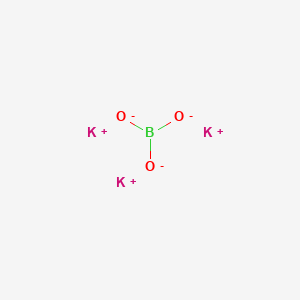 Compound
- Category
- Compound
What Potassium borate is, and what it does.
- Does it work
- Suits people eating few fruits, nuts and pulses, where boron intake runs low. Eat a lot of those foods and you already take in a few milligrams a day.
- How much to take
- No dose figure is on record for this particular salt. Boron from a mixed diet lands at a few milligrams a day, and that everyday range is what a maintenance amount works within.
- Time to feel it
- Boron reaches steady blood levels within a day or two. Its effects on bone and hormone markers show up over weeks on a blood panel rather than as a sensation.
- The first dose
- Quiet, unless a concentrated potassium salt is taken on an empty stomach, which can sting. The boron itself is absorbed almost completely within hours.
- With regular use
- Weeks of daily use show up in mineral and steroid hormone markers on a panel, and in how well your body holds on to magnesium and calcium.
- How well tolerated
- Boron has an established upper intake level for adults, so stay inside label directions. Anyone with reduced kidney function or on potassium sparing medicines should check first.
- How it feels
- No sensation is attached to it. What changes sits in blood markers of mineral and hormone handling rather than in energy or mood.
- The overlooked benefit
- Borate grabs anything with two neighbouring hydroxyl groups, including sugars, polyols and the ribose in NAD. That one reaction sits behind almost all of boron's biology.
2,600 to 3,400mg a day is where Potassium borate works.
Source: NIH ODS + He 2006 blood pressure meta
The proof, claim by claim.
What these words mean
These words describe the research, not the molecule's worth. Research strength is how much work stands behind one claim, and it is never a product score.
- Bone mineral metabolismRandomised trial
- Magnesium and calcium retentionRandomised trial
3 more claims
- Steroid hormone clearanceRandomised trial
- Joint comfortCohort study
- Electrolyte balance from the potassium fractionNarrative review
Why these belong in the same formula, 10 pairings
Why these belong in the same formula. Each row says what the basis is, from settled biochemistry through to a trial that measured the pair.
Borate intake has been reported to reduce urinary magnesium loss in humans, particularly when magnesium intake is low to begin with. The effect is on retention, not on absorption at the gut. Read it as a modest sparing effect rather than a reason to lower a magnesium dose.
In controlled depletion and repletion work, adding borate lowered urinary calcium loss in people whose intake of magnesium or vitamin D was marginal. The signal weakened when those other nutrients were adequate, which is the usual pattern for a conditional nutrient. It is a marker of handling, not a measure of bone strength.
Borate supplementation has been associated with higher serum 25-hydroxyvitamin D in people who started deficient, plausibly through slower hepatic clearance of steroid and secosteroid hormones. The change is in a circulating marker. Nobody has shown a downstream outcome follows from it.
Borate chemistry is defined by reversible complexation with adjacent hydroxyl pairs, which is why borate buffers are used to separate sugars and polyols. Ascorbic acid presents that motif. In a concentrated liquid or a wet blend this can form complexes and change assayed free ascorbate, though in a dry capsule at ordinary doses the practical impact is likely small.
Borate complexes with the polyol chain of riboflavin, a reaction used analytically to shift riboflavin fluorescence. In a solid dose form the two are unlikely to meet in a way that matters. In a liquid, syrup or effervescent format, the interaction is a real formulation consideration.
The adjacent phenolic hydroxyls on catechins are exactly the geometry borate ester chemistry favours. Co-formulating a borate salt with a high catechin extract in a liquid can change the free fraction of both. Whether that matters biologically after dilution in gut contents is not established.
The sodium potassium ATPase moves three sodium ions out for every two potassium in, and the kidney's distal handling of the two is coupled through aldosterone. Raising potassium intake changes renal sodium handling and the same is true in the other direction. Any potassium salt, borate included, participates in that balance once dissociated.
Once dissolved, the potassium ion is the same regardless of which anion delivered it. What differs is the anion's own fate, and here the borate anion is not inert filler but a nutrient of its own. Formulators should count the potassium against total potassium and the boron against total boron rather than against neither.
Vitamin K2 supports the carboxylation of osteocalcin so it can bind calcium. Borate acts elsewhere, on mineral excretion and on steroid hormone half life. The stack is a design choice built on separate mechanisms, and no study has tested the pair together.
Boron from borate salts, from calcium fructoborate and from food all lands in the same body pool. Stacking two boron sources in one regimen is double counting, and regulators set a tolerable upper intake for elemental boron in adults, with the exact figure differing between authorities. Count elemental boron, not salt weight.
Nothing specific on file for Potassium borate. Match the label to the daily amount above, and tell your doctor what you take.
Not medical advice. Show the label to your pharmacist.What Potassium borate actually does.
Once it dissolves, the body sees potassium on one side and boron on the other. The salt name stops mattering.
3 more mechanisms
Boron grabs pairs of neighbouring hydroxyl groups. That one trick explains nearly everything it does.
Potassium sits inside your cells and sets the electrical baseline that nerves and muscle run on.
You absorb nearly all of it, you pee it out within a day or so, and very little stays behind.
Where Potassium borate comes from.
It starts as rock, mostly mined in Turkey. That rock is turned into boric acid, which is then balanced against a potassium base until it forms a stable salt. Everything after that is drying, testing and making sure the label matches what is inside.
What this route gives you
From a mineral source, then refined and usually bound to a carrier so the body can take it up.
5 steps on record
Colemanite, ulexite or tincal, mined from evaporite deposits concentrated in Turkey and in California. These deposits supply most of the world's boron.
Ore is reacted with sulfuric acid and recrystallised to give boric acid, or refined directly to sodium tetraborate depending on the mineral.
Boric acid is neutralised with potassium hydroxide or potassium carbonate at a controlled ratio. The ratio chosen decides whether the product is a metaborate, a tetraborate or a pentaborate.
The salt is crystallised from solution, washed and dried to a defined hydration state, since the water of crystallisation changes the elemental boron per gram.
Batches are assayed for boron and potassium content, along with heavy metals. Dose should be expressed as elemental boron rather than salt weight.
Getting Potassium borate from food.
The whole-food sources on file. A supplement closes the gap, it does not replace dinner.
A gram-for-gram figure (how much of each you would eat to match a dose) will appear here once it is sourced and reviewed. This page will not print a number it cannot cite.
The forms it comes in.
4 more forms
The essence, in one line each.
Chosen from the 1 we read for Potassium borate.
FDA Disclaimer: These statements have not been evaluated by the Food and Drug Administration. This information is for educational purposes only and is not intended to diagnose, treat, cure, or prevent any disease. Consult your healthcare provider before starting any supplement regimen.