Rosavin.
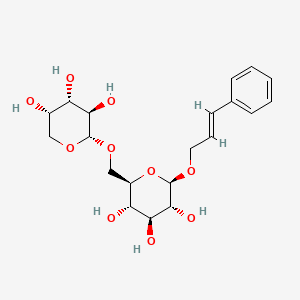
Rosavin is the largest of the three rosavins in Rhodiola rosea root. Labels standardise on it, and its presence is how a lab confirms the root is genuinely rosea.
 Compound
- Category
- Compound
What Rosavin is, and what it does.
- Does it work
- Useful to anyone choosing a Rhodiola product who wants the species confirmed. It isn't taken alone, so the extract around it is what you're actually taking.
- How much to take
- No amount is on record for rosavin alone. It's stated as a percentage of a Rhodiola rosea extract, so follow the extract serving rather than the marker figure.
- Time to feel it
- Nobody has timed rosavin by itself. Studies of the whole root extract run one to four weeks of daily use before measuring anything.
- The first dose
- Day one belongs to the extract, not the marker. Rosavin has no described same-day effect of its own in people.
- With regular use
- No long-term human data exists for rosavin alone. Cell work has placed it in mineralising osteoblast cultures, a laboratory readout and not bone in a person.
- How well tolerated
- There's no standalone safety record for purified rosavin. Inside Rhodiola root extract it's usually well tolerated, and it isn't characterised for pregnancy.
- How it feels
- On its own, nothing has been described. What people notice comes from the whole root extract, most often a mild lift in drive under a heavy week.
- The overlooked benefit
- Rosavins are near-absent from other Rhodiola species, so the number on a certificate of analysis is an identity test hiding inside a potency figure.
The proof, claim by claim.
What these words mean
These words describe the research, not the molecule's worth. Research strength is how much work stands behind one claim, and it is never a product score.
- Species authentication marker for Rhodiola roseaNarrative review
- Osteoblast matrix mineralisation in cultureIn vitro study
2 more claims
- Contribution to Rhodiola extract activity in stress adaptation modelsAnimal study
- Hydrolysis by intestinal and gut microbial beta-glucosidasesIn vitro study
Why these belong in the same formula, 8 pairings
Why these belong in the same formula. Each row says what the basis is, from settled biochemistry through to a trial that measured the pair.
Rosavin does not exist as a standalone supplement in ordinary practice. It reaches people as the headline marker of a Rhodiola rosea root extract, most often stated as three percent rosavins. Any rosavin dose figure is therefore a fraction of an extract dose. The compound and the herb are not two separate things to stack.
These three differ only in the sugar attached to a shared cinnamyl alcohol backbone and are never separated commercially. A label figure for rosavins is the sum of all three, with rosavin usually the largest share. Reading rosavin as an isolated compound misstates what is in the capsule.
The two turn up in the same products because they occupy the same shelf category, not because a shared mechanism has been mapped for the isolated glycoside. Their reported subjective qualities differ, with Rhodiola more often described as activating and ashwagandha as settling, which is part of why formulators combine them. Nothing in the rosavin literature addresses the pairing. This is formulation practice.
The overlap here is behavioural rather than biochemical. Both are taken early in the day and both are reported to affect perceived exertion and alertness, so people stack them without knowing whether the effects add. Anyone sensitive to stimulants may find the pairing more activating than expected. Read it as a practical caution rather than a characterised interaction.
This pairing appears constantly on nootropic labels and has no grounding in the rosavin literature. It is included so a reader understands why the two co-occur in products. The rationale is subjective tolerability, not a mapped mechanism.
Cell-culture work on rosavin has examined osteoblast behaviour and BMP-2 signalling under mineralising conditions. Vitamin D governs the calcium supply side of that same tissue. The connection is that the two touch bone biology from different directions, and nothing more than that has been shown. The rosavin work is in vitro only, so this belongs to mechanism-generating research and not to anything measured in people.
Osteocalcin is made by osteoblasts and needs vitamin K2 to carboxylate before it can bind calcium into the bone matrix. Rosavin has been studied for its effect on those same cells under mineralising conditions in culture. The overlap is the cell type, which is a thin basis and should be read as such. No human work connects the two.
Osteoblasts cannot mineralise matrix without calcium and phosphate to incorporate. Any compound studied for effects on osteoblast behaviour is acting upstream of that requirement rather than replacing it. This is stated so the in vitro rosavin findings are not misread as a substitute for mineral supply. The relationship is substrate logic, not a measured pairing.
Nothing specific on file for Rosavin. Match the label to the daily amount above, and tell your doctor what you take.
Not medical advice. Show the label to your pharmacist.What Rosavin actually does.
Rosavin is a compound from rhodiola rosea root made of cinnamyl alcohol attached to two sugars. It's the biggest member of a group called the rosavins, which also includes rosarin and rosin.
3 more mechanisms
The rosavins are basically unique to rhodiola rosea and barely show up in other rhodiola species. Their presence on a lab test is the standard way to confirm the species is correct, which is really a supply chain check as much as a chemistry one.
Rosavin isn't sold or dosed by itself. It only comes inside a rhodiola rosea root extract, so any stated rosavin amount is really a percentage of an extract dose rather than something you take on its own.
Bone-forming cells build bone material and then mineralize it, a process guided by several signaling pathways. Studies looking at compounds in these cell cultures are examining that specific process, which is a cell-level reading, not a measurement of bone in an actual person.
Where Rosavin comes from.
Rosavin comes out of the root of Rhodiola, an alpine plant that grows slowly in cold places. The root gets dried, soaked in alcohol and water, boiled down to a powder, then tested. That test counts rosavin together with two nearly identical cousins, which is why labels say rosavins and not rosavin. The same test is how a lab spots a cheaper substitute species being passed off as the real thing. Pure rosavin on its own exists, but it goes to laboratories, not to capsules.
What this route gives you
Made from a plant. What ends up in the capsule tracks the harvest, so batch testing and a stated marker matter more here than with a made molecule.
6 steps on record
A cold-adapted succulent of arctic and alpine regions across Europe, Asia and North America. Roots are taken from wild stands or multi-year cultivated plots, since marker content accumulates with plant age. Wild harvest pressure has made cultivated and cell-culture sources increasingly relevant.
Roots are washed, sliced and dried under controlled temperature. Excess heat degrades the glycosides, so drying conditions affect final marker content.
Milled root is extracted with an ethanol and water mixture, which brings out rosavin together with rosarin, rosin, salidroside and other phenolics.
Extract is concentrated under vacuum, ethanol is removed, and the residue is dried to powder, often onto a carrier. Isolate grades go through additional column chromatography to separate rosavin from its two sibling glycosides.
The three cinnamyl glycosides are quantified together against reference standards and blended to a target percentage. Salidroside is assayed in parallel for dual-standardised grades.
Blended extract powder goes into capsules and tablets. Isolated rosavin goes to laboratories rather than to consumers.
The rosavin share within the summed rosavins figure is rarely disclosed, and wild-harvested versus cultivated root origin is often unstated.
The forms it comes in.
3 more forms
The essence, in one line each.
- Rosavin altered CX3CL1 secretion and changed osteoblast morphology under mineralising conditions in cell culture.In vitro study. Wojdasiewicz P et al., 2026 (Molecular Biology Reports). PMID 42171911 ↗
2 more findings
- Rosavin was examined for its effect on BMP-2 induction and osteoblast-related signalling, reporting changes in that pathway in a laboratory model.In vitro study. Wojdasiewicz P et al., 2025 (International Journal of Molecular Sciences). PMID 40649853 ↗
- A review of the proposed role of rosavin in bone metabolism, drawing together preclinical signalling data rather than reporting new human results.Narrative review. Wojdasiewicz P et al., 2024 (International Journal of Molecular Sciences). PMID 38396794 ↗
Chosen from the 3 we read for Rosavin.
FDA Disclaimer: These statements have not been evaluated by the Food and Drug Administration. This information is for educational purposes only and is not intended to diagnose, treat, cure, or prevent any disease. Consult your healthcare provider before starting any supplement regimen.