6-Paradol.
It's the pungent compound from grains of paradise seed, a ginger relative. It's studied for whether it nudges everyday calorie burn by switching on brown fat.
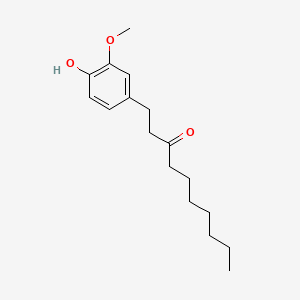 Compound
- Category
- Compound
What 6-Paradol is, and what it does.
- Does it work
- Suits people already training and eating well who want a small metabolic nudge alongside that. The human trials are few and small, so keep expectations measured.
- How much to take
- No dose figure is on record. It's used as a standardised seed extract once a day, and a small steady daily amount is what this kind of extract is built for.
- Time to feel it
- The thermogenic response has been measured within a couple of hours of a single dose. Body composition changes, where they show, take weeks.
- The first dose
- A peppery warmth in the throat and stomach is common on day one. Beyond that, the change is a measured bump in energy expenditure.
- With regular use
- Across weeks of daily use the measured outcomes are a small shift in body composition and a slightly higher resting burn. The human evidence is early and the trials are small.
- How well tolerated
- Generally well tolerated. The usual complaint is heartburn or a warm, peppery reflux, which is easier to avoid by taking it with a meal.
- How it feels
- Peppery and warming, like ginger's sharper cousin. Some people notice mild warmth after a dose. The metabolic part shows up on a measurement.
- The overlooked benefit
- Your body makes it from ginger. 6-shogaol is reduced to paradol after you eat ginger, so anyone who cooks with ginger is already producing some.
The proof, claim by claim.
What these words mean
These words describe the research, not the molecule's worth. Research strength is how much work stands behind one claim, and it is never a product score.
- Everyday energy expenditureRandomised trial
- Brown adipose tissue activationRandomised trial
4 more claims
- Healthy body composition over weeksRandomised trial
- Antioxidant activity in cell systemsIn vitro study
- Healthy inflammatory responseAnimal study
- Formation of paradol as a metabolite of ginger intakeNarrative review
Why these belong in the same formula, 10 pairings
Why these belong in the same formula. Each row says what the basis is, from settled biochemistry through to a trial that measured the pair.
6-Paradol sits downstream of the ginger pungent compounds. 6-Shogaol is reduced in the gut and liver to 6-paradol, so ginger intake raises circulating paradol without paradol ever appearing on the label. A formula that already carries a ginger extract is contributing to the same pool. This is chemistry, not a claim about any outcome.
Paradol is cleared largely by phase II glucuronidation, the same route that limits curcumin and gingerol exposure. Piperine slows that conjugation step, which is the rationale for pairing it with poorly retained plant phenolics. The pairing is mechanistic reasoning, not a measured exposure figure for paradol specifically.
Paradol is a lipophilic oleoresin constituent with poor water solubility. Dispersing it in a medium chain triglyceride carrier keeps it in solution through the gut lumen and lets it partition into mixed micelles. This is why most grains of paradise extracts ship as an oil suspension or a softgel rather than a loose powder.
Lecithin emulsifies a sticky oleoresin so it can be beadleted, spray dried onto a carrier or held in a stable emulsion. It does not change what paradol does in the body. The role is manufacturing feasibility and dose uniformity.
Both compounds push in the same direction on sympathetic tone and energy expenditure, which is why they turn up together in thermogenic blends. Additive means the effects stack, including the unwanted ones: raised heart rate, jitteriness and disturbed sleep. Anyone sensitive to stimulants should count the caffeine from all sources before adding paradol.
Catechins and paradol are both proposed to raise energy expenditure through catecholamine dependent signalling. Formulators combine them for that reason. The combination has not been isolated from the caffeine that usually travels with green tea extract, so the additive contribution of each part is not separable from the trials that exist.
Paradol and capsaicin are both vanilloid pungent principles that act on TRP channels in the gut and mouth. Stacking them raises the total pungent load, which is what drives the burning and reflux some people report. The sensory effect is reliable. The metabolic effect is where the uncertainty sits.
Rosemary extract is used as an antioxidant in lipid matrices to slow peroxidation of the carrier oil that holds the paradol. It protects shelf life rather than doing anything in the body. Expect it on an ingredient list next to any oleoresin in oil.
Mixed tocopherols serve the same protective function as rosemary in an oil suspension, terminating lipid radical chains in the carrier. The presence of tocopherol on a paradol softgel usually reflects a stabiliser dose, not a nutritional one. Read the amount before counting it toward vitamin E intake.
Quercetin is itself a heavy substrate for the glucuronidation and sulfation enzymes that clear paradol. Co-dosing large amounts of one polyphenol can occupy conjugation capacity that the other also needs, which shifts exposure in ways that have not been measured for this pair. Worth flagging rather than assuming a clean addition.
Nothing specific on file for 6-Paradol. Match the label to the daily amount above, and tell your doctor what you take.
Not medical advice. Show the label to your pharmacist.What 6-Paradol actually does.
6-Paradol is a pungent compound related to 6-gingerol and 6-shogaol from ginger, but it lacks the specific chemical features that define those two.
3 more mechanisms
In the body, 6-shogaol gets converted into 6-paradol, so paradol shows up as a byproduct of eating ginger as well as being naturally present in grains of paradise seed.
Grains of paradise seed contains a mix of paradols, gingerols and shogaols together, so an extract from the seed gives you a family of related compounds rather than just one.
As a pungent compound in the same family as capsaicin, paradol interacts with sensory receptors in your mouth and gut, which is likely why it feels peppery and why some people notice reflux.
Where 6-Paradol comes from.
It comes from the seeds of a West African spice plant related to ginger. The seeds get crushed and the peppery oil is pulled out, measured for how much paradol it holds, then mixed into an oil so the dose stays even in every capsule.
What this route gives you
Made from a plant. What ends up in the capsule tracks the harvest, so batch testing and a stated marker matter more here than with a made molecule.
5 steps on record
Seeds of a West African Zingiberaceae plant, harvested from the pod and dried. Ginger rhizome is a secondary route, since paradol also arises from shogaol metabolism.
Milled seed is extracted with ethanol or supercritical carbon dioxide to pull the lipophilic pungent fraction into an oleoresin.
Residual solvent is removed under vacuum and waxes are chilled out, leaving a concentrated oleoresin.
The oleoresin is blended to hit a declared paradol content, since the native level in seed varies by origin and season.
Dispersed into medium chain triglyceride for softgels, or adsorbed onto a maltodextrin or silica carrier for capsules and tablets.
Getting 6-Paradol from food.
The whole-food sources on file. A supplement closes the gap, it does not replace dinner.
A gram-for-gram figure (how much of each you would eat to match a dose) will appear here once it is sourced and reviewed. This page will not print a number it cannot cite.
The forms it comes in.
3 more forms
The essence, in one line each.
- In a 12-week randomised trial in 70 adults with overweight, a standardised Aframomum melegueta seed extract significantly increased energy expenditure and reduced body weight and BMI compared to a placebo.Randomised trial. Sudeep HV et al., 2022 (Drug Design, Development and Therapy). PMID 36329722 ↗
3 more findings
- In a 48-hour randomised trial in healthy adults with moderate anxiety levels, an extract from Aframomum melegueta seeds reduced anxiety and tension, improved overall mood, and enhanced sleep quality.Randomised trial. Perez-Machin R et al., 2025 (Pharmaceuticals). PMID 40006090 ↗
- A critical review of ginger's antioxidant and immunomodulatory activity that places paradol within the gingerol and shogaol metabolite family.Narrative review. Ayustaningwarno F et al., 2024 (Frontiers in Nutrition). PMID 38903613 ↗
- A mini review of ginger derivatives as feed additives, naming paradol among the active pungent constituents.Narrative review. Wei LS et al., 2025 (Heliyon). PMID 39897801 ↗
Chosen from the 4 we read for 6-Paradol.
FDA Disclaimer: These statements have not been evaluated by the Food and Drug Administration. This information is for educational purposes only and is not intended to diagnose, treat, cure, or prevent any disease. Consult your healthcare provider before starting any supplement regimen.