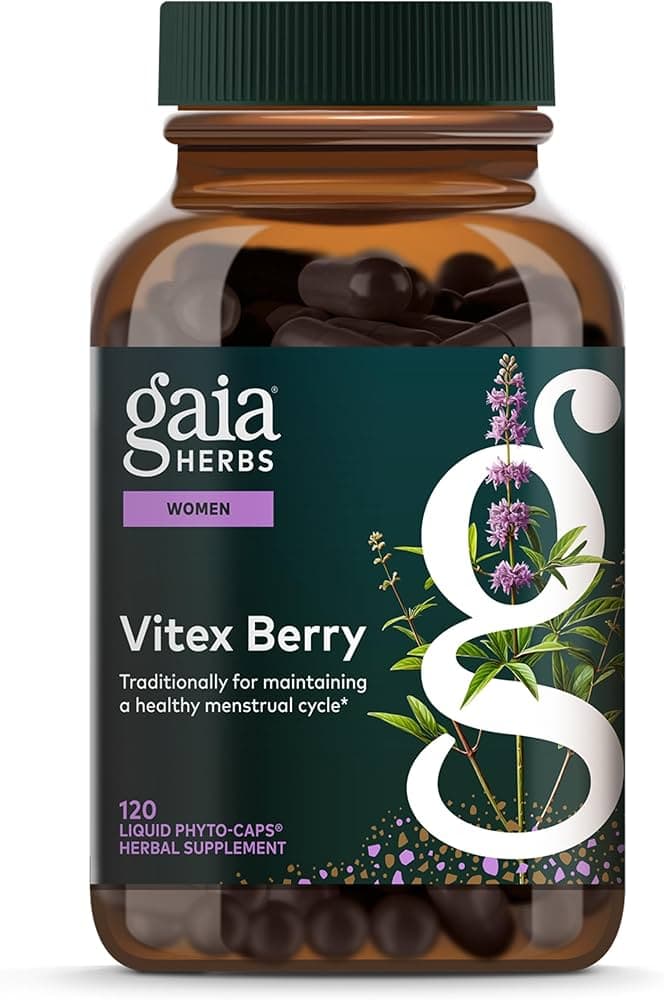
Agnuside.
The active compound in Vitex (chaste tree berry) that helps regulate hormonal balance and PMS symptoms. Modulates prolactin and dopamine pathways to rebalance female hormone cycles, reducing PMS and cycle irregularity
Reviewed March 2026
- Category
- Compound
- Also filed under
- PMS symptom reductionMenstrual cycle regulationProlactin modulation
What Agnuside is, and what it does.
- Does it work
- Suits women tracking comfort and mood across the monthly cycle who can give it three full cycles. The change seen in trials is moderate and gradual rather than dramatic.
- How much to take
- Start with 0.5 to 1mg of agnuside a day, which is what a standardised Vitex extract is built to deliver. 2mg shows up in trials as a research condition.
- Time to feel it
- Two to three full cycles. Little lands in the first weeks, and the change reads as a difference between one cycle and the next.
- The first dose
- Nothing you would notice. It works cycle to cycle, so day one is simply the start of the count.
- With regular use
- By cycle two some women notice milder premenstrual symptoms. Cycle three is where trials read their results, and responders keep building over about six months.
- How well tolerated
- Generally well tolerated. Mild stomach upset, headache or rash can occur. Check with your doctor if you are pregnant or take hormonal contraception, hormone therapy or a dopamine-acting medicine.
- How it feels
- The absence of symptoms is the main experience. Less breast tenderness before your period. Fewer mood swings. Less intense cramps for some women. It's subtle and gradual, not a dramatic shift.
- The overlooked benefit
- Agnuside is the measuring stick, not the engine. It marks extract identity, while lipophilic diterpenes do the dopamine receptor work, so a stated agnuside figure signals batch consistency.
0.5 to 1mg a day is where Agnuside works.
Source: Schellenberg 2001, BMJ; Wuttke et al. 2003
The proof, claim by claim.
These words describe the research, not the molecule's worth. Research strength is how much work stands behind one claim, and it is never a product score.
- Reduces PMS symptoms
- Regulates menstrual cycles
- Reduces prolactin levels
Questions people ask about Agnuside.
- Should I take agnuside or Vitex?
- Take standardized Vitex extract. Agnuside isn't sold as an isolated compound. When you see 'standardized to agnuside,' that means the Vitex extract has been verified to contain a specific amount of this active compound. It's a quality marker, not a separate supplement.
- How long until I know if it's working?
- Give it 3 full menstrual cycles (about 3 months). This is the standard recommendation from clinical trials. Some women notice improvement by cycle 2, but cycle 3 is the fair evaluation point. If nothing has changed by month 3, it's probably not going to work for you.
- Can men take this?
- There's no evidence supporting men taking agnuside/Vitex. Its primary actions are on female reproductive hormone pathways. The prolactin-lowering effect theoretically could affect men, but there are no clinical studies and it's not recommended.
- Will it mess with my birth control?
- Possibly. Vitex affects hormone levels, which could theoretically reduce the effectiveness of hormonal contraceptives. Most practitioners advise against combining them. If you're on the pill, patch, or ring, discuss with your gynecologist before adding Vitex.
- Can it help with fertility?
- It might help women with luteal phase deficiency or elevated prolactin (both can impair fertility). A few small studies suggest improved conception rates. But this is not a first-line fertility treatment. Work with a reproductive endocrinologist for fertility issues.
- What's the difference between standardized and whole berry?
- Standardized extracts guarantee a specific agnuside content (usually 0.5% or 0.6%). Whole berry capsules contain whatever the plant produced that season. The agnuside in whole berries can vary by 200-300% depending on harvest conditions. Standardized extract gives you predictable dosing.
Why these belong in the same formula. Each row says what the basis is, from settled biochemistry through to a trial that measured the pair.
Agnuside-bearing chaste tree extract acts on dopamine D2 signalling that governs prolactin release, and B6 as pyridoxal phosphate is the cofactor for the decarboxylase that makes dopamine. The two touch one dopaminergic step from different sides.
P5P is the ready-made coenzyme for aromatic amino acid decarboxylase, the step that produces dopamine. It supports the same dopaminergic tone that agnuside-standardised extracts act on.
Magnesium appears with Vitex extracts in most cycle-support formulas, contributing to normal muscle function and normal neurotransmission as an established cofactor role. The Vitex side works on the pituitary end of the hormonal axis instead. These are separate mechanisms placed in one capsule, not a tested combination.
Calcium is included in cycle-comfort formulas for its established role in normal muscle contraction and nerve signalling. It shares no pathway with the dopaminergic constituents of Vitex. Take the pairing as a formulation convention.
Tyrosine is hydroxylated to L-DOPA and then decarboxylated to dopamine, making it the dietary substrate for dopamine synthesis. Vitex agnus-castus extracts contain lipophilic diterpenes that bind dopamine D2 receptors on pituitary lactotrophs, which is the accepted explanation for their effect on prolactin secretion. One side supplies substrate for the transmitter, the other acts at the receptor, so the pairing is mechanistically coherent even without a combination trial.
GLA is elongated to dihomo-gamma-linolenic acid, the substrate for the series-1 prostaglandins, which is a separate pathway from anything hormonal. It is the reason evening primrose and borage oils sit next to Vitex in cycle formulas. The eicosanoid pathway itself is textbook. The benefit of the pair is not established.
Evening primrose oil is the usual GLA vehicle in these formulas and is combined with Vitex extract as a matter of convention across the category. Its contribution is fatty acid substrate, not hormonal signalling. Nothing here is evidence for the combination as such.
Black cohosh triterpene glycosides are described as acting on serotonergic and other central receptors rather than as estrogen-receptor ligands, which is a different site from the dopaminergic action attributed to Vitex diterpenes. The two are combined in women's formulas for that reason. Combination data are not cited here.
Dang gui is a standard cycle-support botanical in Chinese formulation practice and travels alongside Vitex in Western women's blends. Its constituents include coumarins and ferulic acid, chemically unrelated to Vitex diterpenes and iridoids. This is a traditional pairing rather than a mechanistic one.
DIM shifts estradiol hydroxylation between the 2-hydroxy and 16-alpha-hydroxy routes, which is a metabolism step in the liver. Vitex acts upstream at the pituitary on prolactin release. Different points on one axis, and the endpoints measured for DIM are urinary metabolite ratios, which are markers rather than clinical outcomes.
Glucaric acid derivatives inhibit intestinal beta-glucuronidase, the enzyme that cleaves glucuronide conjugates and allows deconjugated steroids to be reabsorbed. Inhibiting it favours excretion of the conjugate. That is a clearance mechanism, separate from anything Vitex does at the pituitary.
Myo-inositol and D-chiro-inositol are precursors to inositol phosphoglycan mediators in insulin signalling, which touches ovarian steroid production indirectly. Vitex acts on prolactin secretion instead. Two different levers on reproductive endocrine function, with no combination evidence cited.
Zinc is structural in the zinc-finger domains of steroid hormone receptors and a cofactor for many enzymes in hormone metabolism, so adequacy is a background requirement for normal endocrine function. That is a sufficiency argument, not an added effect. Vitex constituents act on receptor signalling rather than on zinc status.
Menstrual blood loss is a recognised route of iron loss, which is why iron status is monitored in menstruating adults. Iron does nothing to the Vitex mechanism. It addresses the status question that sits alongside it. If a formula pairs them, note that polyphenol-rich extracts taken at the same time can bind non-heme iron in the lumen.
Tryptophan is hydroxylated and decarboxylated to serotonin, a pathway rate-limited by tryptophan hydroxylase and by tryptophan availability. Vitex acts on the dopaminergic side of pituitary control. Pairing them puts substrate into one transmitter system while another is modulated at its receptor.
5-HTP bypasses the rate-limiting hydroxylation step and is decarboxylated straight to serotonin. It is used in cyclic low-mood formulas alongside Vitex. The serotonergic load is where caution belongs, particularly with anything else acting on that system.
St John's wort induces CYP3A4 and intestinal P-glycoprotein via the pregnane X receptor, lowering exposure to co-taken compounds handled by those routes, including hormonal contraceptives. That induction is among the most consistently documented herb interactions in pharmacology. It is a reason to flag the pair rather than to promote it, even though the two appear together in cyclic mood formulas.
Ashwagandha is studied on cortisol and on subjective stress measures, which touches the hypothalamic-pituitary-adrenal axis rather than prolactin secretion. Vitex acts on the pituitary lactotroph side. They are formulated together because the intended use overlaps, not the mechanism.
Alpha-tocopherol is a chain-breaking antioxidant in lipid membranes and is a long-standing inclusion in cyclic comfort formulas. Its role there is conventional and the supporting work is thin. No shared pathway with Vitex constituents is claimed.
Talk to a doctor before taking Agnuside if any of these apply to you: Hormonal effects mean it's not for everyone, Avoid with hormonal contraceptives, Takes 2-3 cycles to see results, Not for use during pregnancy. These are flags to check first, not effects Agnuside is known to cause.
Not medical advice. Show the label to your pharmacist.What Agnuside actually does.
Agnuside is an iridoid glycoside, aucubin carrying a p-hydroxybenzoyl ester. It's the analytical marker used to standardise Vitex agnus-castus fruit extracts, because it's stable and easy to quantify by HPLC.
Dopamine hitting D2 receptors on pituitary lactotroph cells is the main brake on prolactin release. Push that receptor and prolactin falls, block it and prolactin rises. Settled endocrine pharmacology.
Iridoid glycosides like agnuside are polar and water-loving, while the D2-active diterpenes are fat-loving. So the ethanol strength used for extraction sets the ratio between the marker compound and the constituents credited with the receptor activity.
A prolactin level in blood is a hormonal marker. Move that number and you've measured a shift in endocrine signalling, not a change in how someone actually feels.
The forms it comes in.
FDA Disclaimer: These statements have not been evaluated by the Food and Drug Administration. This information is for educational purposes only and is not intended to diagnose, treat, cure, or prevent any disease. Consult your healthcare provider before starting any supplement regimen.