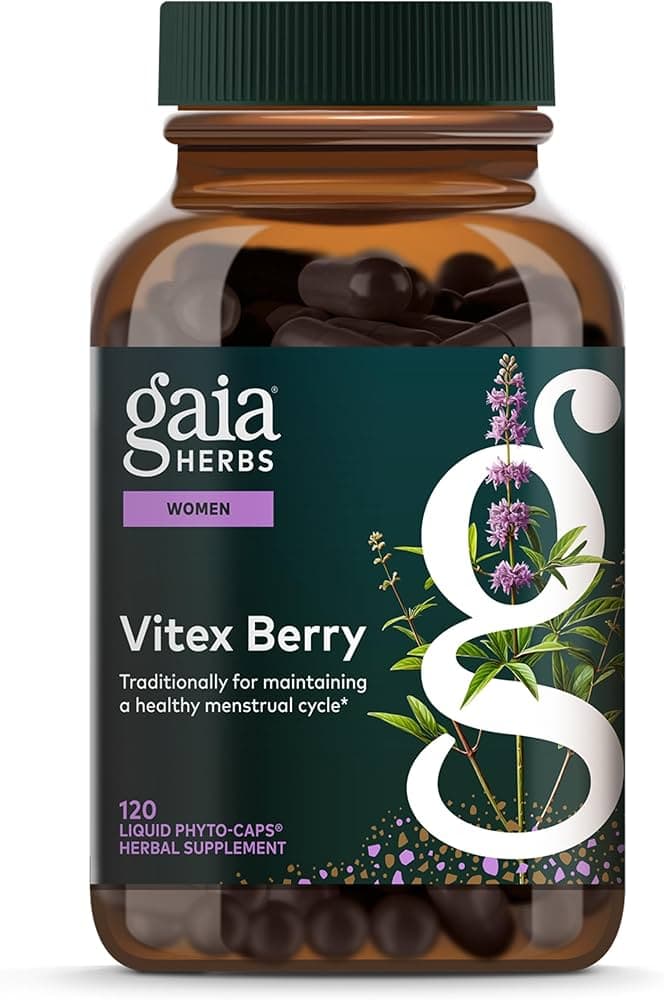
Chaste Tree.
The go-to herb for PMS and menstrual irregularities. Works by gently rebalancing prolactin and progesterone. Binds to dopamine D2 receptors in the pituitary, lowering prolactin. This allows progesterone to normalize, correcting the hormonal imbalance behind most PMS symptoms.
Reviewed March 2026
- Category
- Herb
- Also filed under
- Reduces PMS symptoms significantlyHelps regulate menstrual cyclesLowers elevated prolactin levels
What Chaste Tree is, and what it does.
- Does it work
- One of the strongest herbal medicines for PMS. Multiple clinical trials with clear results. German Commission E approved. If PMS is your issue, this is a first-line natural option.
- How much to take
- 20-40 mg standardized extract (like Ze 440) per day. Higher doses of crude berry powder: 500-1000 mg.
- Time to feel it
- Give it two to three full cycles. Most of the change shows up in how month two or three runs, and it keeps building through months four to six.
- The first dose
- Nothing noticeable. Hormonal rebalancing takes weeks to manifest.
- With regular use
- By month 2-3, significant PMS symptom reduction in most women. Full benefit at 3-6 months.
- How well tolerated
- Generally well tolerated. Don't combine with hormonal contraceptives, hormone therapy, or dopamine-affecting medications. Avoid during pregnancy.
- How it feels
- After 2-3 months: less PMS. That might mean fewer mood swings, less breast pain, fewer headaches, and more regular periods. The cumulative effect is genuinely life-improving for many women.
- The overlooked benefit
- The marker on the label, agnuside or casticin, is an analytical handle. The compounds binding the dopamine receptor are the labdane diterpenes, so two extracts differ.
20 to 40mg a day is where Chaste Tree works.
Source: Schellenberg, 2001; He et al., 2009; Wuttke et al., 2003
The proof, claim by claim.
These words describe the research, not the molecule's worth. Research strength is how much work stands behind one claim, and it is never a product score.
- Significantly reduces PMS symptoms
- Helps regulate irregular menstrual cycles
- Works through prolactin reduction
Questions people ask about Chaste Tree.
- How long until I notice a difference?
- Most women notice improvement after 2-3 menstrual cycles. That means 2-3 months of daily use. Don't give up after one month.
- Can I take this with birth control pills?
- Not recommended. Vitex affects hormonal balance and may interfere with hormonal contraceptive effectiveness. Talk to your doctor.
- Does it help with fertility?
- It may help women with luteal phase deficiency (low progesterone after ovulation). By normalizing progesterone levels, it can improve conditions for conception. But work with a fertility specialist.
- Can men take this?
- Men generally shouldn't. It lowers prolactin, which affects testosterone production. Unless specifically recommended by a healthcare provider for elevated prolactin.
- Will this affect my period timing?
- It might. By normalizing hormones, it can shift cycle length toward a more regular pattern. This is usually a positive change, but track your cycle during the first few months.
Why these belong in the same formula. Each row says what the basis is, from settled biochemistry through to a trial that measured the pair.
B6 as pyridoxal-5-phosphate is the cofactor for the decarboxylase step that makes dopamine, and dopamine tone at the pituitary is what sets prolactin output. Vitex acts on that same dopaminergic receptor side.
P5P is the ready-to-use coenzyme form for aromatic amino acid decarboxylase, the enzyme that produces dopamine. Vitex works on dopamine receptor signalling, so cofactor supply and receptor action line up.
Magnesium supports smooth muscle relaxation and works with B6 in neurotransmitter enzymes, a standing pairing with vitex in monthly cycle formulas. The mechanisms are separate and non-competing.
Black cohosh acts on serotonergic and central pathways rather than the dopamine and prolactin axis vitex works on. Formulas for midlife hormonal change combine the two for that reason.
Dong quai coumarins support circulation and smooth muscle tone while vitex works at the pituitary. They occupy different roles in classic cyclical blends.
Evening primrose GLA feeds the series-1 prostaglandin pathway that governs breast and tissue comfort, a route vitex does not act on. The two are long-standing companions in cyclical formulas.
Saffron crocins act on serotonin reuptake and mood pathways, separate from vitex's dopaminergic effect on prolactin. Cyclical mood formulas pair them for that split.
Mucuna supplies L-dopa, a direct dopamine precursor, while vitex acts as a dopamine receptor agonist at the pituitary. Stacking both pushes the same axis from two directions and the combined effect on prolactin can be larger than intended.
Calcium is a standard component of cycle-support formulas and acts on neuromuscular and smooth-muscle signalling, a different lever from a dopaminergic plant extract. The two are combined for coverage rather than for an interaction. No trial has measured the pair.
Vitamin D drives the calcium-binding transport proteins that make intestinal calcium absorption efficient, so it belongs next to any calcium in the same formula. Its relationship is with the mineral, not with the plant extract. Established physiology with no combination data for chaste tree.
Myo-inositol and its phosphorylated derivatives are second messengers downstream of several peptide hormone receptors, including gonadotropin signalling in the ovary. Chaste tree acts higher up, at pituitary prolactin release through dopamine receptors. The two touch different points of the same axis and have not been trialled together.
Zinc is a cofactor in steroid hormone receptor function, since the classic nuclear receptor DNA-binding domain is a zinc finger. It also supports normal reproductive tissue function generally. This is background physiology rather than a measured effect with the extract.
GLA is elongated to dihomo-gamma-linolenic acid, the precursor of series-1 prostaglandins, which is why it appears in cycle-comfort formulas. It works on lipid mediators. Chaste tree works on pituitary prolactin release. The stored partner evening primrose oil is the usual GLA source, so a formula should not double the same fatty acid unknowingly.
Ashwagandha withanolides are studied for their effect on the hypothalamic-pituitary-adrenal axis and cortisol output, while chaste tree diterpenes act on dopamine receptors at the pituitary. Both touch pituitary output but at different cell populations and hormones. Combination products exist. Combination trials do not.
Rhodiola salidrosides and rosavins are studied for stress-axis and monoamine effects. Chaste tree is dopaminergic at the pituitary. Because both touch monoamine signalling, the combination is worth flagging as overlapping rather than purely additive. Nothing has been measured together.
Chamomile apigenin binds GABA-A receptors at benzodiazepine-adjacent sites in laboratory work, giving it a calming character. Chaste tree is not sedating, so in a blend chamomile carries that property alone. Stacking several calming botanicals can add up, which matters before driving.
Lemon balm constituents inhibit GABA transaminase in laboratory assays, which raises GABA availability. It is a common partner in evening cycle-support blends. The additive calming effect with other GABAergic botanicals is the practical consideration, not an interaction with chaste tree itself.
St John's wort hyperforin activates the pregnane X receptor and induces CYP3A4 and P-glycoprotein, which lowers exposure to many co-administered compounds including hormonal contraceptives. That induction is the single most important thing to know about the pairing, whatever the chaste tree does. Anyone on prescription medicine should raise the combination with a clinician before taking it.
5-HTP is decarboxylated to serotonin by aromatic L-amino acid decarboxylase, the same enzyme that converts L-DOPA to dopamine, so the two substrates compete for it. Chaste tree acts at dopamine receptors rather than on synthesis, but stacking monoamine-active ingredients deserves care and is a reason to involve a clinician if any serotonergic medicine is in play.
Tyrosine is hydroxylated to L-DOPA and decarboxylated to dopamine, so it supplies the substrate side of dopaminergic signalling. Chaste tree diterpenes act on the receptor side. Substrate and receptor are complementary points in one pathway, though the pair has not been studied together.
Menstrual blood loss is the main route of iron loss in menstruating adults, which is why iron sits in cycle-support formulas. It has no pharmacological relationship with chaste tree. Iron absorption is improved by vitamin C and reduced by tea polyphenols and calcium taken in the same dose, so timing matters more than the botanical pairing.
Talk to a doctor before taking Chaste Tree if any of these apply to you: Don't use with hormonal contraceptives, Avoid during pregnancy and breastfeeding, Takes 2-3 months for full effect. These are flags to check first, not effects Chaste Tree is known to cause.
Not medical advice. Show the label to your pharmacist.What Chaste Tree actually does.
Dopamine is the brake pedal on prolactin release, acting at D2 receptors on the pituitary cells that make it. Anything behaving like dopamine there turns prolactin output down, and that is the mechanism people attribute to chaste tree.
Agnuside, an iridoid glycoside, and casticin, a methylated flavonol, are what labs measure to standardise a chaste tree extract. They are handles for the chemist and may not be the compounds doing the work.
The diterpenes like fat and the iridoid glycosides like water, so a water extract, an alcohol-and-water extract and a supercritical carbon dioxide extract of the same berries come out carrying different mixes of constituents.
Since the described mechanism runs through dopamine receptors, you can predict which way it would push against a dopamine agonist or blocker. If you take prescription dopaminergic medicine, that is a conversation with your clinician.
Where Chaste Tree comes from.
The berries come off a Mediterranean shrub, get picked ripe and dried gently, then are either ground up as they are or soaked in alcohol and water to pull out the active chemistry. That liquid is concentrated to a powder and checked against a marker compound so the label figure means something. Different solvents pull out different things, which is why an alcohol extract and a CO2 extract are not interchangeable.
Made from a plant. What ends up in the capsule tracks the harvest, so batch testing and a stated marker matter more here than with a made molecule.
Small peppercorn-like drupes from a Mediterranean and western Asian shrub, harvested when fully ripe and dark. Ripeness matters because the diterpene and flavonoid profile shifts as the fruit matures.
Fruit is dried at controlled temperature to arrest enzymatic degradation, then milled. Excess heat degrades the labdane diterpenes, which is one reason crude powders vary.
Hydroethanolic extraction pulls both the iridoid glycosides and part of the lipophilic fraction. Supercritical CO2 pulls the lipophilic diterpenes and largely leaves the glycosides. The solvent choice defines what the extract contains.
The extract is concentrated under vacuum and dried, often onto a carrier such as maltodextrin or the plant's own fibre. Residual solvent limits are part of the release specification.
Extracts are assayed by HPLC against agnuside, casticin or both, and adjusted with carrier to hit the declared figure. The extract ratio and the marker percentage are two different numbers and both belong on a label.
Dry extract is blended and encapsulated or compressed. Liquid preparations are filtered and filled. Identity testing against Vitex agnus-castus matters because related Vitex species are traded.
Extract ratio, solvent and the identity of the assayed marker are often left off labels, and a plain "standardised extract" claim without a named marker cannot be compared to anything.
Getting Chaste Tree from food.
The whole-food sources on file. A supplement closes the gap, it does not replace dinner.
A gram-for-gram figure (how much of each you would eat to match a dose) will appear here once it is sourced and reviewed. This page will not print a number it cannot cite.
The forms it comes in.
The essence, in one line each.
- Dietary Vitex agnus-castus extract was associated with changes in immune and haematological markers in rainbow trout. The authors report immunomodulatory effects in that species.Animal study. Salem MOA et al., 2025 (Open Veterinary Journal). PMID 42376520 ↗
- Extract supplementation was associated with changes in growth performance and haemato-biochemical markers in farmed fish. Markers, not clinical outcomes, and the ingredient is one of several discussed.Animal study. Mehrim AI et al., 2026 (Aquaculture Nutrition). PMID 41585321 ↗
These are the studies our verdict leans on, chosen from the 2 we read for Chaste Tree. The full linked list is below.
Problems people have reported.
Read this carefully. These are 10,794 voluntary, unverified reactions reported to the FDA (openFDA). The number mostly reflects how popular Chaste Tree is, not how risky it is. A report is not proof Chaste Tree caused anything. It is a signal of what to watch for, nothing more.
Source: openFDA adverse-event reports. Voluntary reporting, not an incidence rate.
FDA Disclaimer: These statements have not been evaluated by the Food and Drug Administration. This information is for educational purposes only and is not intended to diagnose, treat, cure, or prevent any disease. Consult your healthcare provider before starting any supplement regimen.