Thiosulfinate.
Thiosulfinates are the sulfur compounds that appear the moment you crush garlic or onion. Allicin is the famous one, and it carries most of garlic's smell and activity.
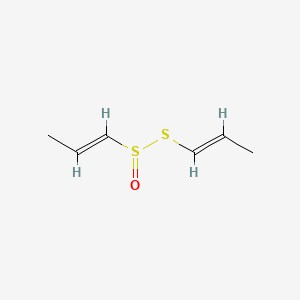 Compound
- Category
- Compound
What Thiosulfinate is, and what it does.
- Does it work
- It suits people using garlic for circulation or seasonal immune support, and cooks who want more out of a clove. Anyone who eats raw garlic daily already gets it.
- How much to take
- No amount for isolated thiosulfinate is on record. It isn't stable enough to dose directly, so garlic products are measured by allicin potential: what a serving can generate.
- Time to feel it
- The smell is immediate. Anything measurable, like blood pressure or lipid markers already in the normal range, is read on a panel after weeks of daily use.
- The first dose
- You'll notice garlic breath, and a warm stomach if you take it without food. Everything else is happening at a level you read rather than feel.
- With regular use
- Weeks of daily garlic show up in circulation and in lipid markers already in the normal range, and the sulfur metabolites keep breath faintly garlicky throughout.
- How well tolerated
- Sulfur compounds can irritate an empty stomach, and garlic has a mild blood-thinning effect. If you take an anticoagulant or have surgery coming, talk to your doctor first.
- How it feels
- Warm, pungent and faintly peppery going down. The lasting sensation is the breath, which comes from allyl methyl sulfide and brushing doesn't shift it.
- The overlooked benefit
- Crushing a clove and leaving it ten minutes before it meets heat lets the enzyme finish its work. Heating a whole clove straight away shuts that chemistry down.
The proof, claim by claim.
What these words mean
These words describe the research, not the molecule's worth. Research strength is how much work stands behind one claim, and it is never a product score.
- Blood pressure already in the normal rangeMeta-analysis
- Cholesterol already in the normal rangeMeta-analysis
2 more claims
- Antimicrobial activityIn vitro study
- Seasonal immune resilienceRandomised trial
Why these belong in the same formula, 11 pairings
Why these belong in the same formula. Each row says what the basis is, from settled biochemistry through to a trial that measured the pair.
An unbruised clove holds the substrate and the enzyme in separate compartments. Crushing, chopping or chewing brings them together and allicin appears almost immediately, then begins degrading almost as fast. This is why preparation method decides thiosulfinate content far more than clove quality does, and why a whole swallowed clove delivers almost none.
The enzyme that makes thiosulfinates cannot work without its PLP cofactor bound at the active site. That is enzyme chemistry inside the plant, not a nutritional interaction in the person taking it. Anyone reading a B6 and garlic pairing as synergistic in the body has the biology in the wrong compartment.
Allicin crosses membranes readily and reacts with glutathione to form S-allylmercaptoglutathione. That reaction is thought to be how much of its downstream signalling actually happens, and it also limits how far intact allicin can travel. Supplemental glutathione adds to the pool that quenches it.
The two come from different plant families but converge on the same cysteine-sensor mechanism. Because the target is shared, effects are not independent and the combination is unlikely to be simply additive. The pathway work is solid in cells, the human read-through is much thinner.
Ajoene, a thiosulfinate rearrangement product, is a documented platelet aggregation inhibitor in vitro. Combined with high-dose omega-3, the effects point the same direction. Anyone on anticoagulant or antiplatelet medication, or heading for surgery, should count these as one stacked load and say so to whoever is prescribing.
Neither is an anticoagulant at food-level intake. The combination is still worth flagging at supplement doses, particularly around dental work or surgery. The evidence here is case reports and in vitro platelet work, not controlled trials of the pairing.
Allicin in aqueous solution is already unstable, and a reducing agent speeds its disappearance. In a liquid formulation, co-formulating a thiosulfinate with high ascorbate shortens its shelf life. In the gut the same chemistry applies, though the practical size of the effect is unmeasured.
Selenium and sulfur are chemically similar enough that the plant's sulfur assimilation machinery incorporates selenium in its place. Selenium-enriched garlic therefore carries Se-methylselenocysteine alongside the usual sulfur compounds. This is an agronomic route, not something achieved by taking selenium and garlic together as separate capsules.
Thiosulfinates and their allyl sulfide products partition into membranes where tocopherol also sits. Class-level antioxidant interaction is plausible on that basis. There is no direct evidence for the pair, so this stays a mechanistic note.
Allicin's antibacterial activity in culture is one of its most reproducible properties, and it works through the same thiol reactivity that hits any exposed cysteine. Taken at the same time as a live culture supplement, that reactivity does not discriminate. Spacing the two apart is the sensible response, though whether it matters at achievable gut concentrations is unproven.
Aged garlic extract is characterised by stable, water-soluble S-allylcysteine and contains little to no thiosulfinate. Stacking it with an allicin-yielding product does not double anything, since the actives are different molecules with different stability. Trial results from one preparation do not transfer to the other, which is the single most common misreading in the garlic literature.
Nothing specific on file for Thiosulfinate. Match the label to the daily amount above, and tell your doctor what you take.
Not medical advice. Show the label to your pharmacist.What Thiosulfinate actually does.
Nothing happens until you break the plant open. Then an enzyme and its substrate meet and build the pungent compound in seconds.
3 more mechanisms
It starts falling apart as soon as it forms. What you actually swallow depends on how long ago the clove was crushed and what happened to it since.
Acid and heat kill the enzyme. A raw crushed clove and a roasted one are chemically different products.
It reacts with anything carrying a free sulfur handle, which is both how it works and why it does not last long inside you.
Getting Thiosulfinate from food.
The whole-food sources on file. A supplement closes the gap, it does not replace dinner.
A gram-for-gram figure (how much of each you would eat to match a dose) will appear here once it is sourced and reviewed. This page will not print a number it cannot cite.
The forms it comes in.
6 more forms
The essence, in one line each.
- Reviews garlic sulfur chemistry, describing alliin conversion to allicin by alliinase and the onward rearrangement to ajoene, vinyldithiins and allyl sulfides, with most target work at preclinical level.Narrative review. Azam et al., 2025 (Pharmaceuticals). PMID 41305007 ↗
Chosen from the 2 we read for Thiosulfinate.
FDA Disclaimer: These statements have not been evaluated by the Food and Drug Administration. This information is for educational purposes only and is not intended to diagnose, treat, cure, or prevent any disease. Consult your healthcare provider before starting any supplement regimen.