Withanolide.
Withanolides are the active steroidal molecules in ashwagandha, the ones tied to its calming and stress-related use, and the percentage on the label is counting them.
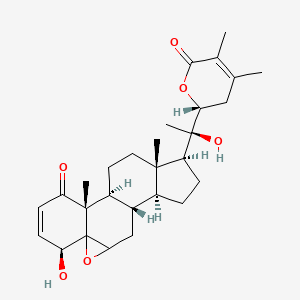 Compound
- Category
- Compound
What Withanolide is, and what it does.
- Does it work
- Worth knowing about if you buy ashwagandha and want to read the label properly. A declared percentage suits people who want a defined extract rather than plain milled root.
- How much to take
- No dose figure is on record for withanolides on their own. What you get is set by the extract's declared percentage and the serving size of that extract.
- Time to feel it
- Trials of withanolide-standardised extracts typically run for eight weeks, so plan on weeks of daily use rather than days.
- The first dose
- Day one is usually quiet. A few people notice a mild settling in the evening, but what these extracts are studied for builds over weeks.
- With regular use
- Weeks of daily use is where the stress and sleep research on these extracts sits, tracked with questionnaires and morning cortisol rather than by feel.
- How well tolerated
- Usually well tolerated at extract doses. Some people get stomach upset or drowsiness. Check with your doctor first if you're pregnant, breastfeeding, or taking thyroid or sedative medication.
- How it feels
- Most people describe the edge coming off rather than sedation. Others feel nothing in particular and see the difference in how they sleep.
- The overlooked benefit
- Root-only and leaf-containing extracts can declare the same total percentage and still hold different molecules, so the number alone doesn't tell you what is inside.
The proof, claim by claim.
What these words mean
These words describe the research, not the molecule's worth. Research strength is how much work stands behind one claim, and it is never a product score.
- Response to everyday stressMeta-analysis
- Sleep quality in adults with poor sleepMeta-analysis
4 more claims
- Strength and training adaptationRandomised trial
- Testosterone already in the normal range in menRandomised trial
- Antioxidant activity of isolated withanolidesIn vitro study
- Withanolide profile differences between root and leaf materialNarrative review
Why these belong in the same formula, 11 pairings
Why these belong in the same formula. Each row says what the basis is, from settled biochemistry through to a trial that measured the pair.
Withanolides are the steroidal lactones used to standardise ashwagandha root and leaf extracts, and every clinical trial in this space dosed a standardised extract rather than an isolated withanolide. That means the human data belongs to the extract, with the withanolide percentage acting as an identity and consistency check. Anyone taking ashwagandha is already taking withanolides, so stacking an isolate on top doubles the intake invisibly.
Withanolides are lipophilic steroidal lactones with poor aqueous solubility, which is the constraint every delivery format in this category works around. Phospholipid dispersions and self-emulsifying systems are the standard approach and the reason newer formulations report different exposure profiles. Improved dispersion is a delivery result and is not itself an outcome.
A medium-chain triglyceride carrier keeps withanolides in solution in a softgel and supports micellar dispersion after a meal. It is the simplest answer to the solubility problem in this class. It changes how much dissolves, nothing more.
Magnesium and standardised ashwagandha extract sit together in most evening formulas because both are positioned around sleep quality and calm. Each has its own separate literature and the combination has not been tested against its parts. The pairing is formulation practice.
L-theanine appears alongside withanolide-standardised extracts in stress and focus blends. Their proposed mechanisms are different, so the pairing is about product positioning rather than a shared pathway. Nothing has shown the combination outperforms either alone.
Withanolide-standardised root extracts are used at night for sleep quality, and melatonin shifts sleep timing directly. Stacking both can produce more next-morning grogginess than either alone, particularly at higher melatonin doses. This is a practical caution rather than a documented interaction.
Valerian and withanolide-containing extracts both push in a sedating direction in evening formulas. Combining them raises the chance of daytime drowsiness, which matters for driving and for anyone already on a sedating medicine. No trial has measured the pair together.
Human work with standardised root extract has reported changes in circulating thyroid hormone concentrations, and iodine is the substrate for thyroid hormone synthesis. Anyone stacking both, or taking a thyroid medicine, should have that conversation with their prescriber rather than adjusting on their own. These are marker changes, not clinical outcomes, and the direction is not uniform across studies.
Rhodiola and withanolide-standardised extracts are the two most stacked ingredients in the adaptogen category. Their constituent chemistry is unrelated, so any combined effect would have to be demonstrated rather than assumed. Read it as category convention.
Panax ginseng and Withania somnifera are paired across traditional systems and modern blends aimed at energy and stress resilience. Both carry their own separate human literature. The combination has not been tested as a unit.
Piperine is added to poorly absorbed botanical extracts on the rationale that it slows glucuronidation and raises exposure. The evidence for that with withanolides specifically is thin compared with the curcumin literature. The inhibition is not selective, so it can affect medicines taken at the same time.
Nothing specific on file for Withanolide. Match the label to the daily amount above, and tell your doctor what you take.
Not medical advice. Show the label to your pharmacist.What Withanolide actually does.
Withanolides are a family of steroid-shaped plant compounds with a specific ring structure, the kind of chemistry detail that shows up on a lab analysis rather than a label.
3 more mechanisms
There are hundreds of withanolides, but a handful, including withanolide A and withaferin A, are the ones typically measured when a batch gets tested.
Withaferin A is chemically more reactive than most other withanolides because of a specific reactive group, which is why root-only extracts, lower in it, get labeled separately from extracts that include leaf.
Withanolides don't dissolve well in water, so how much your body can take up depends a lot on getting them to dissolve, which is why some formulas use oil-based or self-emulsifying delivery.
Where Withanolide comes from.
Withanolides are the steroid-like molecules that make ashwagandha ashwagandha. They are what the label percentage refers to, and they are the reason a root-only extract and a leaf-containing one are not the same product even at the same number.
What this route gives you
Made from a plant. What ends up in the capsule tracks the harvest, so batch testing and a stated marker matter more here than with a made molecule.
6 steps on record
Cultivated mainly in India, with root-only sourcing specified separately because leaf raises withaferin A content
The plant biosynthesis route, upregulated by stress signalling molecules including salicylic acid and jasmonates
Water-based extraction yields a different withanolide glycoside profile from an alcohol extraction of the same material
Maltodextrin or a similar carrier is common and dilutes the assayed percentage accordingly
Which of the two is reported changes the headline number by several-fold, and gravimetric methods inflate it further
Withanolides are also present in Withania coagulans and in Physalis species, though commercial supply is almost entirely from W. somnifera
The forms it comes in.
3 more forms
The essence, in one line each.
- Pooled randomised trials of Withania somnifera extract reported changes in several circulating hormone concentrations relative to placebo, with the authors noting variation in extract type and dose across the included studies.Meta-analysis. Fornalik et al., 2026 (Planta Medica). PMID 41740946 ↗
3 more findings
- A single-dose crossover comparison found higher plasma withanolide exposure from a 1.5 percent formulation than from the comparator preparation.Randomised trial. Ramapalaniappan et al., 2025 (Advances in Therapy). PMID 40748423 ↗
- A low-dose standardised extract was associated with improved exercise endurance measures compared with placebo over the study period.Randomised trial. Prajapati et al., 2026 (Phytotherapy Research). PMID 41846233 ↗
- In adults with mild to moderate stress, a standardised ashwagandha formulation was associated with lower self-reported stress scores and better self-reported sleep quality than a placebo over an 84-day trial.Randomised trial. Mahadevan et al., 2025 (Advances in Therapy). PMID 40875185 ↗
Chosen from the 5 we read for Withanolide.
FDA Disclaimer: These statements have not been evaluated by the Food and Drug Administration. This information is for educational purposes only and is not intended to diagnose, treat, cure, or prevent any disease. Consult your healthcare provider before starting any supplement regimen.