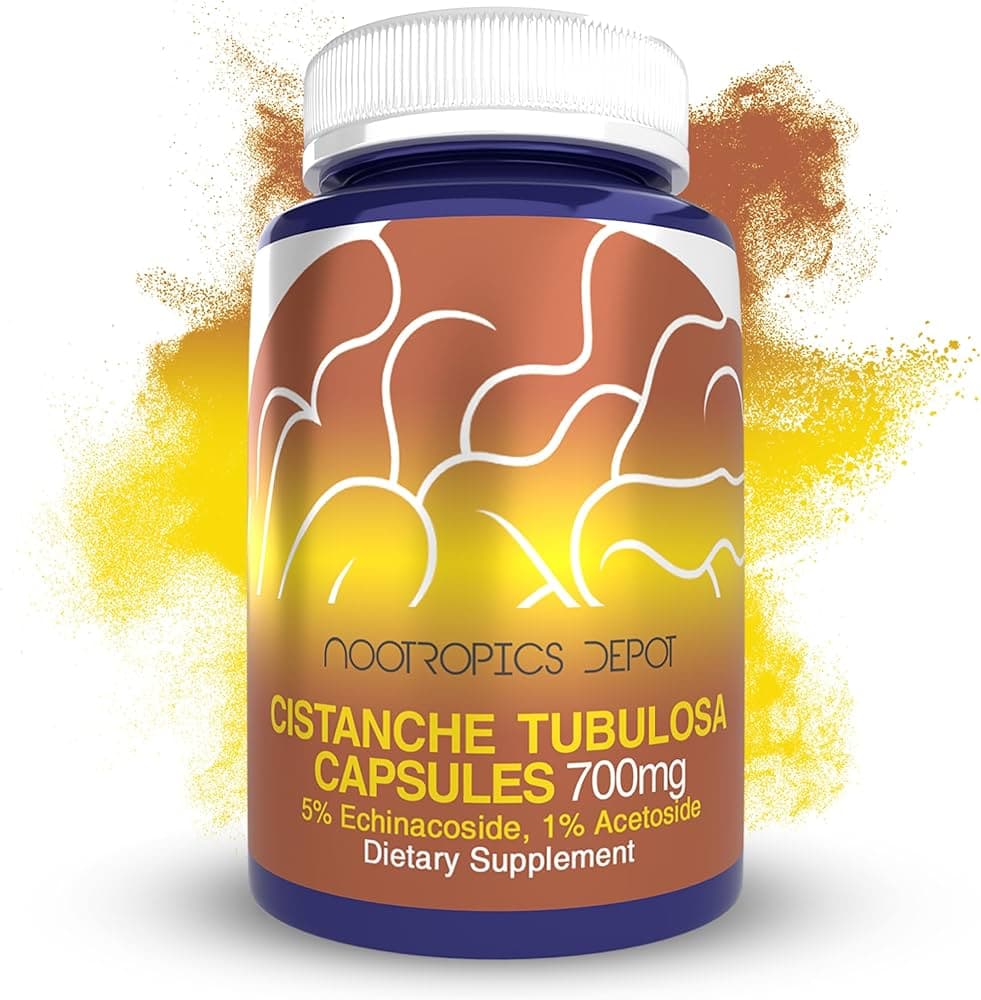
Cistanche.
May offer a mild boost to energy and libido. Modern research is looking at its antioxidant and neuroprotective effects.
Reviewed March 2026
- Category
- Herb
- Also filed under
- Energy BoostLibido EnhancementAntioxidant Support
What Cistanche is, and what it does.
- Does it work
- Suits people who already have sleep, protein and training covered and want a traditional tonic herb with early modern research behind it. Most of that research is still small or preclinical.
- How much to take
- 200-400mg of a standardized extract daily. Look for one that specifies the percentage of active compounds like phenylethanoid glycosides.
- Time to feel it
- Two to four weeks of daily use before anything is describable. Nothing about it behaves like a stimulant on day one.
- The first dose
- Nothing. It needs time to build up in your system. Anyone claiming immediate effects is feeling a placebo.
- With regular use
- After 2-3 weeks of consistent use, some people report feeling more resilient to stress, having more sustained energy, and a modest lift in libido.
- How well tolerated
- Generally well-tolerated. The main caution is for those with hormone-sensitive health issues. As always, if you're on medication, check with your doctor.
- How it feels
- Steady rather than sharp. People describe energy that holds through a day and a mild lift in drive, showing up across weeks rather than after a capsule.
- The overlooked benefit
- The headline glycosides barely get absorbed intact. Your gut bacteria cut the sugars off first, so what actually reaches your blood depends on the microbiome you're carrying.
200 to 300mg a day is where Cistanche works.
Source: Molecules. 2016;21(11):1536. Cistanche species pharmacological review.
The proof, claim by claim.
These words describe the research, not the molecule's worth. Research strength is how much work stands behind one claim, and it is never a product score.
Research suggests potential benefits, but studies are often small or have limitations. More robust trials are needed to confirm the initial findings.
- everyday energy and fatigue resistanceRandomised trial
- libido and sexual function supportAnimal study
- memory and cognitive function in older adultsRandomised trial
- antioxidant activity in laboratory assaysIn vitro study
- fermentation of the polysaccharide fraction by gut bacteriaIn vitro study
Questions people ask about Cistanche.
- Can I take Cistanche every day?
- Yes, but cycling is a good idea. Consider taking it for 8-12 weeks, then a 2-4 week break to maintain sensitivity.
- Is this like Viagra?
- Not even close. Viagra is a powerful, fast-acting drug for blood flow. Cistanche is a slow-acting herb for general vitality and libido.
- Will it boost my testosterone?
- It might have a mild, indirect influence on hormone balance, but the evidence for it being a potent T-booster is weak. Don't count on it.
- What's the best time of day to take it?
- Doesn't really matter. Morning or afternoon is fine. Just take it consistently.
- Does it contain caffeine?
- Nope. The energy support it offers is non-stimulatory.
- What does it taste like?
- The powder is notoriously strong and unpleasant—a mix of bitter and slightly sweet. Stick to capsules.
Why these belong in the same formula. Each row says what the basis is, from settled biochemistry through to a trial that measured the pair.
Echinacoside and acteoside are large glycosides with poor intestinal permeability, and the colonic microbiota cleave the sugar units to release smaller phenolics such as caffeic acid and hydroxytyrosol. Circulating exposure therefore depends on which bacteria a person carries. Individual response to a fixed dose varies for that reason.
Deglycosylation of plant glycosides is carried out by colonic bacteria whose abundance shifts with fermentable fibre intake. A prebiotic fibre supports the population doing that conversion. The connection is mechanistic and has not been tested for this pairing.
Both appear in the same category of tonic preparations and both depend on gut bacteria to deglycosylate their principal constituents before absorption. Ginsenosides and phenylethanoid glycosides follow parallel routes. The combination rests on traditional use and shared pharmacokinetics rather than a trial.
Rhodiola's salidroside is a phenylethanoid glycoside of the same chemical family as cistanche's acteoside, and both hydrolyse to tyrosol-type aglycones. Products aimed at stamina pair them for that overlap. The additive claim is chemical reasoning, not measured.
Cistanche appears alongside ashwagandha in blends built around stamina and stress response. Their constituent classes are unrelated, so the rationale is category convention rather than mechanism. Read it as a formulation pattern.
Both are used in products framed around male vitality and hormonal axis support, and both have small human literatures. No study has tested them together. The pairing is how the category builds products.
Zinc is required by several enzymes in the steroid hormone pathway and is concentrated in reproductive tissue. Formulas positioned around the male hormonal axis carry it for that reason. The mineral role is settled. The combination with cistanche is not studied.
Nitric oxide production depends on arginine supply, and vascular tone in erectile and skeletal muscle tissue runs through that pathway. Cistanche is used in the same product category. Arginine's role is substrate biochemistry, independent of any cistanche effect.
Oral citrulline escapes the first-pass arginase that degrades much of an arginine dose and is converted to arginine renally, which raises plasma arginine more efficiently per gram. It sits upstream of nitric oxide synthesis. This is pharmacokinetics, not a cistanche interaction.
Cistanche and cordyceps appear together in traditional and modern stamina preparations. Their chemistry is unrelated, so the pairing is use convention. There is no combination study.
Both carry immunologically active polysaccharide fractions and both are classic tonic herbs in the same tradition. Polysaccharides from either are fermented in the colon rather than absorbed intact. The pairing is traditional with a plausible shared route.
Schisandra lignans and cistanche glycosides come from separate chemical families but the two herbs are combined in the same tonic tradition. The rationale is documented use, not a measured interaction. Read it as traditional pairing.
Eleutherosides and phenylethanoid glycosides both require microbial deglycosylation and both herbs sit in the adaptogen category. Products combine them on that basis. No trial has tested the combination.
Ascorbate reduces phenoxyl radicals back to the parent phenol in vitro, which is the basis of the classic antioxidant network. Cistanche's phenylethanoid glycosides are polyphenols that participate in that chemistry. This has been demonstrated in solution and is not a clinical outcome.
The phenolic aglycones released from cistanche glycosides are rapidly conjugated in the gut wall and liver, which limits how much circulates unchanged. Piperine slows those conjugation enzymes. The same inhibition applies to unrelated compounds a person may be taking, which is worth knowing before adding it.
Taurine is abundant in skeletal muscle and participates in osmoregulation and calcium handling there. It appears with cistanche in stamina-oriented products. The pairing is convention rather than a studied interaction.
Carnitine is required for beta-oxidation of long chain fatty acids, and preclinical work on cistanche has centred on mitochondrial and lipid handling endpoints. The two touch energy metabolism from different points. Cistanche's side of that link is animal data only.
Talk to a doctor before taking Cistanche if any of these apply to you: Pregnancy, Breastfeeding, Hormone-sensitive conditions. These are flags to check first, not effects Cistanche is known to cause.
Not medical advice. Show the label to your pharmacist.What Cistanche actually does.
The main actives in cistanche are phenylethanoid glycosides, chiefly echinacoside and acteoside. Each is a phenolic core with glucose and rhamnose sugars hung off it, and that is what standardised extracts measure.
Once those smaller phenolics are in, your gut wall and liver tag them heavily with glucuronide and sulfate groups. So most of what circulates is the tagged version rather than the free compound.
Cistanche also carries a sizeable polysaccharide fraction. That part is not absorbed at all. It heads to the colon and gets fermented by your gut bacteria instead.
Phenylethanoid glycosides are redox-active in laboratory antioxidant assays. That describes chemistry measured in a tube, and it does not describe an effect inside a person.
The forms it comes in.
The essence, in one line each.
- In a network meta-analysis pooling 27 randomised trials and 2,334 healthy adults across 19 extracts, a cistanche plus ginkgo combination ranked highest for memory, executive function and cognitive flexibility, while no extract beat placebo on attention.Systematic review. Wang et al., 2025 (Frontiers in Pharmacology). PMID 40213691 ↗
- In 100 middle-aged and older adults, 90 days of a cistanche plus ginkgo tablet raised Montreal Cognitive Assessment scores from 23.4 to 25.3 and improved delayed and long-term memory tests more than placebo.Randomised trial. Chen et al., 2024 (Phytotherapy Research). PMID 38972848 ↗
- In 48 men doing eight weeks of resistance training, 5 g of cistanche extract twice daily produced larger gains in bench press and squat one-repetition maximum than placebo among the previously untrained participants, alongside lower serum cortisol in both training backgrounds.Randomised trial. Tao et al., 2025 (Nutrients). PMID 41010491 ↗
- In 26 adults with early declines in walking ability, 12 weeks of cistanche extract increased step width and 5 metre walking speed in those over 60 compared with placebo (p = 0.046), while skeletal muscle mass did not change.Randomised trial. Inada et al., 2021 (Nutrients). PMID 33477648 ↗
- A Cistanche tubulosa and Ginkgo biloba combination improved memory test performance in participants, alongside changes in cortical activity measures. The trial cannot separate the two components.Randomised trial. Gao et al., 2026 (Frontiers in Pharmacology). PMID 41847135 ↗
- Total glycosides of Cistanche deserticola were associated with improved sperm parameters and with shifts in gut microbial composition in an alcohol-exposure model.Animal study. Yuan et al., 2026 (Phytomedicine). PMID 42372605 ↗
- A fatty acid fraction from Cistanche phelypaea showed neurotrophic activity markers in a non-human evaluation of the extract.Animal study. Aboubaker et al., 2025 (Scientific Reports). PMID 41326444 ↗
- Polysaccharides from Cistanche deserticola were associated with differences in hepatic lipid handling markers in an alcohol-fed animal model.Animal study. Wang et al., 2025 (International Immunopharmacology). PMID 40288152 ↗
- A systematic review and network meta-analysis of dietary supplements and hair density measures that names cistanche among the ingredients included.Systematic review. Zhou et al., 2025 (Frontiers in Nutrition). PMID 41561175 ↗
- A systematic review of non-clinical work on plant-derived food grade substances with reported antiviral activity, listing cistanche among the named species.Systematic review. Umeoguaju et al., 2021 (Frontiers in Nutrition). PMID 33634160 ↗
These are the studies our verdict leans on, chosen from the 680 we read for Cistanche. The full linked list is below.
The studies, linked.
4 sources behind our Cistanche verdict: peer-reviewed studies and registered clinical trials. Every one links straight to PubMed, the journal, or ClinicalTrials.gov. Read them yourself.
- Clinical trialA 60-Day Clinical Study to Evaluate Nutrilite Ginko Biloba Cistanche Tablets in Relieving the Symptoms of Chronic Fatigue Syndromes Compared to Negative ControlClinicalTrials.gov ↗159 participants, Completed
- Clinical trialCistanche Deserticola Extract Combined With Aerobic Exercise Improves Body Composition, Insulin Resistance and Inflammation in Men With Central Obesity: a Randomized Controlled TrialClinicalTrials.gov ↗125 participants, Completed
- Clinical trialEffects of Cistanche Supplementation on Anaerobic Exercise Performance and Recovery in Men With Different Athletic Training Levels: A Double-Blind, Randomized, Placebo-Controlled TrialClinicalTrials.gov ↗56 participants, Completed
- Clinical trialCistanche Total Glycosides Treatment for Amyotrophic Lateral Sclerosis: A Randomized Control Trial Study Assessing Clinical ResponseClinicalTrials.gov ↗Phase 2, 40 participants, Unknown
Evidence surfaced via Semantic Scholar (Allen Institute for AI) and ClinicalTrials.gov. Ranked by study type and citation weight, not cherry-picked.
Problems people have reported.
Read this carefully. These are 33 voluntary, unverified reactions reported to the FDA (openFDA). The number mostly reflects how popular Cistanche is, not how risky it is. A report is not proof Cistanche caused anything. It is a signal of what to watch for, nothing more.
Source: openFDA adverse-event reports. Voluntary reporting, not an incidence rate.
FDA Disclaimer: These statements have not been evaluated by the Food and Drug Administration. This information is for educational purposes only and is not intended to diagnose, treat, cure, or prevent any disease. Consult your healthcare provider before starting any supplement regimen.