Galangin.
A flavonol from lesser galangal and poplar propolis. It scavenges free radicals and binds loose iron and copper, which is the chemistry it is studied for.
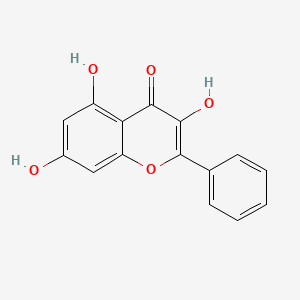 Compound
- Category
- Compound
What Galangin is, and what it does.
- Does it work
- Suits people already taking propolis or a flavonoid blend who want this compound named on the label. Trials in people on isolated galangin have not been run.
- How much to take
- No human dose figure is on record. Start with what your product states, and take it with a meal containing fat, since galangin dissolves poorly in water.
- Time to feel it
- Nobody has measured a timeline in people. Unconjugated galangin in blood is low and short lived, so its work is a slow, laboratory-measured one.
- The first dose
- Day one passes without sensation. What happens is absorption and rapid conjugation in the intestinal wall and liver.
- With regular use
- Weeks of daily use in people have not been measured. The long-running work sits in cell and animal models of antioxidant and enzyme activity.
- How well tolerated
- Human safety data is thin. Galangin inhibits CYP1A enzymes in the lab, so if you take prescription medication, check with a pharmacist or doctor first.
- How it feels
- There is nothing subjective to report. Its activity registers in laboratory measures of oxidative chemistry rather than in how a day feels.
- The overlooked benefit
- It has no catechol on the B ring, which makes it more fat soluble than quercetin and gives it different formulation behaviour.
The proof, claim by claim.
What these words mean
These words describe the research, not the molecule's worth. Research strength is how much work stands behind one claim, and it is never a product score.
- Radical scavenging and antioxidant activityIn vitro study
- Chelation of transition metals such as iron and copperIn vitro study
3 more claims
- Inhibition of cytochrome P450 1A enzymesIn vitro study
- Antioxidant and enzyme activity in animal modelsAnimal study
- Marker compound for poplar-type propolis qualityNarrative review
Why these belong in the same formula, 15 pairings
Why these belong in the same formula. Each row says what the basis is, from settled biochemistry through to a trial that measured the pair.
Propolis composition varies by the botanical source the bees collected from, and galangin content is one of the markers used to identify poplar-type material. Most galangin exposure in supplement use comes through propolis rather than as an isolated compound. That means the dose delivered by a propolis product depends on its geographic origin.
Galangin and quercetin are both flavonols and are both handled by intestinal UDP-glucuronosyltransferases and sulfotransferases, then pumped out by the same efflux transporters. Given together at meaningful doses they compete for that conjugation capacity, which can raise the unconjugated fraction of either. The direction is predictable. The size in a human is not established.
The two differ only in whether the B ring carries a hydroxyl at the 4' position. That structural closeness means near-identical routes through phase 2 conjugation, so they draw on the same enzyme pool. It also means analytical methods must be specific enough to tell them apart in an extract.
When a flavonol donates an electron it becomes a phenoxyl radical. Ascorbate can reduce that radical back to the parent compound, extending the flavonoid's useful lifespan. This recycling is well described for the flavonoid class. It is a chemistry-level relationship and does not by itself say anything about an outcome.
Tocopherol works within the lipid membrane while flavonols act mainly at the membrane surface and in aqueous phase. Flavonoids can reduce the tocopheroxyl radical, returning tocopherol to its active form. This division of labour is standard antioxidant network biochemistry.
Flavonols including galangin have been shown in cell systems to activate Nrf2 signalling, which upregulates the enzymes of glutathione synthesis. That is a cell-culture finding rather than a measured human effect. Reactive flavonoid metabolites also consume glutathione directly, so the net direction depends on concentration.
Galangin is extensively glucuronidated in the gut wall and liver, which is why its unconjugated blood concentrations stay low. Piperine inhibits UGT activity, and that inhibition raises exposure to several polyphenols. It has not been tested with galangin specifically, and the same inhibition applies indiscriminately to medications cleared the same way.
Galangin as the aglycone dissolves poorly in water, which limits how much reaches the absorptive surface. Phospholipid dispersion increases the wetted surface area of the crystalline material. This is standard formulation practice for flavonol aglycones rather than a galangin-specific finding.
Dietary lipid triggers bile release and micelle formation, which helps carry lipophilic aglycones across the gut wall. Taking a poorly soluble flavonol with fat rather than on an empty stomach is the practical version of this. The gain has been measured for other flavonoids, not for galangin.
Galangin has the 3-hydroxy-4-keto arrangement that binds transition metals. That chelation is part of why flavonols reduce iron-driven radical chemistry, and it is also why polyphenols taken alongside an iron supplement reduce iron absorption. The same chemistry produces both effects, so which one matters depends on timing.
Flavonol metal binding is not fully selective, and zinc among other divalent cations can be complexed. The consequence in the gut is a reduction in free mineral available for uptake. Separating polyphenol-rich supplements from mineral doses by a couple of hours removes the issue.
Catechins and flavonols are both heavily conjugated at the intestinal wall. Loading both at once saturates the shared capacity, which can raise unconjugated exposure to either. It is a pharmacokinetic interaction, not evidence that the pair does more.
Botanical mixtures combining Boswellia serrata, myrrh, propolis and Scutellaria have been studied as single products, with galangin present as a propolis constituent. Any effect of such a mixture belongs to the mixture, not to galangin. The row is a formulation observation rather than a mechanistic pairing.
Apigenin is a flavone and galangin a flavonol, but both are lipophilic aglycones subject to extensive intestinal glucuronidation and sulfation. They draw on the same enzyme pool and the same efflux transporters. Combining them changes the pharmacokinetics of each without necessarily changing what they do.
Curcumin and galangin are both cleared rapidly by glucuronidation and sulfation, which is the main reason plasma levels of either stay low. Given together they compete for the same conjugating capacity. That can raise measured exposure while telling you nothing about whether the effect changes.
Nothing specific on file for Galangin. Match the label to the daily amount above, and tell your doctor what you take.
Not medical advice. Show the label to your pharmacist.What Galangin actually does.
Galangin is a flavonol that lacks a certain hydroxyl arrangement other flavonols have, which makes it more fat-soluble than quercetin or kaempferol.
3 more mechanisms
Because it's missing that arrangement, galangin's radical-scavenging ability relies on a different part of its structure rather than the feature that dominates in quercetin.
A specific site on the molecule forms a spot that can grab onto metals like iron and copper.
Galangin occurs naturally in the lesser galangal rhizome, which gave it its name, and in a particular type of propolis.
Where Galangin comes from.
A plant compound named after galangal, the ginger-family root it was first found in. It also turns up in bee propolis, which is how most people encounter it. It does not dissolve well in water and your gut processes it fast, so getting much of it into the bloodstream is the hard part.
What this route gives you
The same molecule is reached more than one way. Which route a given product used is a manufacturing choice, and the finished compound is the same either way.
5 steps on record
The rhizome of lesser galangal is the botanical namesake source. Poplar-type propolis, collected by bees from poplar bud exudate, is the other main natural source. Synthetic routes from flavone intermediates also exist.
Milled rhizome or raw propolis is extracted with aqueous ethanol, which pulls the flavonoid fraction along with resins and waxes.
For propolis, cold filtration removes the wax fraction. Column or preparative chromatography then separates galangin from the structurally close flavonols pinocembrin, chrysin and kaempferol.
Purity or content is confirmed by HPLC. Method specificity matters here, because kaempferol differs by a single hydroxyl and co-elutes on inadequate methods.
Supplied as a purified powder, as a standardised propolis or rhizome extract, or complexed with phospholipid for dispersion.
Getting Galangin from food.
The whole-food sources on file. A supplement closes the gap, it does not replace dinner.
A gram-for-gram figure (how much of each you would eat to match a dose) will appear here once it is sourced and reviewed. This page will not print a number it cannot cite.
The forms it comes in.
4 more forms
The essence, in one line each.
- Galangin was investigated against a DPP4-driven ferroptosis and senescence pathway in a model of age-related bone loss.Animal study. Zhou H et al., 2026 (Drug Development Research). PMID 42041149 ↗
4 more findings
- Galangin reduced markers of cold-stress-induced splenic injury with NLRP3 inflammasome signalling identified as the pathway involved.Animal study. Tian X et al., 2026 (Poultry Science). PMID 42184625 ↗
- Galangin 3-methyl ether acted on HDAC2 in a mouse model of cardiac hypertrophy, identifying a molecular target for the methylated derivative.Animal study. Zhang K et al., 2026 (Acta Pharmacologica Sinica). PMID 41176539 ↗
- Review of propolis and its constituent compounds, galangin among them, against Candida biofilm formation in laboratory systems.In vitro study. Rivera-Yanez N et al., 2026 (Journal of Fungi). PMID 42187783 ↗
- A botanical mixture containing propolis alongside Boswellia, myrrh and Scutellaria altered inflammatory marker expression.Animal study. Ha D et al., 2026 (Veterinary Medicine and Science). PMID 42057627 ↗
Chosen from the 5 we read for Galangin.
FDA Disclaimer: These statements have not been evaluated by the Food and Drug Administration. This information is for educational purposes only and is not intended to diagnose, treat, cure, or prevent any disease. Consult your healthcare provider before starting any supplement regimen.