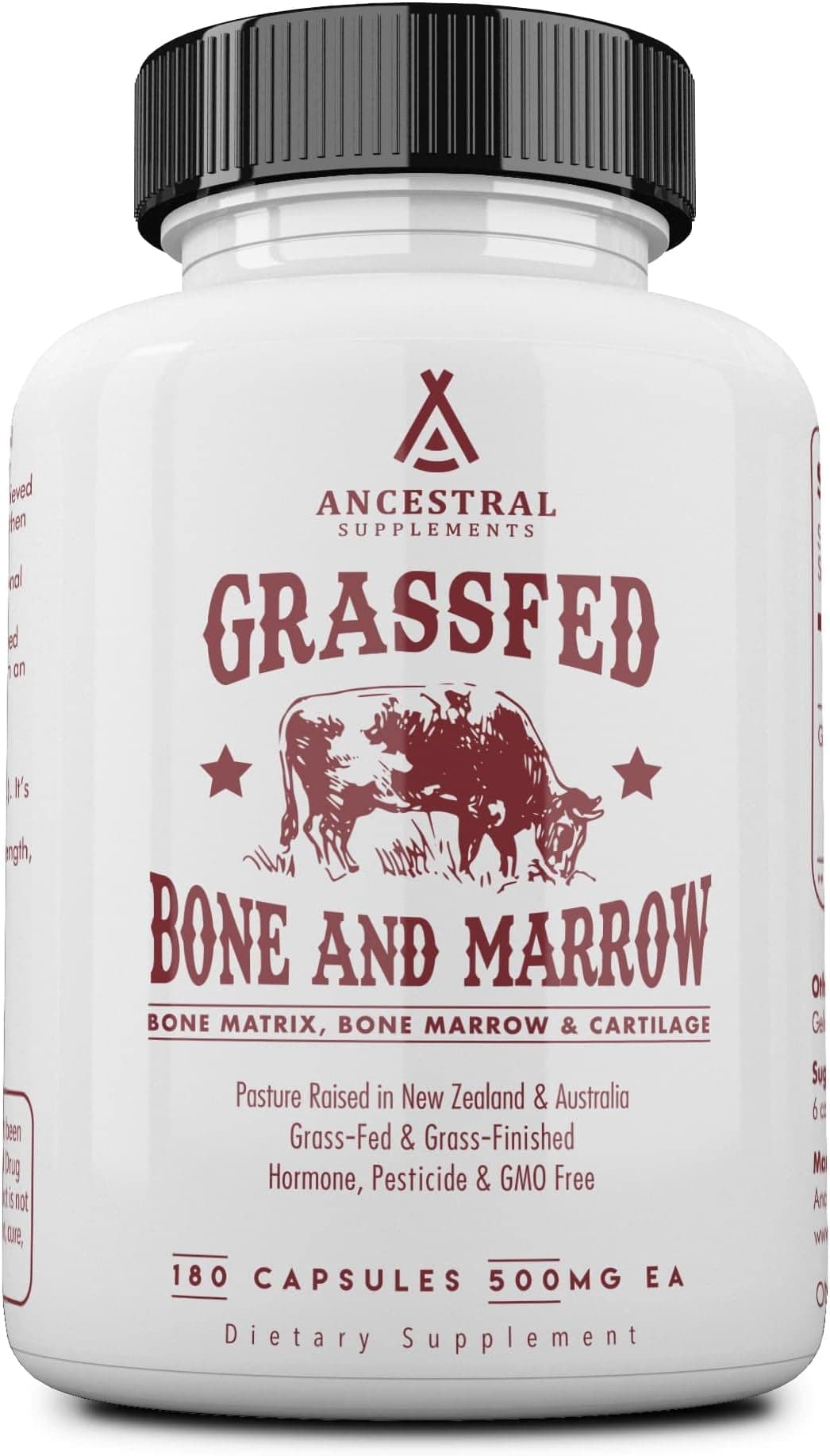
Grassfed Whole Bone Extract (Bovine).
Whole bone extract providing calcium, collagen, and other bone matrix nutrients in their natural form. Provides calcium, collagen, and bone matrix nutrients in their natural form for bone density support
Reviewed March 2026
- Category
- General
- Also filed under
- Natural calcium source with cofactorsContains type I collagenWhole bone matrix (not isolated calcium)
What Grassfed Whole Bone Extract (Bovine) is, and what it does.
- Does it work
- It suits people who want calcium with its phosphorus and collagen matrix intact rather than as a single salt, and people already taking vitamin D and K alongside it.
- How much to take
- Start with 3g to 6g a day, which supplies roughly 750mg to 1,000mg of calcium depending on the product. Split it across two servings, since uptake per sitting is limited.
- Time to feel it
- Bone changes take six to twelve months to show on a scan. Where people notice joint and connective tissue comfort, it tends to arrive around weeks six to eight.
- The first dose
- Zero noticeable effect. Calcium works on a timeline measured in months, not hours.
- With regular use
- Bone density changes take 6-12 months to appear on a DEXA scan. Collagen benefits for joints might appear sooner (6-8 weeks).
- How well tolerated
- Well tolerated with food. Bone stores metals across an animal's life, so batch lead testing matters, and count the calcium from every supplement toward your daily total.
- How it feels
- There is no sensation to this one. The payoff reads on a bone density scan and in how your frame holds up over decades, not in how today goes.
- The overlooked benefit
- Low temperature processing keeps the type I collagen that makes up about a third of bone by weight. An ashed mineral carries the mineral phase alone, and the label tells you which.
3 to 6g a day is where Grassfed Whole Bone Extract (Bovine) works.
Source: Microcrystalline hydroxyapatite (MCHA) studies
The proof, claim by claim.
These words describe the research, not the molecule's worth. Research strength is how much work stands behind one claim, and it is never a product score.
- MCHA is better absorbed than calcium carbonate
- Whole bone matrix preserves natural nutrient ratios
- Prevents bone loss better than standard calcium
Questions people ask about Grassfed Whole Bone Extract (Bovine).
- What about lead contamination?
- Real concern. Lead accumulates in bone tissue throughout an animal's life. Some bone meal products have tested positive for lead. Only buy from brands that publish third-party lead test results. The FDA hasn't set specific limits for lead in bone meal supplements, so the industry self-regulates.
- Do I still need vitamin D with this?
- Absolutely. Calcium without vitamin D is a waste of money. Your body can't absorb calcium properly without adequate vitamin D, regardless of the calcium source. Take 1,000-2,000 IU of vitamin D3 daily alongside any calcium supplement.
- Is bone broth the same thing?
- No. Bone broth contains surprisingly little calcium (10-40mg per cup). It's mostly collagen, amino acids, and gelatin. Good for other reasons, but terrible as a calcium source. Don't confuse bone broth benefits with bone extract benefits.
- How much calcium do I actually need?
- Most adults need 1,000-1,200mg of calcium daily from ALL sources (food + supplements). If you eat dairy, you're probably getting 500-800mg from food already. Supplement only the gap. More is not better: exceeding 1,500mg/day from supplements may increase cardiovascular risk.
- Should I take K2 with this?
- Strong yes. Vitamin K2 (especially MK-7) directs calcium into bones and teeth rather than arteries. Taking calcium without K2 is like hiring movers without telling them where the furniture goes. Aim for 100-200mcg of MK-7 daily alongside your calcium.
Why these belong in the same formula. Each row says what the basis is, from settled biochemistry through to a trial that measured the pair.
Whole bone extract is essentially microcrystalline hydroxyapatite with its collagen matrix intact. Adding a separate hydroxyapatite raises the same mineral in the same crystalline form.
Active vitamin D drives expression of the intestinal calcium binding protein and the transport channel that move calcium across the gut wall. Without adequate vitamin D a calcium dose is far less well taken up.
Vitamin K is the cofactor for the carboxylase that activates osteocalcin and matrix Gla protein, the proteins that bind calcium into bone matrix. It directs where absorbed calcium is deposited.
Magnesium is required for both hydroxylation steps that activate vitamin D and it sits in the bone mineral surface itself. Very large single calcium doses also compete with magnesium for shared paracellular uptake, so splitting them helps.
Ascorbate is the cofactor for prolyl and lysyl hydroxylase, the enzymes that build the collagen scaffold bone mineral is laid onto. The extract supplies the mineral, vitamin C supports the new matrix.
Bone is roughly a third collagen by weight, so peptide collagen supplies amino acids for the organic phase while the extract supplies the mineral phase.
Boron influences how calcium, magnesium and vitamin D are retained and handled by bone tissue. It is a long-standing minor partner in bone formulations.
Silicon takes part in early collagen crosslinking and mineralisation at the bone forming surface, supporting the matrix that the mineral attaches to.
Manganese is the cofactor for the glycosyltransferases that assemble the proteoglycans of bone and cartilage matrix. Calcium in large doses also lowers manganese uptake, so the two are worth separating.
A large calcium dose in the same meal reduces zinc uptake at the intestinal surface, and zinc is itself used by bone forming cells. Dosing them at different times keeps both intakes intact.
Calcium interferes with both heme and non-heme iron uptake when the two share a meal. This is one of the clearest mineral to mineral competitions and is handled by separating the doses.
Strontium and calcium are chemically alike and compete for the same intestinal transport and the same site in the bone crystal. They should be dosed hours apart rather than in one serving.
Hydroxyapatite already carries phosphate in a roughly two to one calcium to phosphorus ratio, so whole bone extract supplies both minerals together. Extra phosphorus adds to a load that is already balanced.
Bulk soluble fibre taken in the same serving traps mineral cations in its gel and carries some of the calcium past the absorptive window. Taking the mineral away from the fibre dose avoids the loss.
Inulin is fermented by colonic bacteria to short-chain fatty acids, which lower luminal pH and keep calcium in a soluble ionised form further along the gut than it otherwise would be. That gives a second window for calcium uptake beyond the small intestine. The effect has been measured in humans as a change in fractional calcium absorption, which is a marker of uptake rather than a bone outcome.
Short-chain fructooligosaccharides ferment faster and more proximally than long-chain inulin, acidifying the caecal contents and holding calcium in solution there. Formulas often combine chain lengths so that fermentation is spread across the colon rather than finished early. As with inulin, what is measured is absorption, not bone.
Galactooligosaccharides are fermented to short-chain fatty acids in the same way as the fructans and have been studied for their effect on calcium absorption. The mechanism is shared, the specific data are thinner than for inulin. Pair the claim to what was measured.
Butyrate is one of the short-chain fatty acids that fibre fermentation generates and that lowers colonic pH. Supplying butyrate directly does not reproduce the whole picture, because the pH drop from fermentation happens across the lumen rather than from an absorbed salt. It is listed as the same pathway approached from the other end, with the caveat attached.
Lysine residues in collagen are hydroxylated and then oxidised by lysyl oxidase to form the covalent crosslinks that give bone matrix its tensile strength. A whole bone extract supplies the mineral and an intact collagen matrix, so lysine sits on the protein side of the same tissue. Small human studies have also reported changes in calcium retention with lysine, which is a marker and a thin literature.
Lysyl oxidase is a copper-dependent enzyme, and without copper the crosslinks that hold collagen fibrils together cannot form. Since a whole bone extract is a mineral plus a collagen matrix, copper sits directly on the matrix side of it. High long-term zinc intake competes with copper uptake, which is worth watching in a mineral-heavy stack.
Non-heme iron and calcium compete for shared handling in the enterocyte, and a large calcium load taken with iron lowers iron uptake from that meal. Separating the two by a few hours is the ordinary way round it. This is a textbook absorption competition rather than a reason to avoid either.
Sodium and calcium are reabsorbed together in the proximal tubule, so a higher sodium load raises urinary calcium loss. That happens regardless of which calcium source was taken. It is a whole-diet consideration that sits alongside any calcium supplement rather than an interaction inside the capsule.
Caffeine produces a small short-lived rise in urinary calcium excretion and a small fall in absorption efficiency around the time of intake. The size of it is modest against normal daily calcium turnover. Worth naming, not worth alarming anyone about.
Bone is roughly one third organic matrix by weight, almost all of it type I collagen, so amino acid supply is part of what bone tissue needs alongside mineral. Whey also carries its own calcium and delivers a rapid amino acid rise. Adequate protein intake tracks with bone mineral measures in observational data, which is association rather than cause.
Lactoferrin is a milk iron-binding protein that in cell and animal work influences osteoblast and osteoclast activity. A bovine bone extract and a bovine milk protein are frequently formulated together on that basis. The human evidence is thin and the mechanism sits mostly in laboratory models, so it belongs at the early end.
Resistant starch escapes small-intestinal digestion and is fermented in the colon, producing the same short-chain fatty acids that lower luminal pH. That keeps calcium and magnesium ionised where they would otherwise precipitate. The measured endpoint in this line of work is mineral absorption, not bone density.
Hydroxyapatite is a poorly soluble calcium phosphate that needs an acidic gastric environment to begin dissolving, in the same way calcium carbonate does. People with reduced stomach acid, including those on acid-suppressing medicines, get less dissolution from any such source. Taking it with food is the ordinary way to raise gastric acid output.
Talk to a doctor before taking Grassfed Whole Bone Extract (Bovine) if any of these apply to you: Low calcium per capsule compared to standalone calcium, Grassfed claim hard to verify, Not a substitute for dietary calcium. These are flags to check first, not effects Grassfed Whole Bone Extract (Bovine) is known to cause.
Not medical advice. Show the label to your pharmacist.What Grassfed Whole Bone Extract (Bovine) actually does.
The mineral part of bone is hydroxyapatite, a calcium phosphate, so a whole bone extract hands you calcium and phosphorus together in the ratio the tissue holds them rather than as two separate salts.
Bone is roughly two thirds mineral and one third organic matrix by weight, and around ninety percent of that matrix is type I collagen. That's why a low-temperature bone extract still carries collagen while a calcined or ashed bone product doesn't.
Biological hydroxyapatite isn't pure calcium phosphate. Carbonate slots into the lattice, and magnesium, sodium, fluoride, strontium and zinc turn up as minor substitutions. A microcrystalline hydroxyapatite preparation keeps that mix, a synthetic apatite doesn't.
Calcium gets absorbed two ways: a saturable route through duodenal cells run by calcitriol and the calbindin proteins, and a passive route between cells further down that rises with how much calcium is in the gut. That's why splitting a big dose captures more than one large dose does.
Where Grassfed Whole Bone Extract (Bovine) comes from.
This is cattle bone, cleaned of all meat and fat, then processed gently enough that both the mineral and the collagen inside it stay intact, and finally ground to a powder. Gentle heat is the whole point: burn it hot and you are left with mineral alone. Because bone stores what an animal took in over its lifetime, every batch is tested for lead and other metals and the herd origin is documented.
Made from an animal material. Species and tissue are the things worth knowing, and both belong on a label.
Long bones from cattle raised on pasture, with the grassfed designation resting on documented feeding practice and country of origin. Origin control matters here beyond marketing, because bone concentrates whatever the animal was exposed to over its life. New Zealand and Australian herds are the usual sourcing for that reason.
Bones are stripped of muscle, fat, periosteum and marrow by mechanical cleaning and washing. Any fat left behind will oxidise later and is the main driver of off-odour in a finished powder.
The cleaned bone is processed under controlled low temperature so that the microcrystalline apatite structure and the collagen matrix both survive. This is the step that separates a whole bone extract from bone ash, since sustained high heat destroys the organic fraction entirely.
Lot testing covers lead, cadmium, arsenic and mercury, microbial counts, and documentation of herd origin and animal health status. Heavy metal testing is not optional for a bone-derived material.
The dried material is milled to a fine powder and screened, then either filled into capsules, compressed into tablets or sold as bulk powder. Particle size affects both dissolution and how the powder handles in a blend.
The forms it comes in.
FDA Disclaimer: These statements have not been evaluated by the Food and Drug Administration. This information is for educational purposes only and is not intended to diagnose, treat, cure, or prevent any disease. Consult your healthcare provider before starting any supplement regimen.