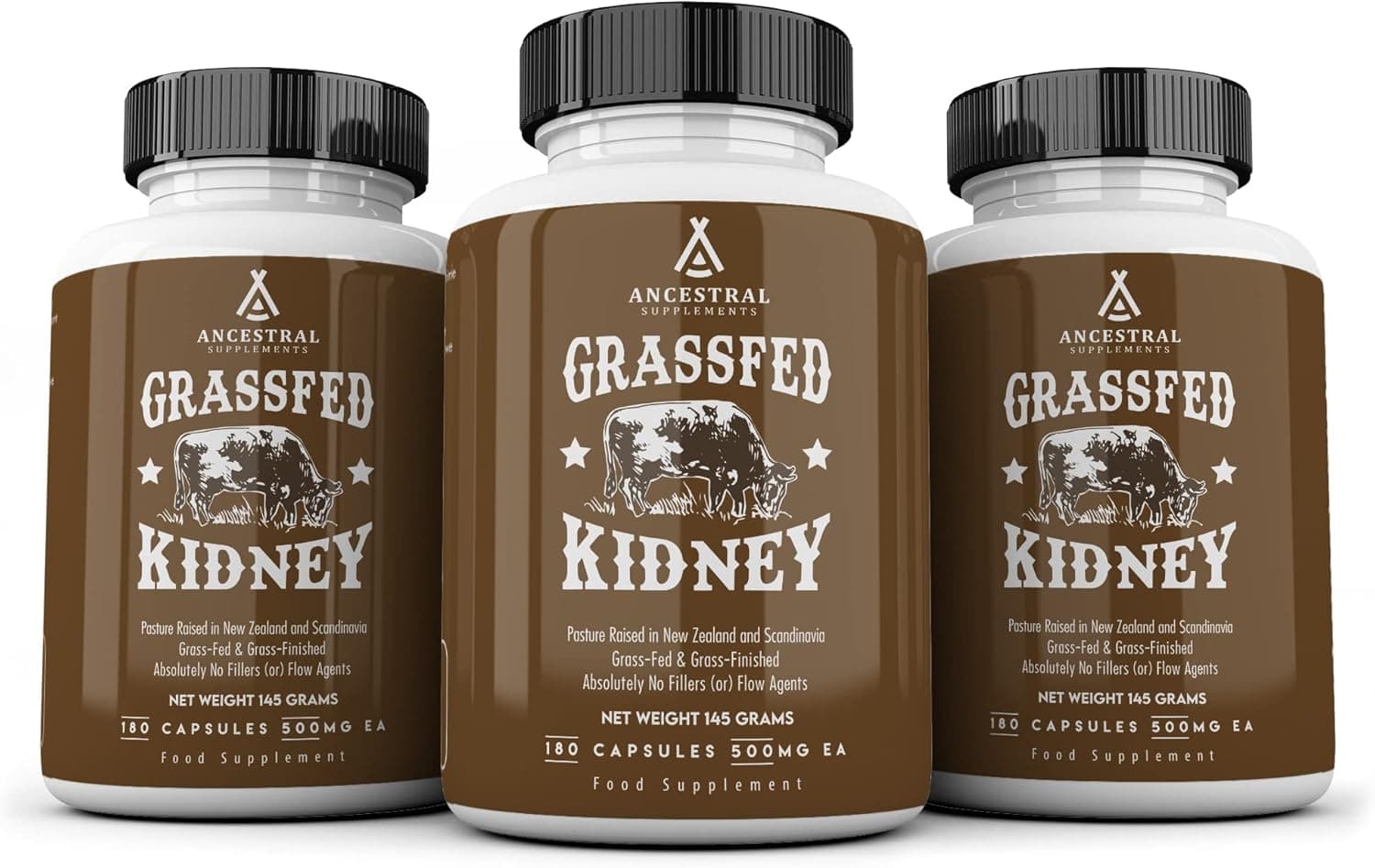
Bovine Spleen.
Desiccated spleen providing heme iron and immune-related peptides for blood and immune health. Delivers concentrated heme iron and immune peptides from whole spleen tissue
Reviewed March 2026
- Category
- General
- Also filed under
- Very high heme iron contentContains immune peptides (tuftsin, splenopentin)Traditional use for anemia support
What Bovine Spleen is, and what it does.
- Does it work
- Suits people whose iron stores sit low, especially women with heavy cycles and anyone eating little red meat. If you're a man or past your cycles, get iron checked first.
- How much to take
- 3,000mg daily for iron support. Some people go up to 6,000mg if using specifically for immune support, though the evidence for higher doses is lacking. Split across 2-3 meals for best absorption.
- Time to feel it
- Iron stores rebuild slowly. Ferritin usually moves over six to twelve weeks of daily use, and that shows up on a blood panel before it shows up in your day.
- The first dose
- Nothing dramatic. Iron supplementation takes weeks to rebuild stores. You won't feel the B12 either unless you were severely depleted.
- With regular use
- Over two to three months, ferritin and haemoglobin tend to climb in people who started low. B12 status also holds steadier on a diet thin in animal foods.
- How well tolerated
- Well tolerated, and gentler on the gut than iron salts for most people. Iron accumulates, so have levels checked if you're not short of it. Sourcing and metal testing matter.
- How it feels
- Day to day, mostly nothing you can point to. If your iron was low, it arrives as steadier energy across weeks rather than a lift you can time.
- The overlooked benefit
- Heme iron rides its own absorption route, so the tea, coffee and phytate sitting in the same meal barely dent it. Iron from plants gets no such pass.
3 to 6g a day is where Bovine Spleen works.
Source: Tuftsin/splenopentin research, nutrient databases
The proof, claim by claim.
These words describe the research, not the molecule's worth. Research strength is how much work stands behind one claim, and it is never a product score.
- Rich source of heme iron
- Contains immune-supporting peptides
- Better tolerated than iron supplements
Questions people ask about Bovine Spleen.
- How does it compare to liver for iron?
- Spleen has roughly 3-4x more iron per gram than liver. But liver provides much more vitamin A, B12, and other nutrients. For pure iron needs, spleen wins. For overall nutritional value, liver wins. They're different tools.
- Will it cause constipation like iron pills?
- Much less likely. Standard iron supplements (ferrous sulfate) are notorious for constipation. Heme iron from spleen is gentler on the gut because it absorbs through a different pathway that doesn't irritate the intestinal lining as much.
- Do the immune peptides actually work?
- In lab studies and isolated peptide research, tuftsin and splenopentin show immune-modulating effects. Whether eating dried spleen delivers these peptides intact to your immune system is a big question mark. They likely get partially digested before they can act. Don't buy spleen primarily for immunity.
- Should I check my iron levels first?
- Absolutely yes. Get a ferritin test before starting any iron-containing supplement. If your ferritin is already above 100 ng/mL, you don't need extra iron and adding more could be harmful. Iron supplementation should always be guided by lab work.
- Can I take this during pregnancy?
- The iron would be helpful (pregnancy dramatically increases iron needs). But check with your OB/GYN first. Unlike liver, spleen has minimal vitamin A, so the retinol teratogenicity concern doesn't apply. The main question is whether your doctor prefers a standardized iron supplement where dosing is more precise.
Why these belong in the same formula. Each row says what the basis is, from settled biochemistry through to a trial that measured the pair.
Ascorbate holds iron in the ferrous state and forms a soluble complex with it, which is the form the DMT1 transporter takes up. Spleen concentrate carries both heme and non-heme iron, and it is the non-heme fraction that gains most from ascorbate.
Hephaestin in the enterocyte and ceruloplasmin in plasma are copper enzymes that oxidise ferrous iron so it can be loaded onto transferrin. Without adequate copper, iron from any source moves poorly out of stores and into circulation.
Iron supplies the heme ring while B12 supports the DNA synthesis that dividing erythroid precursors depend on. Normal red cell production needs both, so an iron-bearing glandular is routinely paired with B12.
Folate donates one-carbon units for thymidylate synthesis in rapidly dividing erythroid precursors, the step iron cannot substitute for. Iron plus folate covers two different limiting inputs to the same process.
Riboflavin-derived flavins support the ferrireductase activity that releases iron from ferritin stores and reduces it for transport. Poor riboflavin status blunts how well absorbed iron is handled.
Retinol status influences the release of iron from liver and spleen stores into circulation, which is why the two nutrients are often assessed together. Adequate vitamin A helps stored iron become available rather than staying sequestered.
Calcium is the one dietary factor that lowers uptake of both heme and non-heme iron taken in the same meal, acting at the enterocyte rather than by binding in the lumen. Spacing a calcium dose several hours from an iron-bearing glandular avoids the overlap.
Zinc and non-heme iron compete for uptake through DMT1, most noticeably when both are given in solution away from food. Taking them with a meal or at separate times reduces the competition.
Galloyl groups on tannins bind non-heme iron in the gut lumen and form complexes the enterocyte cannot take up. The heme fraction of spleen concentrate is largely spared, the non-heme fraction is not.
Catechins chelate non-heme iron in the gut and lower its uptake when taken in the same sitting. Separating tea polyphenols from an iron-bearing glandular by a couple of hours removes the effect.
Heme is built from glycine and succinyl-CoA in a reaction that needs pyridoxal 5-phosphate. Spleen supplies iron and preformed heme. B6 supports the body's own heme assembly downstream. The cofactor step is textbook, so no combination trial is needed to state it.
Delta-aminolevulinate is formed from glycine and succinyl-CoA before iron is incorporated into the porphyrin ring. Providing iron without the carbon skeleton addresses only one half of the pathway. This is settled biochemistry about heme assembly rather than a measured effect of the pairing.
DMT1 carries several divalent cations, so a large manganese dose taken with a non-heme iron source competes for the same transporter. The heme fraction of spleen uses a separate uptake route and is less affected, but organ tissue also carries non-heme iron. Spacing the two by a couple of hours sidesteps the overlap.
A gram-scale calcium dose lowers iron absorption from the same meal, and calcium is unusual among inhibitors in that it touches the heme fraction as well as the non-heme fraction. Someone taking spleen for its iron content has a reason to keep a calcium supplement at a different time of day. The interaction is well established and does not depend on a combination trial.
Flavonoids bind iron into poorly absorbed complexes when the two meet in the stomach. The heme iron in organ tissue is largely protected inside its porphyrin ring, so the effect falls mainly on the non-heme portion. This is a timing note rather than a reason to avoid either.
Non-heme iron needs an acidic stomach environment to stay soluble and reducible before it reaches the duodenal absorption site. Heme iron is much less dependent on gastric pH. Any benefit therefore applies to the non-heme fraction of the tissue, not the heme fraction.
Lactoferrin binds ferric iron with high affinity and is used both as an iron source and as an iron-sequestering protein depending on its saturation state. Combined with an iron-rich organ tissue, the net effect on absorbed iron depends on which form is used. Read this as an interaction to be aware of rather than a straightforward additive one.
Spleen tissue and a ferrous salt both contribute elemental iron to the same serving, so combining them stacks the dose. Iron is a nutrient where more is not automatically better and total intake is the number that matters. Anyone taking both should be counting the combined figure.
Phytate from grains and legumes binds non-heme iron in the gut and is the main dietary inhibitor in plant-heavy meals. Phytase cleaves phosphate groups from the molecule and reduces that binding. The relevance to spleen is limited to its non-heme iron fraction and to whatever else is in the meal.
Free redox-active iron drives Fenton chemistry, and selenium-dependent glutathione peroxidases are part of the system that manages the resulting peroxides. Pairing an iron-dense food with adequate selenium status supports the handling side of that chemistry. The rationale is mechanistic, not measured in a trial of the pair.
Talk to a doctor before taking Bovine Spleen if any of these apply to you: Immune peptides may not survive digestion, Iron content can be too high for some people, Not a replacement for medical treatment of anemia. These are flags to check first, not effects Bovine Spleen is known to cause.
Not medical advice. Show the label to your pharmacist.What Bovine Spleen actually does.
Heme iron gets in by its own route, separate from non-heme iron. The whole porphyrin ring enters the gut cell first, then heme oxygenase releases the iron inside.
Because heme iron has its own doorway, the phytate, polyphenols and calcium that hold back non-heme iron from the same meal get in its way much less.
The spleen filters out and recycles worn-out red blood cells, which is why spleen tissue runs dense in iron and in ferritin, the protein that stores it.
B12 in ruminant organ tissue arrives bound to protein. Stomach acid and pepsin release it, then intrinsic factor picks it up for absorption in the ileum.
Where Bovine Spleen comes from.
Spleens from cattle are cleaned, sliced thin and dried, usually by freezing them and pulling the water out under vacuum so no heat is involved. The dried tissue is ground to a powder, tested for iron content and for contamination, and put into capsules.
Made from an animal material. Species and tissue are the things worth knowing, and both belong on a label.
Spleens recovered at slaughter from cattle, with sourcing generally specified by country of origin and by the herd's feeding regime. Jurisdictional controls on specified bovine tissues apply to the abattoir stream.
Tissue is trimmed of connective tissue and surface fat, rinsed and sliced thin so that drying reaches the centre of each piece.
Sliced tissue is frozen and dried under vacuum by sublimation, or dried at controlled low temperature, taking moisture down to a level where microbial growth stops.
Dried tissue is milled to a uniform powder and screened, with metal detection and particle-size control as standard steps.
Batches are typically tested for iron content, moisture, microbial load and pathogen absence. Some suppliers also report protein content.
Powder is filled into capsules, usually with minimal excipients since the tissue itself is the whole content.
Getting Bovine Spleen from food.
The whole-food sources on file. A supplement closes the gap, it does not replace dinner.
A gram-for-gram figure (how much of each you would eat to match a dose) will appear here once it is sourced and reviewed. This page will not print a number it cannot cite.
The forms it comes in.
FDA Disclaimer: These statements have not been evaluated by the Food and Drug Administration. This information is for educational purposes only and is not intended to diagnose, treat, cure, or prevent any disease. Consult your healthcare provider before starting any supplement regimen.