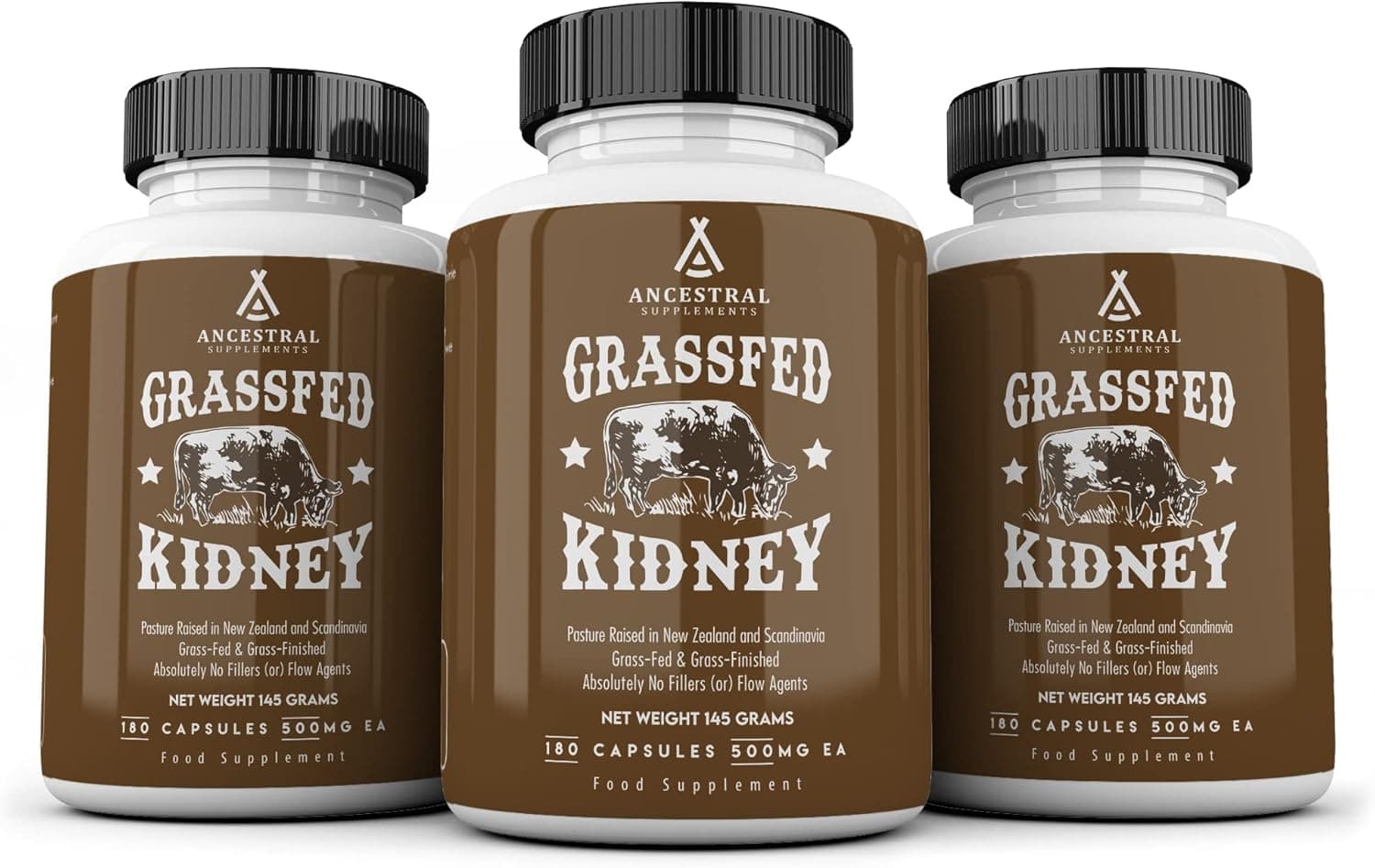
Bovine Bone Marrow.
Desiccated bone marrow rich in collagen, alkylglycerols, and fat-soluble nutrients for immune and joint support. Delivers marrow-specific nutrients (alkylglycerols, collagen, fat-soluble vitamins) for immune and connective tissue support
Reviewed March 2026
- Category
- General
- Also filed under
- Alkylglycerols for immune supportNatural collagen sourceFat soluble vitamins
What Bovine Bone Marrow is, and what it does.
- Does it work
- Suits people eating nose to tail and anyone who wants glycine-rich connective tissue material in food form. What it reliably delivers is collagen amino acids, heme iron and B12.
- How much to take
- 3,000mg daily (typically 6 capsules). Minimum effective is around 1,500mg. Going higher hasn't shown additional benefits. Some brands suggest up to 6,000mg but there's no evidence-based reason for it.
- Time to feel it
- Nothing on day one. Nobody has measured a time course for marrow powder in people, so the honest answer is weeks of daily use before there is anything to look for.
- The first dose
- Nothing noticeable. This isn't an acute-effect supplement. It's providing slow-release nutrition that accumulates over weeks.
- With regular use
- Weeks of daily use mainly show up as steady glycine and heme iron intake. Connective tissue and skin changes, where they happen, run over months and are measured rather than felt.
- How well tolerated
- Well tolerated. It is a fatty tissue, so a serving on an empty stomach can sit heavily. Sourcing and batch testing matter, and check first if you have been told to watch iron status.
- How it feels
- Little to notice hour to hour. It behaves like food, not a stimulant. What people describe is gradual joint comfort, which is a soft endpoint and easy to confuse with everything else.
- The overlooked benefit
- Marrow carries heme iron and B12, absorbed by routes that tea, coffee and phytate do not block. That is the part people miss while arguing about collagen.
3 to 6g a day is where Bovine Bone Marrow works.
Source: Alkylglycerol research (shark liver oil extrapolated), traditional use
The proof, claim by claim.
These words describe the research, not the molecule's worth. Research strength is how much work stands behind one claim, and it is never a product score.
- Contains immune-boosting alkylglycerols
- Supports joint health via collagen
- Ancestral superfood
Questions people ask about Bovine Bone Marrow.
- Is this the same as bone broth?
- No. Bone broth extracts some marrow components into water, but most of the fat-soluble nutrients stay in the bones. Desiccated marrow is the actual marrow tissue, freeze-dried. They're complementary but different products. Bone broth is mostly collagen and minerals. Marrow capsules are mostly fats and fat-soluble nutrients.
- Can't I just eat roasted marrow bones?
- Yes, and you'd get more marrow per serving than any capsule can deliver. Two roasted marrow bones give you more actual marrow than a month of capsules. If you enjoy the taste and have access to quality bones, eating the food is better in every way.
- Does it really boost the immune system?
- The alkylglycerol theory is interesting but unproven for bovine marrow supplements specifically. Shark liver oil alkylglycerols have some immune research behind them. Whether the amounts in bovine marrow capsules are enough to replicate those effects is a big unknown.
- Is grassfed sourcing important for marrow?
- Yes, more so than for muscle meat. The fatty acid composition of marrow directly reflects the animal's diet. Grassfed animals produce marrow with higher omega-3s and CLA. Since marrow is mostly fat, the fat quality matters a lot.
Why these belong in the same formula. Each row says what the basis is, from settled biochemistry through to a trial that measured the pair.
Prolyl and lysyl hydroxylases need ascorbate to stay in the reduced state, and without it the collagen triple helix does not form stably. Marrow and bone tissue supply the amino acid raw material for that same matrix.
Lysyl oxidase is a copper enzyme that cross-links collagen and elastin fibrils into mature connective tissue. Collagen material without adequate copper is laid down with weaker cross-linking.
Bone and marrow tissue carry type I collagen and its glycine and proline-rich sequences, the same building blocks hydrolysed collagen delivers as di and tripeptides. The two supply one matrix pool by different routes.
Orthosilicic acid is the absorbable form of silicon and is associated with collagen formation and cross-linking in connective tissue. It is paired with collagen-bearing material for that structural role rather than as a mineral in its own right.
Marrow tissue supplies heme iron, and B12 supports the DNA synthesis that dividing erythroid precursors depend on. The two cover different limiting inputs to normal red cell production.
Roughly a third of the amino acid residues in collagen are glycine, and marrow-bearing bone material is collagen-rich. Supplemental glycine adds to the same amino acid pool. Both are contributing the same building block to connective tissue synthesis.
Proline and its hydroxylated form are the other signature residues of the collagen triple helix. Prolyl hydroxylase converts proline to hydroxyproline only after the chain is assembled, and it needs vitamin C and iron to do it. Supplying proline alongside a collagen-bearing material feeds the same synthesis step.
Marrow-bearing bone material supplies calcium and phosphorus in the mineral matrix. Calcium uptake across the gut depends on vitamin D driving the transcellular transport machinery. Without adequate vitamin D status, more of that mineral simply passes through.
Osteocalcin, the most abundant non-collagen protein in bone, has to be gamma-carboxylated before it binds calcium, and vitamin K is the cofactor for that carboxylation. Marrow and bone preparations supply matrix material. Vitamin K supports the carboxylation step that lets that matrix hold mineral. This is settled cofactor biochemistry.
Bone material carries calcium as hydroxyapatite, so a marrow and bone blend already contributes to calcium intake. Adding a calcium supplement stacks on top of that. Total daily intake is the figure that matters, not the individual sources.
Magnesium sits in the bone mineral surface and is a cofactor for the enzymes that handle calcium and vitamin D. A high calcium load without matching magnesium shifts the ratio between them. Formulas that supply bone mineral usually carry magnesium for that reason.
Manganese is the cofactor for the glycosyltransferases that attach sugars to collagen and for the synthesis of proteoglycans in cartilage. Connective tissue building materials cannot be assembled without it. Intakes are usually adequate, so this matters most where they are not.
Zinc is the metal at the active site of the matrix metalloproteinases and of alkaline phosphatase, both central to how bone matrix turns over. It is also present in marrow tissue itself. High supplemental zinc competes with copper for absorption, so the pair is usually balanced.
Boron influences how the body handles calcium, magnesium and vitamin D, and it appears in bone-support formulas for that reason. The mechanism is not fully worked out. It is a supporting role rather than a structural contribution.
Hyaluronan is the backbone that proteoglycan aggregates hang from in cartilage and synovial fluid, while marrow and bone material supplies collagen-type protein. The two occupy different structural roles in the same tissue. Combination formulas pair them on that basis rather than on a combination trial.
MSM supplies sulfur used in the sulfation of glycosaminoglycans and in disulfide bonding. Marrow and bone material supplies collagen amino acids. Joint comfort formulas commonly combine the two. The pairing is mechanistic rather than measured.
Glucosamine is the amino sugar backbone of the glycosaminoglycan chains in cartilage, a different component from the collagen protein that marrow-bearing material contributes. They are complementary inputs to the same tissue. No trial has tested this particular combination.
Chondroitin is a sulfated glycosaminoglycan of cartilage matrix. Collagen is the fibrous protein it sits within. Combining them supplies both halves of the matrix on paper. Absorption of intact chondroitin is limited, which tempers what can be claimed.
Marrow is a fat-rich tissue and its unsaturated fatty acids oxidise readily under heat or long storage. Tocopherols terminate lipid peroxidation chains in that fat phase. This is a stability role as much as a nutritional one.
Retinol and vitamin D signal through partner nuclear receptors and high retinol intakes can oppose vitamin D signalling on bone cells. Organ and marrow preparations, particularly those blended with liver, can carry substantial preformed retinol. Anyone stacking several organ products should add up total preformed vitamin A.
Marrow tissue carries heme iron, which is absorbed through a different route from the non-heme iron in mineral supplements and is not blocked by phytate or polyphenols. Adding a non-heme iron supplement on top stacks two intakes handled by two systems. Anyone with high ferritin should count both.
Marrow fat is metabolised through beta-oxidation, which runs on flavin-dependent dehydrogenases. Riboflavin supplies the FAD those enzymes need. This is textbook cofactor biochemistry and applies to any fat-rich food.
Talk to a doctor before taking Bovine Bone Marrow if any of these apply to you: Very limited clinical data on supplement form, Small amounts per capsule, Expensive for what you get. These are flags to check first, not effects Bovine Bone Marrow is known to cause.
Not medical advice. Show the label to your pharmacist.What Bovine Bone Marrow actually does.
Marrow is mostly fat, and the main fat in it is the same monounsaturated fat found in olive oil.
Collagen is built on a repeating pattern where every third amino acid has to be glycine, the smallest one.
The body makes hydroxyproline inside collagen after the chain is built, and that step needs vitamin C and iron.
The glycine in collagen-rich foods also feeds the body's own production of glutathione and creatine.
Where Bovine Bone Marrow comes from.
Bones from meat processing are cracked open, the marrow is taken out and dried cold, then ground. Where the cattle came from and how gently it was dried are what separate one product from another.
Made from an animal material. Species and tissue are the things worth knowing, and both belong on a label.
Femur and other long bones are recovered as a meat processing coproduct. Grass-fed and pasture-raised sourcing claims, where made, are supply chain attributes rather than processing steps.
Bones are cracked or sawn and the marrow is pushed or scraped out. Recovery is done cold to keep the fat from smearing and oxidising.
Marrow is frozen and lyophilised, or dried at low temperature under vacuum, because heat both oxidises the unsaturated fat and darkens the material.
The dried marrow is milled to a defined particle size. Fat-rich powders are milled cold or with a flow aid to stop them caking.
Specified on species identity, moisture, fat content, peroxide value and microbial limits. Sourcing from countries and herds with the appropriate veterinary controls is the documented safety step for any bovine tissue material.
Encapsulated or packed in bulk, usually under nitrogen or with an oxygen absorber given the fat content.
Labels often say freeze-dried without stating the temperature or the peroxide specification, and the ratio of marrow to bone in a blend is frequently not declared.
Getting Bovine Bone Marrow from food.
The whole-food sources on file. A supplement closes the gap, it does not replace dinner.
A gram-for-gram figure (how much of each you would eat to match a dose) will appear here once it is sourced and reviewed. This page will not print a number it cannot cite.
The forms it comes in.
The essence, in one line each.
- A high-functional bovine collagen peptide was associated with changes in reported measures of knee joint comfort and mobility over the study period. The material tested was a bovine collagen peptide, not bone marrow.Open-label trial. Devasia et al., 2024 (Cartilage). PMID 38235711 ↗
- Human platelet lysate was compared with fetal bovine serum as a culture supplement for expanding human cells, as a step toward standardising that production.In vitro study. Immalaraju et al., 2025 (Frontiers in Toxicology). PMID 40655131 ↗
These are the studies our verdict leans on, chosen from the 2 we read for Bovine Bone Marrow. The full linked list is below.
FDA Disclaimer: These statements have not been evaluated by the Food and Drug Administration. This information is for educational purposes only and is not intended to diagnose, treat, cure, or prevent any disease. Consult your healthcare provider before starting any supplement regimen.