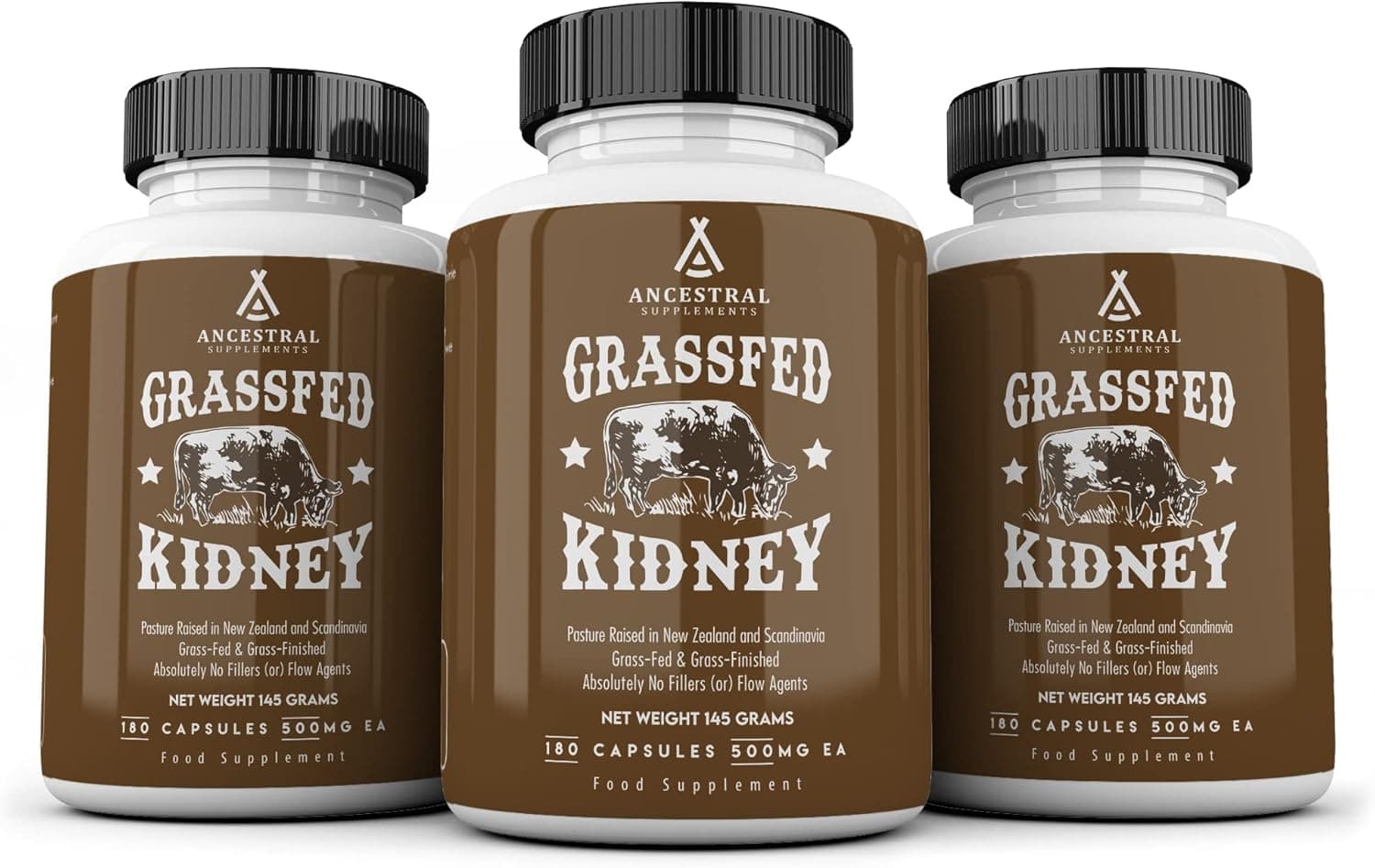
Bovine Kidney.
Desiccated kidney providing natural selenium, B12, and DAO enzyme for histamine support. Provides natural DAO enzyme for histamine breakdown, plus selenium and B12 for general health
Reviewed March 2026
- Category
- General
- Also filed under
- Natural selenium sourceB12 contentPotential DAO enzyme for histamine metabolism
What Bovine Kidney is, and what it does.
- Does it work
- Suits people who already eat organ meats and want the selenium and B12 density of kidney in a powder. The diamine oxidase angle is the reason most people pick it.
- How much to take
- Start with about 3g a day and settle anywhere up to 6g, split across meals. For the enzyme angle, take it just before the meal rather than after it.
- Time to feel it
- Selenium and B12 status move over four to eight weeks and show up on a blood panel. Anything around a histamine rich meal would be same day and varies a lot.
- The first dose
- Day one is quiet. The nutrient side is a slow build read on a panel, and any meal time enzyme effect is the only thing that could show that fast.
- With regular use
- Weeks of daily use add up as selenium, B12, riboflavin and heme iron intake, which is where the change registers on a blood panel.
- How well tolerated
- Well tolerated as a food powder. Kidney concentrates trace elements, so batch testing and sourcing matter. It's high in purines, so check first if you track uric acid.
- How it feels
- Most people feel nothing specific, which is normal for a nutrient dense food. Some people who react to aged or fermented foods report fewer flushes, and it varies.
- The overlooked benefit
- Diamine oxidase is a heat sensitive protein, so freeze dried powder keeps far more activity than heat dried, and most organ powders are never assayed for it at all.
3 to 6g a day is where Bovine Kidney works.
Source: Nutrient composition databases, traditional use
The proof, claim by claim.
These words describe the research, not the molecule's worth. Research strength is how much work stands behind one claim, and it is never a product score.
- Contains DAO enzyme for histamine breakdown
- Good source of selenium
- Supports histamine intolerance
Questions people ask about Bovine Kidney.
- Is this better than a standalone DAO supplement?
- For histamine support specifically? Probably not. Standalone DAO supplements (like DAOsin or Histamine Block) are standardized for enzyme activity. Desiccated kidney gives you DAO plus other nutrients, but the DAO content is unstandardized and may be low.
- Does it actually contain active DAO enzyme?
- Fresh kidney does. Whether the freeze-drying process preserves enough active DAO to matter is the million-dollar question. Most brands don't test for it. If a brand claims specific DAO activity units on the label, that's a good sign.
- Can this help with histamine intolerance?
- Maybe, but don't bet on it as your primary strategy. If you have diagnosed histamine intolerance, a standardized DAO supplement before meals has better evidence. Desiccated kidney is more of a general nutritional support with a potential DAO bonus.
- Why is cadmium a concern?
- Kidneys are filtration organs. They trap and concentrate heavy metals, especially cadmium, from the animal's environment. Low-quality kidney from feedlot cattle in polluted areas can have meaningfully high cadmium. Always choose brands that publish heavy metal test results.
- How does it compare to liver supplements?
- Liver is the better all-around organ supplement: more vitamin A, more B12, better iron, more research. Kidney's unique selling point is the DAO enzyme and high selenium. If you had to pick one organ supplement, liver wins. If you specifically need DAO or selenium, kidney has a niche.
- Can I eat actual kidneys instead?
- Absolutely, and you'll get more nutrients per serving. Steak and kidney pie is a classic for a reason. But most people find kidney's flavor... challenging. The strong, almost metallic taste puts off a lot of people. Capsules solve that problem entirely.
Why these belong in the same formula. Each row says what the basis is, from settled biochemistry through to a trial that measured the pair.
Renal tissue concentrates selenium into selenoproteins more than most organ foods. Kidney intake therefore adds to whatever a selenium supplement contributes to the same pool.
Kidney carries cobalamin bound to tissue proteins, released by gastric acid and pepsin before intrinsic factor binding. It contributes to the same B12 pool as a supplemental form.
Kidney is among the richer natural sources of riboflavin, mostly as FAD and FMN bound to enzymes. These are hydrolysed to free riboflavin before uptake and join the same pool as supplemental B2.
Kidney holds folate largely as polyglutamates that intestinal conjugase trims before absorption. Folate and the B12 the same tissue supplies both act on the methionine synthase step.
Iron in organ tissue is largely heme bound and is taken up by a route separate from non-heme iron, so it is less affected by other meal components. Both forms end up in the same body iron pool.
Ascorbate reduces ferric iron to the ferrous form that DMT1 carries and keeps it soluble at intestinal pH. This raises uptake of the non-heme fraction of iron in organ tissue.
Calcium taken in the same dose lowers absorption of both heme and non-heme iron at the enterocyte. Separating the two by a few hours avoids the overlap.
Zinc and non-heme iron compete for DMT1 at the brush border when given together as large single doses. Spacing them apart keeps each on its own uptake window.
Galloyl groups on tannins bind ferric iron in the gut lumen into complexes the enterocyte cannot take up. The heme fraction of organ tissue is much less affected.
Diamine oxidase is a copper-containing amine oxidase. Each active site holds a copper ion alongside a topaquinone cofactor derived from an internal tyrosine residue. Without copper the enzyme has no catalytic centre. This is textbook enzymology rather than a tested supplement pairing, and copper has a narrow intake range so more is not better.
Pyridoxal 5-phosphate is the working form of vitamin B6 and is repeatedly named in clinical reference material alongside copper as supporting amine-degrading enzyme activity. The primary enzymology of diamine oxidase rests on copper and topaquinone, so the B6 link is weaker than the copper one and should be labelled as such. It is a supportive nutrient claim, not a demonstrated increase in enzyme activity.
P5P is the already-phosphorylated coenzyme form, so it skips the hepatic conversion step that pyridoxine needs. For amine metabolism the relevant enzymes use the coenzyme form directly. Whether starting from P5P changes anything measurable in a person with normal liver function has not been shown.
Betaine donates a methyl group to homocysteine to regenerate methionine, which feeds back into the SAM pool that intracellular methyltransferases draw on. That places it upstream of the methylation route for amine handling. It is an upstream nutrient relationship, not a measured effect on enzyme rates.
5-methyltetrahydrofolate supplies the methyl group for the B12-dependent remethylation of homocysteine, the other route to regenerating methionine and with it SAM. Organ meats are themselves a folate source, so a combined intake should be counted rather than stacked blindly. This is settled biochemistry upstream of methylation, not evidence about kidney powder.
Organ and muscle meats are rich in methionine, and glycine participates in the disposal of the methyl load that follows a high methionine intake. The two amino acids are often discussed as a balance in a meat-heavy diet. The framing is nutritional, and no study measures it against a kidney supplement.
Molybdenum forms the cofactor for sulfite oxidase, xanthine oxidase and aldehyde oxidase, enzymes concentrated in liver and kidney tissue. Organ tissue is therefore a dietary source of the element as well as of the enzymes. Requirements are small and ordinarily met from food.
Organ meats are dense in phosphorus, which is handled alongside calcium and is why total intake from organ-based products is worth counting. Anyone advised to limit phosphorus intake should count a desiccated organ capsule as food, not as a neutral supplement. This is composition arithmetic rather than an interaction.
Quercetin reduces histamine release from mast cells in laboratory systems, which is a different point in the pathway from enzymatic breakdown of histamine already released. The two are combined on that logic in histamine-focused formulas. The mast cell data are in vitro, so the confidence stays low.
Diamine oxidase is itself a protein, and proteases digest proteins. Taking a protease blend in the same swallow as an enzyme-bearing organ preparation is chemically working against it. Separating the two, or using a protected capsule, sidesteps the question.
Lowering gastric pH activates pepsin, which digests dietary protein and would not spare a swallowed enzyme. That runs against the reason a kidney-derived enzyme preparation is taken. Products intended to deliver enzyme activity past the stomach use delayed-release shells for exactly this reason.
Some bacterial strains carry histidine decarboxylase and generate histamine from dietary histidine, while others do not, and the difference is strain-level rather than species-level. That makes a strain list relevant to anyone tracking dietary amines. Strain-specific data are thin and this is a flag to check rather than a general caution.
Kidney is among the tissues with the highest mitochondrial density and correspondingly high native coenzyme Q10 content. A freeze-dried organ powder therefore carries some, though far less per capsule than a dedicated CoQ10 product. The contribution is nutritional and undeclared on most labels.
Organ tissue is among the densest dietary sources of pantothenic acid, which forms coenzyme A. That places kidney powder in the B-vitamin group of contributions alongside its riboflavin and B12 content. Counting it as food rather than as an isolated nutrient avoids double-dosing.
Manganese concentrates in mitochondria-rich tissue as the metal in mitochondrial superoxide dismutase. Organ powders contribute small amounts. Manganese needs are small and excess intake is unhelpful, so an organ product is worth counting against a multivitamin.
Talk to a doctor before taking Bovine Kidney if any of these apply to you: DAO enzyme likely degraded in processing, Less nutrient-dense than liver, Limited clinical evidence. These are flags to check first, not effects Bovine Kidney is known to cause.
Not medical advice. Show the label to your pharmacist.What Bovine Kidney actually does.
Diamine oxidase is a copper-containing amine oxidase that breaks down histamine and other diamines outside the cell, mostly in the lining of the small intestine, the kidney and the placenta. Kidney is thick with it, which is why kidney is the tissue used commercially.
The enzyme needs a copper ion plus a topaquinone cofactor built from one of its own tyrosine residues. Both have to be present for it to work, which is why copper status keeps coming up alongside amine metabolism.
Histamine gets cleared two separate ways. Diamine oxidase works on it outside cells, in the gut lumen and wall, while histamine N-methyltransferase works inside cells using S-adenosylmethionine as the methyl donor. One route can't stand in for the other.
Diamine oxidase is a protein, so swallowing it means it meets stomach acid and pepsin like any protein in your dinner. That's why enzyme-intended products use delayed-release or acid-resistant delivery, and why the label declares activity units instead of milligrams.
Getting Bovine Kidney from food.
The whole-food sources on file. A supplement closes the gap, it does not replace dinner.
A gram-for-gram figure (how much of each you would eat to match a dose) will appear here once it is sourced and reviewed. This page will not print a number it cannot cite.
The forms it comes in.
The essence, in one line each.
- A bibliometric and narrative review of bovine alkaline phosphatase, an enzyme purified commercially from bovine tissue including kidney, summarising where the research effort has gone. It is a review of an isolated enzyme and not of kidney as a food or supplement.Narrative review. Smagulova et al., 2026 (Veterinary and Animal Science). PMID 42317644 ↗
- Collagen hydrolysate based protein complexes were assessed against endurance, glucose handling and kidney function measures in animals. The material is a bovine-derived protein preparation rather than kidney tissue, and the endpoints are animal markers.Animal study. Kurkin et al., 2026 (Nutrients). PMID 42280377 ↗
- Bovine colostrum with sodium butyrate was reported to change gut microbiota and gut to liver measures in animals. The tested material is colostrum, a different bovine-derived input, so it says nothing about kidney tissue.Animal study. Pieszka et al., 2026 (Nutrients). PMID 42280427 ↗
- A single case describing episodic muscle weakness with low potassium in a young woman under investigation for histamine-related mast cell symptoms. A case report of one person that involves no supplement and cannot support any claim about kidney-derived enzyme preparations.Case report. Moradi et al., 2026 (Clinical Case Reports). PMID 42256938 ↗
These are the studies our verdict leans on, chosen from the 4 we read for Bovine Kidney. The full linked list is below.
FDA Disclaimer: These statements have not been evaluated by the Food and Drug Administration. This information is for educational purposes only and is not intended to diagnose, treat, cure, or prevent any disease. Consult your healthcare provider before starting any supplement regimen.