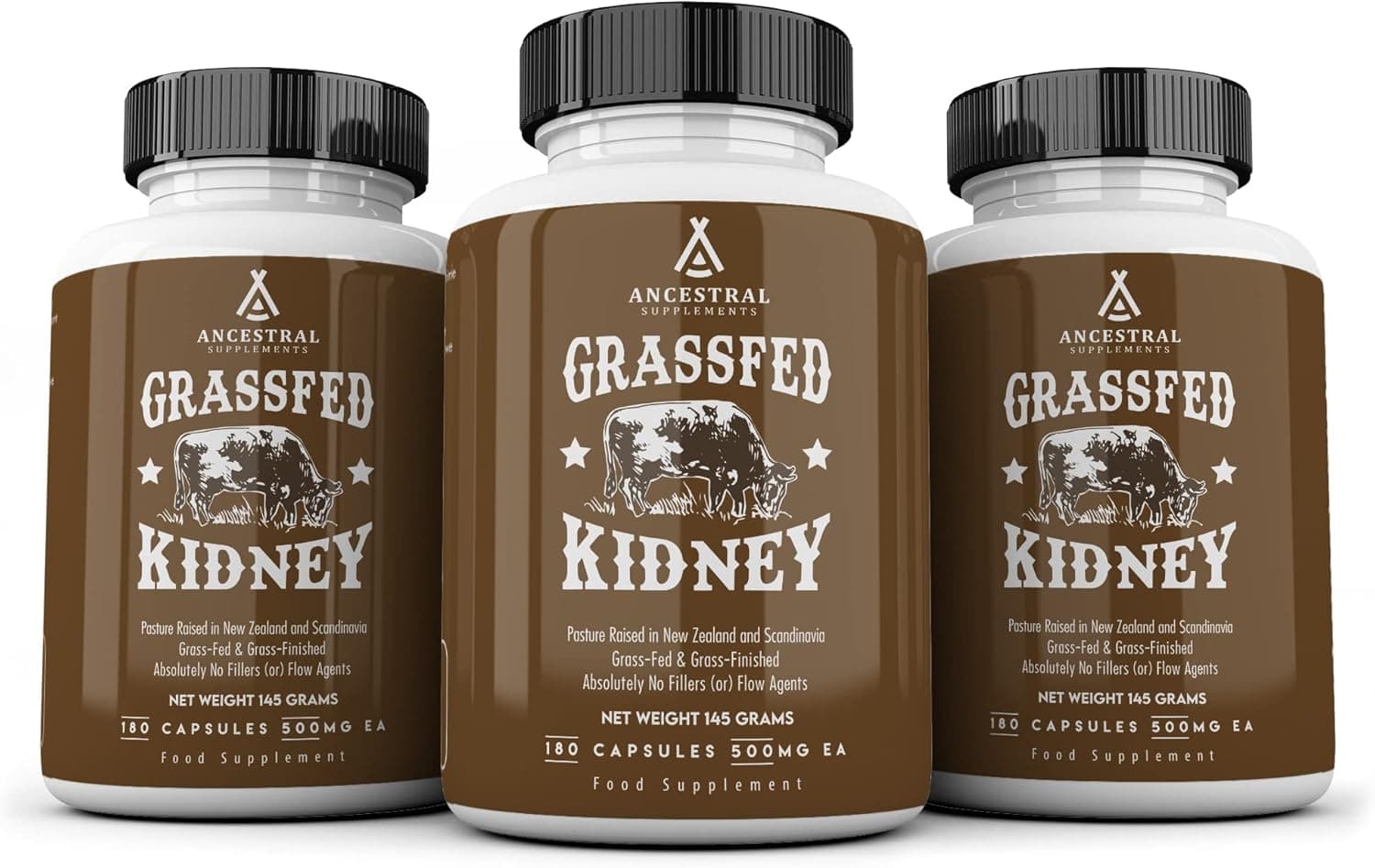
Bovine Liver.
Concentrated beef liver powder delivering bioavailable iron, B12, and vitamin A. Delivers concentrated, bioavailable iron, B12, and vitamin A from real food, not synthetic isolates
Reviewed March 2026
- Category
- General
- Also filed under
- Rich in heme ironNatural B12 sourcePreformed vitamin A
What Bovine Liver is, and what it does.
- Does it work
- Suits people who want iron, B12, copper and vitamin A from a whole food rather than isolates, and people who will never cook liver. Vitamin A is why the serving stays modest.
- How much to take
- Start with 3g a day, usually around six capsules, and stay inside the 3 to 6g band. That band tracks a small portion of fresh liver, and vitamin A is the reason not to climb past it.
- Time to feel it
- Blood counts respond over weeks and iron stores over months. If iron and B12 were already fine, this is topping up rather than filling a hole.
- The first dose
- Honestly? Nothing dramatic. You might notice slightly warmer extremities if you're iron-deficient (cold hands are a classic sign). Most of the magic happens over weeks as nutrient stores rebuild.
- With regular use
- Weeks of daily use keep iron, B12, copper and vitamin A intake steady. Where someone was running low, a panel shows it. Where they were not, it is maintenance.
- How well tolerated
- Vitamin A is the real limit here, so keep to the band, and this is one to avoid during pregnancy. Check with your doctor first if you have been told to watch iron status.
- How it feels
- Most days, nothing to notice. Where iron or B12 were low, what people describe is a shallower afternoon dip. Otherwise the change sits in the bloodwork.
- The overlooked benefit
- Liver is one of the densest food sources of copper and choline. Copper is needed to move iron where it is going, and choline supports normal fat handling in the liver itself.
3 to 6g a day is where Bovine Liver works.
Source: Nutrient composition databases (USDA)
The proof, claim by claim.
These words describe the research, not the molecule's worth. Research strength is how much work stands behind one claim, and it is never a product score.
- Excellent source of bioavailable iron
- Contains meaningful B12
- Better than synthetic multivitamins
Questions people ask about Bovine Liver.
- What's the difference between this and 'grassfed liver'?
- Marketing, mostly. 'Bovine liver' is the generic term. 'Grassfed liver' specifies the animal's diet. The nutrient profiles are similar, but grassfed versions may have slightly higher omega-3s and fewer pesticide residues. Both work.
- Why do I need 6 capsules?
- Because you're eating food, not taking a drug. Each capsule is about 500mg of dried liver. To get meaningful nutrient amounts, you need enough actual liver powder. This is normal for any whole-food supplement.
- Is it safe to take daily long-term?
- Yes, for most healthy adults at standard doses (3,000mg/day). Humans have eaten liver regularly for our entire evolutionary history. Just get your vitamin A and iron levels checked annually to make sure you're not accumulating too much.
- Does the source country matter?
- Yes. New Zealand, Australia, and Argentina have stricter livestock regulations (no growth hormones, limited antibiotics). US-sourced can be great too if from verified grassfed operations. The key is avoiding feedlot cattle that may have higher toxin loads.
- Can I take it with my multivitamin?
- Be careful. If your multi already has vitamin A (retinol, not beta-carotene) and iron, you could overshoot safe levels. Either use liver OR a multivitamin containing vitamin A and iron, not both at full doses. Beta-carotene based multis are fine to combine.
Why these belong in the same formula. Each row says what the basis is, from settled biochemistry through to a trial that measured the pair.
Liver is where retinol is stored as retinyl esters, so liver intake and a preformed vitamin A supplement add into the same retinol pool. Total preformed intake is what matters against the upper limit, not each source alone.
Retinyl palmitate is the exact ester form liver stores and delivers. Combining the two stacks preformed retinol intake rather than adding anything new.
Hepatic tissue holds the body's copper reserve, largely bound to metallothionein and destined for ceruloplasmin. Liver intake adds directly to the same copper pool a supplement supplies.
High zinc induces intestinal metallothionein, which holds copper inside the enterocyte and lowers how much copper from liver reaches circulation. The same is true in the other direction at very high copper intakes.
Much of the iron in liver is heme bound and enters by a route separate from non-heme iron, so it is less sensitive to other meal components. Both converge on the same body iron pool.
Ascorbate holds iron in the ferrous state and keeps it soluble at intestinal pH, raising uptake of the non-heme portion of liver iron. It also counters the binding effect of polyphenols eaten at the same time.
Calcium in the same dose reduces absorption of both heme and non-heme iron at the enterocyte. Spacing the two apart avoids that overlap.
Tannin galloyl groups bind ferric iron in the lumen into complexes that are not taken up. Only the non-heme fraction of liver iron is affected.
Galloylated catechins chelate non-heme iron in the gut and lower its uptake when taken in the same dose. Added ascorbate offsets part of that binding.
Liver stores cobalamin bound to tissue protein, released by gastric acid and pepsin before intrinsic factor binding. It feeds the same B12 pool as a supplemental form.
Liver supplies both folate and B12, which meet at methionine synthase where methyl groups pass from methylfolate to cobalamin. Loading one without the other leaves that hand-off unbalanced.
Liver is choline dense, and choline is oxidised to betaine which donates a methyl group to homocysteine in parallel with the folate route. Choline and folate partly spare each other for that reason.
Liver carries riboflavin as protein bound FAD and FMN, hydrolysed to free riboflavin before uptake. Riboflavin is also the flavin cofactor that keeps folate and B6 activation running.
Liver holds pantothenic acid mainly as coenzyme A, which digestive enzymes strip back to free pantothenate before absorption. It contributes to the same pool a B5 supplement supplies.
Much of the niacin in liver is present as NAD and NADP, hydrolysed to nicotinamide during digestion. It joins the same nicotinamide pool used to rebuild NAD.
Liver holds biotin covalently attached to carboxylase enzymes, released by biotinidase before absorption. It adds to the same free biotin pool as a supplemental dose.
Liver carries selenium built into selenoproteins such as glutathione peroxidase. Digestion releases selenocysteine, which enters the same selenium pool as a supplement.
Delta-aminolevulinic acid synthase, which condenses glycine and succinyl-CoA to start haem synthesis, requires pyridoxal 5-phosphate. Supplying iron without adequate B6 leaves that first step limited. Liver itself carries B6, so this is about total dietary pattern rather than a gap in the food.
Xanthine oxidase, a molybdoenzyme, oxidises ferrous iron released from ferritin and participates in iron mobilisation. Sulfite oxidase handles sulfur amino acid breakdown, which liver protein supplies in quantity. Both cofactor relationships are settled biochemistry rather than a measured pairing.
Non-haem iron, manganese, zinc and copper all use divalent metal transporter 1 at the enterocyte brush border, so high intake of one reduces uptake of another taken at the same time. Haem iron uses a separate route and is less affected. Separating high-dose mineral supplements from a mineral-dense food is the practical implication.
Dietary B12 arrives bound to food protein and must be freed by gastric acid and pepsin before haptocorrin can take it up. Low stomach acid limits release from food sources specifically, while crystalline B12 in a tablet is not protein bound. This is why food-bound B12 and supplemental B12 behave differently.
Pepsin digests the globin portion of haemoglobin and myoglobin, freeing haem for uptake, and it releases cobalamin from its food protein carriers. Both steps happen in the stomach and both depend on an acidic pH for pepsin activity. Nothing here is a supplement pairing claim. It is the digestive sequence.
Desiccated liver is largely protein, and the nutrients bound to that protein are released as it is digested. Supplemental proteases act on the same substrate as endogenous ones. The relationship is digestive rather than a distinct nutritional effect.
The vitamin D receptor works as a heterodimer with the retinoid X receptor, so retinoid status affects the transcriptional output of vitamin D signalling. Liver is a concentrated source of preformed retinol, which makes it relevant to that balance. The direction and magnitude of the interaction depend on the intake of both.
Retinol, vitamin D and vitamin K all act on bone and calcium handling through separate mechanisms, and high preformed retinol intake has been described as opposing some vitamin D effects. Liver supplies preformed retinol at high density, so total intake from all sources deserves attention. This is an interaction to account for, not a benefit to stack.
Beta-carotene 15,15-dioxygenase cleavage of carotene to retinal is downregulated when retinoid status is adequate, so provitamin A intake is self-limiting. Preformed retinol from liver is not regulated in that way and accumulates. Anyone counting vitamin A intake should regard the two as different in kind, not just in potency.
Bovine liver is one of the densest food sources of preformed retinol, and a retinol supplement adds directly to that total. Preformed vitamin A stores in the liver and upper intake levels are set by regulators for that reason. Stacking them is a total-intake question and should be counted, not assumed.
Thiamine pyrophosphate is the cofactor for pyruvate dehydrogenase and alpha-ketoglutarate dehydrogenase, the entry and mid-points of the citric acid cycle. The B vitamins in liver work as a group through overlapping energy pathways rather than singly. Established biochemistry, not a tested combination.
Methionine synthase transfers a methyl group from 5-methyltetrahydrofolate to homocysteine using methylcobalamin as the carrier, so neither vitamin completes the reaction alone. Liver supplies both folate and B12, which is why they are discussed together for this food. Adding folate without adequate B12 leaves the folate trapped in the methyl form.
Betaine provides an alternative methyl donor for homocysteine remethylation that runs independently of folate and B12. Liver supplies choline, which is oxidised to betaine. The two routes converge on the same reaction from different directions.
Methionine is adenosylated to SAM, the universal methyl donor, and returns through homocysteine to be remethylated by folate, B12 or betaine. Liver protein is rich in methionine, so it supplies both the substrate and several of the cofactors for the cycle. Very high methionine intake without adequate remethylation cofactors pushes homocysteine up, which is a marker.
Bovine liver supplies haem iron absorbed through a route that bypasses the phytate and polyphenol inhibition affecting non-haem iron, and a bisglycinate chelate supplies non-haem iron in a protected form. Taken together they add to total iron intake. Iron status should be measured rather than assumed, since the body has no active route for excreting excess.
Phytate chelates non-haem iron and zinc in the gut and blocks their uptake, and phytase hydrolyses it. Haem iron from liver is largely unaffected by phytate, which is one of the differences between animal and plant iron sources. The enzyme matters for the plant portion of a meal, not for the liver portion.
Riboflavin is required for flavin-dependent reductases involved in mobilising iron from ferritin stores. Liver is a dense source of riboflavin as well as of iron, which is part of why the food behaves as a package. This states the cofactor mechanism rather than a measured combination.
Talk to a doctor before taking Bovine Liver if any of these apply to you: Vitamin A toxicity risk at high doses, Source and quality vary by brand. These are flags to check first, not effects Bovine Liver is known to cause.
Not medical advice. Show the label to your pharmacist.What Bovine Liver actually does.
The iron in liver comes packaged inside the same molecules that carry oxygen in blood and muscle, and that form is taken up differently.
Tea, coffee and grain compounds block plant iron much more than they block iron from meat and liver.
Once inside the gut wall cell, an enzyme opens the ring and lets the iron out into the same pool as any other iron.
The body dials iron absorption up or down depending on how much it already has.
Where Bovine Liver comes from.
The liver is taken at the abattoir, chilled quickly, trimmed and sliced, then dried either by freezing it and pulling the water off under vacuum or by warm air, and ground into powder for capsules. Because the organ is where an animal processes what it takes in, good suppliers test each batch for lead, cadmium, arsenic and bacteria. Where the cattle were raised matters, because the rules on veterinary medicines and inspection differ by country.
Made from an animal material. Species and tissue are the things worth knowing, and both belong on a label.
Liver recovered at abattoir from cattle raised for meat, most commonly stated as grass-fed and pasture-raised or as conventionally finished. Country of origin matters because veterinary drug residue rules, feed rules and abattoir inspection standards differ.
Livers are chilled promptly, trimmed of connective tissue and large vessels, and sliced thin so drying is even. Cold chain integrity from slaughter to drying is what governs the microbial load going into the next step.
Sliced liver is frozen and dried by sublimation under vacuum, which removes water at low temperature, or dried with warm air at higher throughput and lower cost. The route chosen sets how much of the heat-labile vitamin content survives.
The dried material is ground to a fine, free-flowing powder. Water activity is controlled at this point because a dried animal product picks up moisture readily.
Testing typically covers heavy metals including lead, cadmium and arsenic, microbiological limits for salmonella and enterobacteriaceae, and in some programmes veterinary drug residues. The liver is a metabolic organ, which is why the metals panel is a standing specification rather than an optional extra.
Powder is filled into capsules, usually bovine or plant-derived, or packed as a bulk powder. Oxygen and moisture barriers matter because the material contains iron and residual lipid, a combination that oxidises.
Getting Bovine Liver from food.
The whole-food sources on file. A supplement closes the gap, it does not replace dinner.
A gram-for-gram figure (how much of each you would eat to match a dose) will appear here once it is sourced and reviewed. This page will not print a number it cannot cite.
The forms it comes in.
FDA Disclaimer: These statements have not been evaluated by the Food and Drug Administration. This information is for educational purposes only and is not intended to diagnose, treat, cure, or prevent any disease. Consult your healthcare provider before starting any supplement regimen.