Magnesium Taurinate.
It pairs magnesium with taurine, so one capsule delivers both. Magnesium supports nerve and muscle signalling, and taurine is an osmolyte concentrated in heart and muscle.
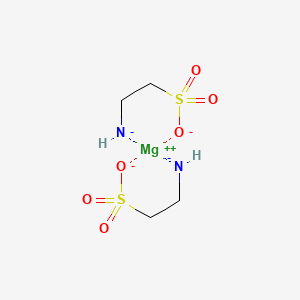 Compound
- Category
- Compound
What Magnesium Taurinate is, and what it does.
- Does it work
- Suits people who already want taurine and would rather get their magnesium alongside it. People whose gut reacts to inorganic salts also tend to do well on it.
- How much to take
- No daily amount is on record. Read the elemental magnesium figure rather than the capsule weight, since taurine accounts for most of that weight.
- Time to feel it
- Nobody has run a human trial on this specific salt. With magnesium generally, changes in sleep and cramping are reported within one to three weeks.
- The first dose
- Day one is usually quiet, and less likely to loosen stools than an inorganic salt. Some people notice a settled feeling on the first evening.
- With regular use
- Over weeks of daily use it keeps topping up magnesium stores while adding a steady taurine intake. Both are slow background changes rather than daily ones.
- How well tolerated
- Well tolerated, with less bowel loosening than the oxides. Check with your doctor if your kidney function is reduced, since magnesium is cleared by the kidney.
- How it feels
- People often describe it as gentler on the stomach than other magnesium. Any evening calm is subtle and builds across a couple of weeks.
- The overlooked benefit
- A fully reacted salt and a physical mix of magnesium and taurine powders are not the same product, and only the label wording tells you which you're holding.
200 to 400mg a day is where Magnesium Taurinate works.
Source: NIH Office of Dietary Supplements + Rosanoff 2012 meta-analysis
The proof, claim by claim.
What these words mean
These words describe the research, not the molecule's worth. Research strength is how much work stands behind one claim, and it is never a product score.
- magnesium delivery with a smaller osmotic bowel effectNarrative review
- taurine as a cellular osmolyte in muscle and retinaNarrative review
2 more claims
- clinical effects of this specific salt in peopleNarrative review
- magnesium cofactor role in ATP-dependent enzymesNarrative review
Why these belong in the same formula, 13 pairings
Why these belong in the same formula. Each row says what the basis is, from settled biochemistry through to a trial that measured the pair.
Each magnesium taurate unit carries two taurine anions, so taking the salt delivers both minerals and a meaningful taurine load. Adding separate taurine on top stacks the same amino sulfonic acid rather than adding something new. Anyone budgeting a taurine intake should count what the chelate already contributes.
Cysteine sulfinic acid decarboxylase, the committed step toward taurine, is a pyridoxal-5-phosphate dependent enzyme, so B6 status governs how much taurine the body makes for itself. Magnesium and B6 are also combined in long-standing formulas on the basis that B6 supports cellular magnesium handling. The biochemistry of the taurine link is settled. The magnesium retention claim is weaker.
Pyridoxal-5-phosphate is the form the decarboxylase actually uses, so it skips the hepatic conversion step that pyridoxine requires. It matters most for people whose conversion capacity is impaired. For everyone else the difference is a formulation preference rather than a functional one.
Both hydroxylation steps that turn vitamin D into its active hormone are magnesium-dependent, as is the binding protein that transports the metabolites. Someone depleted in magnesium responds less to a vitamin D dose. This applies to any salt that raises magnesium status.
Calcium and magnesium compete for intestinal uptake when taken as large simultaneous boluses, and inside the cell magnesium acts as a natural counterweight to calcium influx through voltage-gated channels. Splitting the two across the day avoids the absorption competition. The intracellular relationship is physiology, not something a supplement dose steers directly.
Magnesium depletion opens ROMK channels in the distal nephron and drives potassium into the urine, which is why stubborn low potassium often will not correct until magnesium is restored. The relationship runs in that direction specifically. This is standard clinical physiology and one of the more useful things to know about magnesium.
Zinc and magnesium share transport routes at the enterocyte, so a large dose of one taken at the same moment as the other reduces uptake. Chelated forms sidestep some but not all of this because they still dissociate before absorption. Separating the doses is the simple answer.
Iron and magnesium compete for divalent metal transport in the duodenum when given together at supplement doses. This matters most for anyone correcting low iron status, where every percentage point of absorption counts. Two hours of separation resolves it.
Taurine and theanine both interact with inhibitory neurotransmission, and magnesium modulates NMDA receptor activity through its voltage-dependent block. Stacking them is common in evening formulas. The combination has not been tested, so this is mechanistic overlap and nothing more.
Glycine and taurine both act at glycine receptors, and both are used as the amino acid partner in magnesium chelates. Taking magnesium glycinate and magnesium taurate together stacks two magnesium doses alongside two inhibitory amino acids. Neither form is better than the other. They simply carry a different passenger.
Magnesium chelates and melatonin appear together in sleep products. Melatonin acts on circadian timing through MT1 and MT2 receptors, which is a different route from anything magnesium or taurine does. The pairing is formulation convention rather than a demonstrated interaction.
Thiamine pyrophosphokinase, which converts thiamine to its active pyrophosphate coenzyme, is magnesium-dependent, and the resulting coenzyme works with magnesium at its enzyme sites. Low magnesium therefore produces a functional thiamine problem even when thiamine intake looks adequate. This is well-characterised biochemistry and a genuinely underused pairing.
Coenzyme Q10 shuttles electrons in the respiratory chain while magnesium is required by ATP synthase and by every downstream kinase that spends the ATP. They act at different points of the same production line. The overlap is real biochemistry, though no trial has tested the combination.
Nothing specific on file for Magnesium Taurinate. Match the label to the daily amount above, and tell your doctor what you take.
Not medical advice. Show the label to your pharmacist.What Magnesium Taurinate actually does.
Magnesium taurate pairs one magnesium ion with two taurine molecules, and its elemental magnesium content is low by weight, around eight to nine percent, so a large capsule gives a modest magnesium dose alongside a substantial taurine dose.
3 more mechanisms
Magnesium is a required cofactor for hundreds of enzymes, and every ATP-dependent kinase actually uses magnesium bound to ATP as its substrate, not free ATP.
Magnesium sits inside a specific nerve receptor channel as a voltage-dependent block, which is the physiological basis for its effect on nerve cell excitability.
Taurine is concentrated in heart and skeletal muscle and the retina, where it helps stabilize cell volume and calcium handling, and it's conditionally essential, meaning the body usually makes enough on its own but can fall short under stress or restricted intake.
Where Magnesium Taurinate comes from.
Magnesium is joined to taurine, an amino-acid-like compound the body also makes on its own. Taurine is heavy, so each capsule carries less magnesium by weight than a plain mineral salt would, and less unabsorbed magnesium is left in the gut to pull water in. Some products just mix the two powders and call it the same thing, which it is not.
What this route gives you
The same molecule is reached more than one way. Which route a given product used is a manufacturing choice, and the finished compound is the same either way.
5 steps on record
The magnesium side starts from a mineral salt, usually magnesium oxide, hydroxide or carbonate derived from seawater, brine or magnesite. The taurine side is almost entirely synthetic, made industrially from ethylene oxide and sodium bisulfite or from aziridine chemistry.
Taurine and the magnesium source are reacted in aqueous solution under controlled pH and temperature so magnesium binds the sulfonate groups. Reaction completeness is the whole point of this step.
Unreacted starting material is removed and the product spray-dried or granulated.
Elemental magnesium is assayed and, on properly controlled material, infrared spectroscopy confirms the magnesium is actually bound rather than blended.
Milled to a flowable powder and encapsulated or compressed.
The forms it comes in.
3 more forms
The essence, in one line each.
- A review of trials on magnesium supplementation in people vulnerable to anxiety concluded that the evidence for a benefit on subjective anxiety is suggestive but of poor quality.Systematic review. Boyle NB et al., 2017 (Nutrients). PMID 28445426 ↗
3 more findings
- Oral magnesium N-acetyltaurinate altered measures of synaptic plasticity in rodents, supporting the idea that the taurine-linked salt reaches nervous tissue.Animal study. Fassin M et al., 2020 (Magnesium Research). PMID 33593714 ↗
- A clinical overview of magnesium across enzyme systems, emphasising that serum magnesium poorly reflects total body stores and that depletion is commonly missed.Narrative review. Schwalfenberg GK et al., 2017 (Scientifica). PMID 29093983 ↗
- An induced magnesium depletion model in rats characterised how quickly nervous system excitability changes track falling magnesium status.Animal study. Bac P et al., 1996 (Magnesium Research). PMID 9247876 ↗
Chosen from the 6 we read for Magnesium Taurinate.
FDA Disclaimer: These statements have not been evaluated by the Food and Drug Administration. This information is for educational purposes only and is not intended to diagnose, treat, cure, or prevent any disease. Consult your healthcare provider before starting any supplement regimen.