Monoammonium glycyrrhizinate.
The water-soluble salt of licorice's sweet active. In tiny amounts it sweetens and covers bitterness. In larger amounts it changes how the kidney handles cortisol, sodium and potassium.
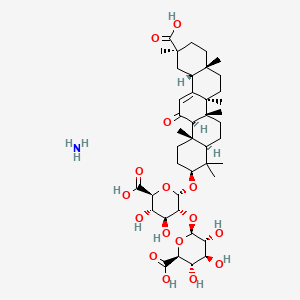 Compound
- Category
- Compound
What Monoammonium Glycyrrhizinate is, and what it does.
- Does it work
- Suits aqueous formulas that need sweetness without sugar. It suits people who keep total licorice intake modest and who keep an eye on potassium and blood pressure.
- How much to take
- No dose figure is on record here. There is a ceiling on record instead: several national authorities set daily glycyrrhizin guidance around 100 mg for the general population.
- Time to feel it
- Sweetness arrives slowly on the palate and lingers. The mineralocorticoid effect is cumulative over days to weeks rather than something a single serving produces.
- The first dose
- Day one is taste and nothing more: slow, sweet, distinctly licorice. The kidney effect needs repeated intake, so it doesn't show up on a first day.
- With regular use
- Weeks of intake above the guidance level show as sodium retention, rising urinary potassium and falling plasma renin and aldosterone. Those are lab readings, not sensations.
- How well tolerated
- Fine at the sweetener levels used in formulation. Intake stacks up across sweets, teas and supplements, and people watching blood pressure or potassium should ask a clinician.
- How it feels
- Very sweet with a long licorice tail. Some people find it comforting and others find it cloying. There's no other felt effect at formulation levels.
- The overlooked benefit
- Absorption depends on gut bacteria removing two sugar units first, so how much reaches your bloodstream is partly a property of your microbiome, not just the amount taken.
The proof, claim by claim.
What these words mean
These words describe the research, not the molecule's worth. Research strength is how much work stands behind one claim, and it is never a product score.
- sweetening and bitterness masking in formulationNarrative review
- inhibition of 11-beta-hydroxysteroid dehydrogenase type 2 and electrolyte handlingRandomised trial
3 more claims
- daily intake guidance for glycyrrhizinNarrative review
- microbial conversion to glycyrrhetinic acid before absorptionNarrative review
- digestive comfort from licorice preparationsNarrative review
Why these belong in the same formula, 9 pairings
Why these belong in the same formula. Each row says what the basis is, from settled biochemistry through to a trial that measured the pair.
This is the interaction that matters most for the ingredient and it works against potassium status. Regular intake over weeks drives potassium out in the urine, and adding potassium alongside does not remove the enzyme inhibition causing it. The effect scales with dose and duration rather than appearing after a single serving.
Sodium retention raises blood pressure, and a high dietary sodium load pushes in the same direction through the same route. The two stack rather than cancel. Several countries set daily glycyrrhizin intake ceilings for this reason.
A product carrying both the salt and whole licorice root delivers one active from two label entries, and total daily glycyrrhizin is what governs the electrolyte effect. Formulators sometimes double up without noticing. Deglycyrrhizinated licorice is the exception because the active has been stripped out.
Glycyrrhizin preparations are used clinically in China and Japan in the setting of elevated liver enzymes, and silymarin occupies a similar role in European practice. Both have antioxidant and membrane-stabilising mechanisms described in laboratory work. Head to head data on the pair against either alone is thin, so read the combination as convention with mechanistic support.
The perinatal cow study reported improvements in oxidative stress markers with monoammonium glycyrrhizinate, which is a marker-level finding in a non-human species. Glutathione operates in the same broad antioxidant network. The pairing is mechanistically coherent and untested in people.
Lipid and aqueous phase antioxidants cover different compartments and do not substitute for one another. Combining them is standard antioxidant formulation. This says nothing about clinical outcomes for either ingredient.
Marshmallow supplies viscous mucilage that physically coats mucosal surfaces, which is unrelated to what glycyrrhizin does. The pairing is old herbal practice. No controlled work has tested the combination.
The two co-occur in gastric and throat formulas across European herbal practice. Chamomile contributes apigenin and related flavonoids with their own laboratory literature. The combination has not been studied and any electrolyte considerations for glycyrrhizin still apply.
Glycyrrhizinate salts are added at low levels as sweeteners and bitterness maskers, and they leave a persistent licorice note. Glycine softens that finish and helps hold formulation pH. This is sensory and physical chemistry with no physiological implication.
Nothing specific on file for Monoammonium Glycyrrhizinate. Match the label to the daily amount above, and tell your doctor what you take.
Not medical advice. Show the label to your pharmacist.What Monoammonium Glycyrrhizinate actually does.
It blocks the kidney enzyme that switches cortisol off locally. Cortisol then behaves like a salt-retaining hormone, so sodium stays and potassium goes.
3 more mechanisms
Gut bacteria have to strip the sugars off before the active form gets absorbed, and that varies from person to person.
The free acid barely dissolves. Making it an ammonium salt lets it go into water properly.
Very sweet with a long finish, so tiny amounts go a long way as a flavour cover.
Where Monoammonium Glycyrrhizinate comes from.
Licorice root goes in, hot water pulls the active out, acid drops it into a solid, and ammonia turns that solid into something that dissolves in water. The result is a very sweet white powder that is the same active molecule found in licorice sweets.
What this route gives you
Made from a plant. What ends up in the capsule tracks the harvest, so batch testing and a stated marker matter more here than with a made molecule.
6 steps on record
Roots and stolons from cultivated and wild stands in China, Uzbekistan, Turkey, Iran and Afghanistan. Glycyrrhizin runs at a few percent of dried root weight and varies by species and region.
Glycyrrhizin sits in the plant as calcium and potassium salts and is pulled into aqueous solution along with flavonoids and polysaccharides.
Acidifying the extract precipitates glycyrrhizic acid, which is filtered, washed and recrystallised to raise purity before salification.
Reaction with ammonia converts the poorly soluble acid into the water-soluble monoammonium salt.
Commercial material is typically specified at 98 percent or higher, with the assay reporting glycyrrhizin content rather than salt form.
Supplied for oral, topical, food and animal feed applications.
Getting Monoammonium Glycyrrhizinate from food.
The whole-food sources on file. A supplement closes the gap, it does not replace dinner.
A gram-for-gram figure (how much of each you would eat to match a dose) will appear here once it is sourced and reviewed. This page will not print a number it cannot cite.
The forms it comes in.
5 more forms
The essence, in one line each.
- The authors reported that dietary monoammonium glycyrrhizinate improved oxidative stress markers in perinatal cows, which is a marker-level finding in livestock and not evidence of any effect in people.Animal study. Zhang C et al., 2023 (Journal of Animal Physiology and Animal Nutrition). PMID 35989475 ↗
Chosen from the 2 we read for Monoammonium Glycyrrhizinate.
Problems people have reported.
Read this carefully. These are 207 voluntary, unverified reactions reported to the FDA (openFDA). The number mostly reflects how popular Monoammonium Glycyrrhizinate is, not how risky it is. A report is not proof Monoammonium Glycyrrhizinate caused anything. It is a signal of what to watch for, nothing more.
3 more reported effects
Source: openFDA adverse-event reports. Voluntary reporting, not an incidence rate.
FDA Disclaimer: These statements have not been evaluated by the Food and Drug Administration. This information is for educational purposes only and is not intended to diagnose, treat, cure, or prevent any disease. Consult your healthcare provider before starting any supplement regimen.