Stinging Nettle Leaf.
Allergy relief. Different from nettle root. A dried green leaf used for comfort through pollen weeks and for everyday joint comfort. It also brings flavonols, vitamin K1, lutein and silica, so it doubles as a leafy-green nutrient source.
Reviewed March 2026
- Category
- Herb
- Also filed under
- AllergiesInflammationProstate
What Stinging Nettle Leaf is, and what it does.
- Does it work
- Suits people who feel pollen weeks keenly and want a food-like leaf rather than an isolate. Mention it to your doctor if you take an anticoagulant, because of the vitamin K1.
- How much to take
- Start with 300 to 600mg a day of dried leaf or leaf extract. That band is where the leaf's flavonols and minerals do their day to day work.
- Time to feel it
- Two to four weeks of daily use for most of it. Through high pollen weeks some people notice easier nasal comfort within a few days.
- The first dose
- Day one is mild and grassy. The leaf sits gently on the stomach with food, and its effect on comfort through pollen weeks builds with repeat dosing.
- With regular use
- Weeks of daily use is the horizon nettle leaf is followed over, and people describe steadier nasal comfort through pollen season. Its vitamin K1, lutein and flavonols add to everyday intake.
- How well tolerated
- Follow dosing guidelines. Consult doctor if needed.
- How it feels
- Allergy symptoms may reduce. Anti-inflammatory effects subtle.
- The overlooked benefit
- The leaf is a genuine source of vitamin K1 and lutein, worth mentioning if you take anticoagulant medication. It also carries oxalate, which binds calcium in the same meal.
300 to 600mg a day is where Stinging Nettle Leaf works.
Source: Lopatkin et al. 2005 World J Urol (BPH); Mittman 1990 Planta Med (allergies).
The proof, claim by claim.
These words describe the research, not the molecule's worth. Research strength is how much work stands behind one claim, and it is never a product score.
Based on 15 human trials.
- Nasal and eye comfort through pollen seasonRandomised trial
- Joint comfort and a healthy inflammatory responseRandomised trial
- Flavonol and carotenoid content of the dried leafNarrative review
- Vitamin K1 content of green leaf materialNarrative review
Questions people ask about Stinging Nettle Leaf.
- When should I take it?
- Timing matters less than consistency. Pick a time that works for you and take it daily.
- Can I take it with other supplements?
- Usually fine. The main thing to watch is not doubling up on the same ingredient from different products. If you're on prescription meds, check with your pharmacist first.
- Any side effects to watch for?
- Most people tolerate it well at recommended doses. GI upset is the most common complaint with any supplement. Start with a lower dose and work up. If something feels off, stop and reassess.
Why these belong in the same formula. Each row says what the basis is, from settled biochemistry through to a trial that measured the pair.
Nettle leaf constituents interfere with histamine H1 signalling and mast cell degranulation, and quercetin stabilises the mast cell membrane upstream of release. Seasonal formulas have combined the two for decades on exactly that split.
Bromelain contributes proteolytic activity on circulating inflammatory mediators, a different action from nettle leaf's effect on histamine signalling and mast cell release. The two are standard members of the same seasonal stack.
Ascorbate keeps the plant iron in nettle leaf in its reduced and soluble ferrous state so the intestine can take it up, offsetting the binding effect of the leaf's own polyphenols. Vitamin C also supports normal histamine turnover, which fits the same use case.
Petasins act on leukotriene synthesis while nettle leaf works mainly on histamine receptor signalling and mast cell release. The two mediator families are separate, so the pairing covers more of the same response.
Nettle leaf carries tannins and flavonoids that bind non-heme iron in the gut lumen into complexes the intestine cannot absorb. Co-dosing an iron salt with the leaf lowers uptake unless ascorbate is present or the two are spaced apart.
The same phenolic and phytate content that binds iron in nettle leaf also chelates divalent zinc in the intestine. Taking the mineral away from the herb keeps that binding from cutting absorption.
Nettle leaf is one of the richer plant sources of vitamin K1, the cofactor that carboxylates osteocalcin so it can bind calcium, while vitamin D governs how much calcium is absorbed. The two vitamins sit at consecutive points in normal bone mineral handling.
The vitamin K1 in nettle leaf activates the matrix proteins that bind calcium into bone. Supplying the mineral alongside the cofactor that directs it is the standard pairing logic.
Nettle leaf is a dark green leaf and carries phylloquinone at levels comparable to other leafy greens, so a dried leaf dose adds meaningfully to vitamin K1 intake. Anyone whose clotting is being managed by a clinician needs consistency of vitamin K intake, and a variable nettle dose works against that. The additivity here is straightforward nutrient arithmetic. Concentrated hydroalcoholic extracts carry far less K1 than whole dried leaf.
Leaf and root of Urtica dioica are chemically different plants for practical purposes: the leaf carries flavonol glycosides, carotenoids, chlorophyll, silica and vitamin K1, while the root carries lignans, sterols and the UDA lectin. Combining them delivers both constituent sets, which no single plant part does. Traditional and modern products often use only one and label it simply as nettle. Checking which part is in a product matters more than the extract ratio.
Nettle leaf accumulates silica in its trichomes and tissue, which is part of why the dried leaf is gritty. Adding a silicon supplement to a nettle leaf formula stacks two sources of the same element. Silica in plant tissue is less soluble than orthosilicic acid preparations, so bioavailability differs between the two sources. The composition point is established. A functional outcome of the combination is not.
Rutin, the quercetin rhamnoglucoside, is among the flavonol glycosides documented in nettle leaf, so an isolated rutin dose raises intake of something the extract already provides. Both need microbial deglycosylation before the aglycone is absorbed. A formulator setting a rutin dose should count the leaf's own contribution. This is compositional, not a demonstrated clinical synergy.
Luteolin and the nettle leaf flavonols are conjugated by the same intestinal glucuronosyltransferases and sulfotransferases, so co-dosing raises competition for that capacity and can raise circulating levels of both. That is a pharmacokinetic expectation from established phase II biochemistry. Whether it changes anything measurable in a person has not been shown for this pair. The direction is additive rather than opposing.
Nettle leaf contributes calcium, magnesium and potassium as a leaf material, though the amounts in a capsule dose are small next to a mineral supplement. Oxalate in the leaf binds part of the divalent mineral load, so what is present is not all available. Combining the two mostly means the mineral supplement dominates the arithmetic. The interaction to note is oxalate binding, not a boost.
Nettle leaf and curcuminoids are co-formulated in products aimed at joint comfort and mobility during activity. Both are heavily glucuronidated, so heavy doses of one occupy conjugation capacity used by the other. No trial has tested the combination in people. The pairing is formulation convention with a mechanistic rationale behind it.
Boswellic acids and nettle leaf flavonols act on different signalling steps within the same broad inflammatory cascade, which is the usual argument for stacking them. The grounding is mechanistic and formulation practice, not a combination trial. Boswellia needs a lipid vehicle for absorption while nettle leaf flavonols do not, so a single format suits one better than the other. Confidence stays at the bottom band.
MSM is a small, highly soluble sulfur donor and nettle leaf is a polyphenol and mineral source, so the two do not compete for anything in absorption. They are stacked because their use cases overlap, not because an interaction has been characterised. No combination study exists. The pairing is a formulation decision.
Glucosamine is an amino sugar substrate for glycosaminoglycan synthesis while nettle leaf contributes polyphenols. The mechanisms are unrelated and independent. They appear together because products in this category bundle several actives. No trial has tested the pair. The row exists so a formula containing both is not read as containing an unstudied novelty.
EGCG and nettle leaf flavonols compete for the same glucuronidation and sulfation enzymes, and both bind non-heme iron in the gut lumen. Stacking two polyphenol-heavy ingredients therefore raises the mineral-binding load of the meal. The conjugation competition can raise exposure to both, which is not automatically desirable. Space either from an iron dose.
Ginger and nettle leaf are combined in infusion practice, largely for palatability and warming character alongside the nettle. The grounding is documentary and culinary rather than pharmacological. No interaction between the two has been characterised. It is listed as a pairing convention.
Oxalate and polyphenols in leaf material bind manganese and other divalent trace minerals in the gut lumen, lowering uptake from that meal. Whole dried leaf carries far more oxalate than a concentrated hydroalcoholic extract does. Spacing a trace mineral dose from a large leaf-powder dose is the ordinary handling. This concerns absorption from a meal, not mineral status over time.
Nothing specific on file for Stinging Nettle Leaf. Match the label to the daily amount above, and tell your doctor what you take.
Not medical advice. Show the label to your pharmacist.What Stinging Nettle Leaf actually does.
Nettle leaf carries flavonol glycosides, mostly rutin, isoquercitrin and kaempferol forms. Gut bacteria or brush-border enzymes have to strip the sugar off before the core compound gets absorbed.
Like other dark green leaves, nettle brings vitamin K1 along with chlorophyll and the carotenoids lutein and beta-carotene.
Silica builds up in the leaf and in the stinging hairs, and that's where the dried powder's slightly gritty texture comes from.
The fresh plant's sting comes from hair contents including histamine, serotonin and formic acid. Drying, cooking or extraction wrecks all of that, so no supplement form stings.
Where Stinging Nettle Leaf comes from.
The leafy tops are cut and dried, which is what removes the sting. From there the leaf is either ground into powder or soaked in water or alcohol to pull out the plant compounds, then the liquid is thickened and dried. Labels usually give a concentration ratio rather than an amount of any one compound.
Made from a plant. What ends up in the capsule tracks the harvest, so batch testing and a stated marker matter more here than with a made molecule.
Leaves cut before or at early flowering, from cultivated stands or managed wild harvest, mostly across Europe. Soil mineral status changes the harvested leaf's mineral and phenolic content
Cut material is dried in shade or warm forced air. Drying destroys the trichome contents responsible for the sting and stops the enzymatic browning that would otherwise degrade the flavonols
For a powder the dried leaf is milled and sieved. For an extract the leaf is macerated or percolated in water, or in an ethanol and water mixture that also carries the less polar constituents
Leaf solids are filtered out and the ethanol is recovered under vacuum at low temperature, leaving a concentrate
Most nettle leaf extracts are sold on a drug-to-extract ratio rather than an assayed marker. Where a marker is used it is usually total flavonoids expressed as rutin
Dried extract is blended with a flow aid and encapsulated, or the liquid concentrate is bottled
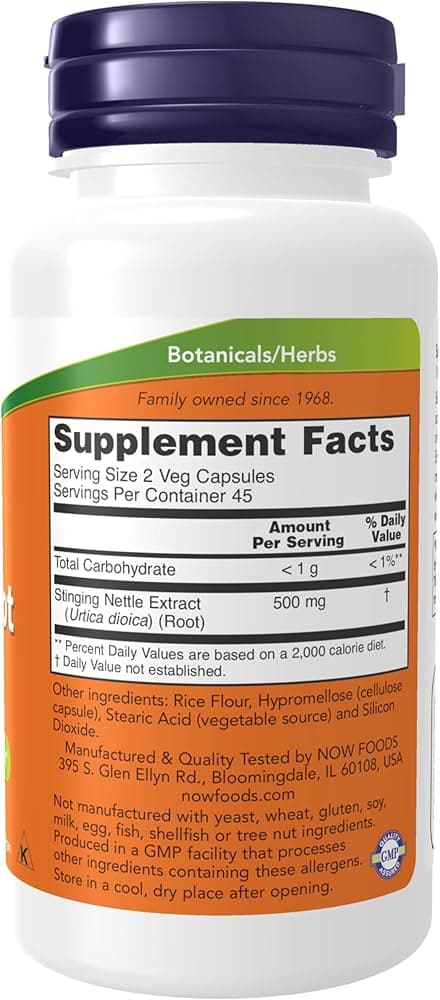
Many labels say only nettle without stating leaf or root, and the two plant parts have different chemistry.
Getting Stinging Nettle Leaf from food.
The whole-food sources on file. A supplement closes the gap, it does not replace dinner.
A gram-for-gram figure (how much of each you would eat to match a dose) will appear here once it is sourced and reviewed. This page will not print a number it cannot cite.
The forms it comes in.
The essence, in one line each.
- A review of the nutritional and pharmacological literature on Urtica dioica, summarising its composition and the range of laboratory and preliminary human work rather than reporting a new outcome.Narrative review. Bhusal et al., 2022 (Heliyon). PMID 35800714 ↗
- Controlled plant nutrition changed the measured nutritional composition of stinging nettle, showing that how the plant is grown alters what ends up in the harvested leaf.In vitro study. Dujmović et al., 2023 (Food Technology and Biotechnology). PMID 38205052 ↗
- Vitamin D3 and a stinging nettle extract were assessed against gastric tissue changes in rats given a chemical irritant. The findings are histological measures in rodents, not human outcomes.Animal study. Gezer et al., 2024 (Veterinarni Medicina). PMID 38623153 ↗
- A review tracing Urtica dioica findings from cell-culture work through to clinical reports. The authors describe cell-level effects that have not been established at ordinary human intakes.Narrative review. Abi Sleiman et al., 2024 (International Journal of Molecular Sciences). PMID 39000608 ↗
- Nettle appeared among the supplements assessed for productive performance in honey bee colonies. An agricultural endpoint in insects with no bearing on human intake.Animal study. Amera et al., 2024 (PLoS One). PMID 38809892 ↗
These are the studies our verdict leans on, chosen from the 5 we read for Stinging Nettle Leaf. The full linked list is below.
FDA Disclaimer: These statements have not been evaluated by the Food and Drug Administration. This information is for educational purposes only and is not intended to diagnose, treat, cure, or prevent any disease. Consult your healthcare provider before starting any supplement regimen.