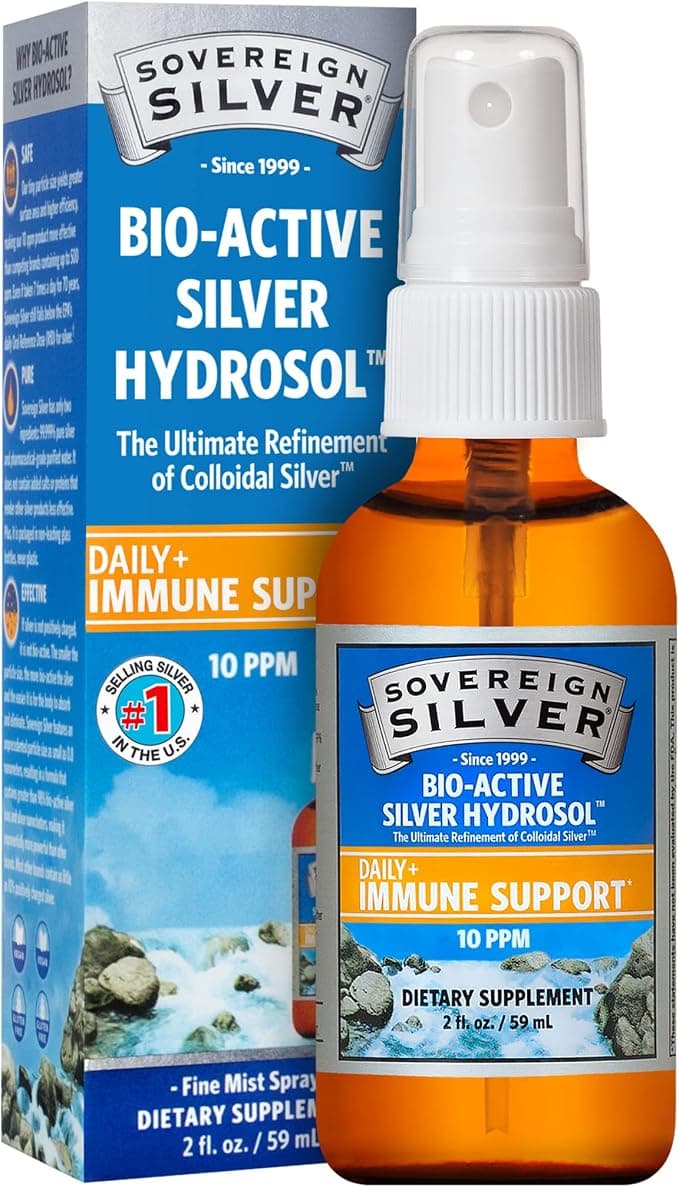
Colloidal Silver.
A controversial supplement claimed to kill pathogens, but with no proven benefits and real safety risks. Silver has no known job in human biochemistry. No enzyme uses it and there is no deficiency state. Its ionic form is antimicrobial in laboratory culture, which is where the interest began.
Reviewed March 2026
- Category
- Mineral
- Also filed under
- Antimicrobial properties in lab settings (topical only)
What Colloidal Silver is, and what it does.
- Does it work
- There is no established human need for silver, and what gets absorbed deposits permanently in skin and mucosa. Anyone considering oral use should speak with their doctor first.
- How much to take
- Zero. There is no safe or effective dose for oral silver supplementation. The recommended intake is none.
- Time to feel it
- There is no onset to describe, because silver has no measured human function to follow. The one documented change, tissue deposition, builds quietly over months to years of intake.
- The first dose
- Nothing beneficial. Silver doesn't produce any positive acute effects.
- With regular use
- Silver accumulates in your organs, skin, and eyes. Long-term use can cause argyria (permanent blue-gray skin discoloration) that doesn't go away even if you stop taking it.
- How well tolerated
- Not safe for internal use. The FDA issued a consumer advisory. Silver accumulates in your body and can cause permanent side effects.
- How it feels
- Nothing positive. If you take enough long enough, you'll eventually notice your skin changing color. That's permanent.
- The overlooked benefit
- Taken by mouth it is a non-selective antimicrobial and does not tell your resident gut bacteria apart from anything else, which matters if you also take a probiotic.
The proof, claim by claim.
These words describe the research, not the molecule's worth. Research strength is how much work stands behind one claim, and it is never a product score.
- Kills harmful bacteria and viruses internally
- Boosts immune system
- Natural antibiotic alternative
Questions people ask about Colloidal Silver.
- Can colloidal silver really turn you blue?
- Yes. Argyria is real and permanent. Silver deposits in your skin and turns it blue-gray. It doesn't go away, ever.
- But silver kills germs in hospitals, right?
- Topically, yes. Silver wound dressings work. But drinking silver and putting it on a wound are completely different things. Your stomach acid and digestive system change everything.
- Is it safe in small amounts?
- The FDA says no amount of oral silver is proven safe or effective as a supplement. Even small amounts accumulate over time.
- Why is it still sold?
- Supplements don't need FDA approval before sale. Companies can sell it as long as they don't make drug claims. Many do anyway.
- What about silver nasal spray?
- Same problems. No proven benefits, potential for silver accumulation in nasal tissues. The FDA hasn't approved any silver nasal products.
- My naturopath recommended it. Should I trust them?
- On this one, the science is very clear: the FDA, NIH, and mainstream medical community all agree oral silver has no proven benefits and real risks. Listen to the consensus here.
Why these belong in the same formula. Each row says what the basis is, from settled biochemistry through to a trial that measured the pair.
Silver ions compete with copper for the same metallothionein and transport handling, and dietary silver lowers copper retention in animal nutrition studies. A silver-containing product therefore works against copper status.
Silver binds selenide with very low solubility, so silver ions lock up reduced selenium and lower the amount available to selenoprotein synthesis. This is inorganic chemistry rather than a nutritional inference.
Silver ions have an extremely high affinity for sulfhydryl groups, so any thiol in the gut binds free silver and removes it from solution. NAC is a thiol donor, so the two act on each other directly.
The sulfhydryl group of cysteine complexes silver ions on contact, which is the textbook basis for the affinity of silver for proteins. Co-dosing reduces the free ion pool.
Glutathione binds silver through its cysteine thiol, forming a complex that removes the free ion from solution. It is the same chemistry that governs how cells handle heavy metal ions.
Ascorbate is a reducing agent strong enough to convert silver ions to metallic silver, a reaction routinely used to make silver particles in the laboratory. Taken together, ascorbate changes the chemical species present.
Silver ions are antibacterial across species, so they act on delivered lactic acid bacteria the same way they act on other organisms in the lumen. The two should not share a dose.
Silver ions bind avidly to the cysteine thiols of metallothionein, the same sites zinc and copper occupy, and silver exposure induces metallothionein expression. That competition is the recognised route by which a soft-metal load shifts handling of the essential trace metals. The direction and size of any change in zinc status from an oral silver product has not been characterised. Flagged as a competition to be aware of, not a benefit.
A published study gave vitamin E together with vitamin C and reported better immunological and biochemical readouts against silver nanoparticle toxicity in experimental animals. The framing there is protection from an exposure, not a nutritional pairing that adds benefit. It says nothing about a person taking a colloidal silver supplement by choice. Read it as a toxicology lead at low confidence.
Dietary silver nanoparticle supplementation in a published animal model produced a Bifidobacterium-poor gut community, and the reported brain changes tracked with that deficiency rather than with silver alone. An antimicrobial taken by mouth does not distinguish resident commensals from anything else. That is the mechanistic reason to flag silver against any Bifidobacterium-containing product. The evidence is a model system and what was reported is an association, not a cause established in people.
Talk to a doctor before taking Colloidal Silver if any of these apply to you: FDA warns it's not safe or effective, Can cause permanent skin discoloration (argyria), Interferes with antibiotic and thyroid medication absorption, No proven health benefits when taken orally, Not an essential mineral. These are flags to check first, not effects Colloidal Silver is known to cause.
Not medical advice. Show the label to your pharmacist.What Colloidal Silver actually does.
The human body does not use silver for anything, so there is nothing for a silver supplement to fill in.
Silver kills microbes in a dish because the dissolved ion sticks to their proteins and membranes.
Silver that gets absorbed settles into skin and nails as dark particles, and that colour change does not wash out.
Swallowed silver hits gut bacteria you want along with anything else.
Getting Colloidal Silver from food.
The whole-food sources on file. A supplement closes the gap, it does not replace dinner.
A gram-for-gram figure (how much of each you would eat to match a dose) will appear here once it is sourced and reviewed. This page will not print a number it cannot cite.
The forms it comes in.
The essence, in one line each.
- The authors report permanent slate-grey discolouration of the nails and face after colloidal silver supplementation, and raise the practice itself as the medical concern.Case report. Park SW et al., 2013 (Annals of Dermatology). PMID 23463831 ↗
- Dietary silver nanoparticle supplementation produced brain lesions in this animal model, and the effect tracked with a silver-induced loss of Bifidobacterium rather than with silver reaching the brain directly.Animal study. Shou R et al., 2026 (NPJ Science of Food). PMID 41935066 ↗
- Vitamins E and C were reported to improve immunological and biochemical responses against silver nanoparticle toxicity in the experimental animals studied. The paper is about limiting harm from an exposure.Animal study. Iqbal KJ et al., 2023 (PLOS ONE). PMID 37104295 ↗
- Ashwagandha-derived silver nanoparticles were reported to change pre-freeze and post-thaw semen quality measures in bulls. A veterinary semen-processing application.Animal study. Kanwar A et al., 2025 (Frontiers in Veterinary Science). PMID 41684717 ↗
- In ovo administration of silver nanoparticles was associated with changes in post-hatch growth and metabolic measures in poultry. Species-specific and not applicable to human intake.Animal study. Al-Khalaifah H et al., 2026 (Animals). PMID 42121769 ↗
- Silver nanowires inhibited Vibrio pathogens and altered shrimp immune measures in an aquaculture setting. An antimicrobial application in animals.Animal study. Sahoo SR et al., 2026 (Life). PMID 42073355 ↗
- Chitosan-silver nanocomposites showed additive antimicrobial and antiviral activity against insect pathogens in laboratory testing.In vitro study. Xu T et al., 2026 (Insects). PMID 42042445 ↗
These are the studies our verdict leans on, chosen from the 7 we read for Colloidal Silver. The full linked list is below.
The studies, linked.
1 source behind our Colloidal Silver verdict: peer-reviewed studies and registered clinical trials. Every one links straight to PubMed, the journal, or ClinicalTrials.gov. Read them yourself.
Evidence surfaced via Semantic Scholar (Allen Institute for AI) and ClinicalTrials.gov. Ranked by study type and citation weight, not cherry-picked.
Problems people have reported.
Read this carefully. These are 329 voluntary, unverified reactions reported to the FDA (openFDA). The number mostly reflects how popular Colloidal Silver is, not how risky it is. A report is not proof Colloidal Silver caused anything. It is a signal of what to watch for, nothing more.
Source: openFDA adverse-event reports. Voluntary reporting, not an incidence rate.
FDA Disclaimer: These statements have not been evaluated by the Food and Drug Administration. This information is for educational purposes only and is not intended to diagnose, treat, cure, or prevent any disease. Consult your healthcare provider before starting any supplement regimen.