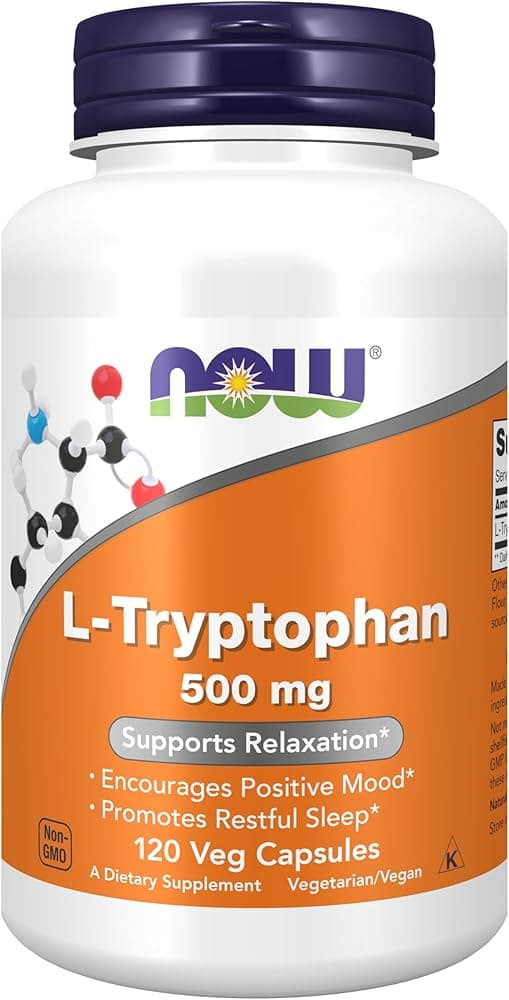
Tryptophan.
Research-backed amino acid with potential health benefits. Your body turns it into serotonin (for mood) and then melatonin (for sleep). It's a foundational piece for your brain's calming systems.
Reviewed March 2026
- Category
- Amino acid
What Tryptophan is, and what it does.
- Does it work
- Maybe. It's a gentler approach to sleep than direct melatonin. If you have mild trouble falling asleep, it's worth a shot.
- How much to take
- For sleep, 1-5 grams 30-60 minutes before bed. Start low with 1 gram and see how you feel. Best taken on an empty stomach or with a small amount of carbs.
- Time to feel it
- A drowsy edge can arrive within an hour of an evening dose. A clearer pattern in how quickly you drop off usually takes about a week of consistent nights.
- The first dose
- You might feel a gentle drowsiness an hour after your first dose. Or you might feel nothing. It can take a few nights to notice a pattern.
- With regular use
- Consistent use may lead to falling asleep faster and potentially a slightly better mood. Effects on mood are less established than those for sleep.
- How well tolerated
- Well tolerated in most, but the big one: DO NOT take with antidepressants (SSRIs, MAOIs). Risk of serotonin syndrome. If you're on any psych meds, this is a 'talk to your doctor first' supplement.
- How it feels
- A gentle nudge toward sleep. Calm, not sedated. Like the sleepiness you get after a big, carb-heavy meal, but cleaner.
- The overlooked benefit
- It shares its route into the brain with the other large neutral amino acids, so a small carbohydrate snack alongside it lowers the competition while a protein meal raises it.
250 to 1,000mg a day is where Tryptophan works.
Source: Silber & Schmitt (2010) J Psychiatry Neurosci; Hartmann (1982) J Nerv Ment Dis
The proof, claim by claim.
These words describe the research, not the molecule's worth. Research strength is how much work stands behind one claim, and it is never a product score.
Tryptophan is documented in the library. The clinical read is in the queue. Nothing about the strength of the research prints until the read is done.
- Falling asleep more easilyMeta-analysis
- Mood steadiness through the dayRandomised trial
- Serotonin and melatonin synthesis as the precursorNarrative review
- Niacin supply through the kynurenine pathwayNarrative review
Questions people ask about Tryptophan.
- Is this the same as 5-HTP?
- Close, but no. Tryptophan is the step before 5-HTP. Your body has more control over converting Tryptophan, which some see as a built-in safety feature.
- Will it make me groggy in the morning?
- Usually not. Because your body makes melatonin from it, the effect is more natural and less likely to cause a 'hangover' than some sleep aids.
- Is this why turkey makes me sleepy?
- Partly, but it's mostly a myth. The carbs and sheer volume of a Thanksgiving meal do more of the work. Tryptophan needs to be taken without other protein to have a strong effect on the brain.
- What's the best time to take it?
- About 30-60 minutes before you want to go to sleep. Taking it on an empty stomach or with a light carbohydrate snack can help it cross into the brain.
- Can I take it every night?
- Seems to be well tolerated in nightly use for most people, but it's always smart to cycle off supplements occasionally. Check with your doctor for long-term use.
Why these belong in the same formula. Each row says what the basis is, from settled biochemistry through to a trial that measured the pair.
Tryptophan hydroxylase converts tryptophan into 5-HTP, the rate limiting step of serotonin synthesis. Supplying 5-HTP skips that regulated step.
5-HTP sits one enzymatic step past tryptophan on the serotonin route. The two occupy consecutive positions on one pathway.
The L form is the one that enters the hydroxylation route. Both entries deliver the same molecule.
Pyridoxal phosphate is needed to decarboxylate 5-HTP into serotonin and again at kynureninase on the NAD branch. Low B6 shifts where tryptophan ends up.
Roughly sixty milligrams of tryptophan can yield one milligram of niacin equivalent through the kynurenine route. Supplying niacin lowers the pull on tryptophan for that purpose.
Kynurenine monooxygenase is FAD dependent, so riboflavin governs flow along the NAD branch of tryptophan metabolism. It decides how much tryptophan continues past that fork.
Tryptophan hydroxylase is a non heme iron enzyme using tetrahydrobiopterin. Iron status affects the first and rate limiting step toward serotonin.
The last step from N-acetylserotonin to melatonin is a SAM dependent methylation. Methyl group availability caps the end of the tryptophan route.
Melatonin is the terminal product of tryptophan through serotonin. Supplying both loads one route at its start and its finish.
Tyrosine and tryptophan are both large neutral amino acids using the same brain transporter. Dosing them together lowers the brain entry of each compared with dosing alone.
Branched chain amino acids compete with tryptophan at LAT1. A protein or BCAA load taken alongside blunts tryptophan uptake into the brain.
St John's wort slows serotonin reuptake while tryptophan raises the amount available for synthesis. Combining them pushes the same signal from supply and clearance at once, which calls for care.
Theanine works on glutamate signalling and alpha wave activity rather than serotonin supply. The levers do not overlap.
Glycine acts at its own inhibitory receptor and influences body temperature at night. It complements a serotonin precursor rather than duplicating it.
LAT1 has limited capacity and carries tryptophan, phenylalanine, tyrosine, leucine, isoleucine, valine and methionine as a group. Raising one raises its share of the carrier and lowers everyone else's entry into brain tissue. This is why the tryptophan to LNAA ratio, not the absolute amount, is what the transport literature tracks. Taking the two together works against the reason someone takes tryptophan.
Branched-chain amino acids are the largest competing fraction after a protein meal. A branched-chain dose taken alongside tryptophan lowers the tryptophan to LNAA ratio and reduces central tryptophan entry. Separating them in time is the straightforward answer. The step affected is transport, which is measurable, not a downstream mood outcome.
Methionine sits in the large neutral amino acid group that shares the carrier. Co-dosing raises the competing load. The interaction is transport chemistry and applies equally to any of the group. It is a timing consideration in a formula rather than a reason to avoid either.
A whey dose delivers a large branched-chain load with comparatively little tryptophan. That shifts the carrier competition against tryptophan even though total tryptophan intake goes up. Alpha-lactalbumin-enriched fractions are the exception, since they carry an unusually high tryptophan share. Read the interaction as ratio-driven, not amount-driven.
Every ATP-using enzyme in the pathway works on the magnesium-ATP complex rather than free ATP. Magnesium and tryptophan are combined in sleep-oriented formulas for that reason plus their separate calming profiles. The cofactor relationship is established biochemistry. The combined behavioural effect is not something a trial has isolated. Read the pairing as mechanistic.
The rate-limiting hydroxylation of tryptophan needs BH4 as the electron donor, and BH4 is regenerated by dihydrofolate reductase alongside its folate role. Poor folate handling therefore intersects with pterin availability. The link is real biochemistry but the size of any effect on serotonin synthesis in people has not been established. It is mechanistic, not clinical.
More than ninety percent of ingested tryptophan goes down the kynurenine route, and a fraction of that terminates in quinolinic acid and then NAD. Nicotinamide riboside enters the same NAD pool through the salvage route instead. Adequate preformed niacin equivalents reduce the pull on tryptophan for NAD synthesis. The convergence is established biochemistry.
Lactobacilli and other commensals convert tryptophan to indole, indole-3-lactate and related compounds that act on the aryl hydrocarbon receptor in gut tissue. That consumption is a genuine competing sink for luminal tryptophan and also produces its own signalling molecules. Which direction dominates depends on the strain and the transit time. The pathway is well described. A specific combination effect in people is not.
Feeding saccharolytic bacteria with inulin shifts fermentation away from protein breakdown, which alters indole production from tryptophan. The direction of that shift depends on the starting microbiome. Nothing here has been measured as a combination in a supplement setting. It is flagged as a plausible interaction rather than a claimed one.
Tryptophan supports serotonin and melatonin synthesis, while valerian constituents act on GABAergic signalling. The routes differ but the subjective effect on alertness points the same way. Anyone taking both should know the drowsiness can stack. No combination trial has measured the pair.
Apigenin has affinity for the benzodiazepine binding site on GABA-A receptors. Combined with tryptophan's serotonergic route, the two contribute to sleepiness through separate mechanisms. Stacked drowsiness is the practical point. This is a formulation convention with no combination study behind it.
Magnolia lignans modulate GABA-A allosterically, a different route from tryptophan's serotonin pathway. The sedative direction is shared. Combined use raises the chance of next-morning grogginess. No study has tested the two together.
Tryptophan is the substrate for serotonin and then melatonin, while GABA is itself an inhibitory transmitter, though how much oral GABA reaches the brain is disputed. Formulators pair them for the shared use case. Additive drowsiness is the practical consideration. The pairing is convention, not measured combination evidence.
Kynureninase and related steps in tryptophan degradation depend on pyridoxal phosphate, and zinc status intersects with vitamin B6 handling. The connection is indirect and described mostly in mechanistic work. No human co-supplementation study exists. Read it as a plausible cofactor link rather than an interaction to act on.
Passionflower is used for evening calm through GABA-related mechanisms distinct from tryptophan's serotonergic route. The subjective effects point the same way and can stack. No trial has measured the pair together. It is a category convention.
Nothing specific on file for Tryptophan. Match the label to the daily amount above, and tell your doctor what you take.
Not medical advice. Show the label to your pharmacist.What Tryptophan actually does.
Tryptophan is an essential amino acid built around an indole ring. The body can't make it, so all of it comes from the diet.
It's the scarcest amino acid in most food proteins. Because there's so little of it to begin with, its share swings more from food to food than other amino acids do.
Tryptophan hydroxylase adds a hydroxyl using tetrahydrobiopterin, iron and oxygen. It's the slow step in making serotonin, and it isn't running flat out at normal tryptophan levels.
A decarboxylase then turns that hydroxylated intermediate into serotonin, using the active form of vitamin B6 as its cofactor.
Where Tryptophan comes from.
Bacteria are fed sugar in a tank and make tryptophan, which they release into the liquid around them. The cells are filtered out and the amino acid is captured on a resin, decolourised and crystallised until it is pure. The purity testing is the part that matters most here, because a contamination problem in one manufacturer's process in 1989 is what shaped how this ingredient is checked today.
Built by fermentation, the same way vitamin B12 and many amino acids are made at scale. Controlled conditions, consistent output.
Glucose from corn or another starch source, plus an inorganic nitrogen source such as ammonium salts, feeds the fermentation.
An engineered Escherichia coli or Corynebacterium glutamicum strain with a deregulated shikimate and tryptophan operon converts the sugar to L-tryptophan and secretes it into the broth.
Biomass is removed by centrifugation and filtration, leaving a broth containing tryptophan alongside residual nutrients and by-products.
The amino acid is captured on ion exchange resin, eluted, and passed through activated carbon to remove pigment and related impurities.
Concentrated eluate is crystallised, and the crystals are washed and recrystallised to reach pharmaceutical or food grade assay.
Material is released on assay, optical rotation confirming the L-enantiomer, and a chromatographic impurity profile. The impurity profile is the specification that changed most after the historical 1989 contamination episode traced to one manufacturer's process.
Dried crystals are milled to a defined particle size and filled into capsules or tabletted with binders and flow agents.
Getting Tryptophan from food.
The whole-food sources on file. A supplement closes the gap, it does not replace dinner.
A gram-for-gram figure (how much of each you would eat to match a dose) will appear here once it is sourced and reviewed. This page will not print a number it cannot cite.
The forms it comes in.
The essence, in one line each.
- A systematic review with meta-analysis and meta-regression of tryptophan supplementation and sleep quality measures, pooling the available human trials and examining dose as a moderator.Meta-analysis. Sutanto et al., 2022 (Nutrition Reviews). PMID 33942088 ↗
- A systematic review of L-tryptophan supplementation and its reported effects on mood and emotional functioning measures in human studies.Systematic review. Kikuchi et al., 2021 (Journal of Dietary Supplements). PMID 32272859 ↗
- Tested 5-hydroxytryptophan, the immediate downstream metabolite of tryptophan, in adults scoring high on an attention and activity symptom scale. The tested compound is 5-HTP rather than tryptophan itself.Randomised trial. Jackson et al., 2026 (PLoS One). PMID 42160304 ↗
- A systematic review of dietary tryptophan as a modulator of behaviour and productivity measures in sows. Animal production data, not human evidence.Systematic review. Buchini et al., 2026 (Journal of Animal Science). PMID 42054598 ↗
- Dietary tryptophan supplementation was evaluated for effects on body temperature, hormone and cytokine measures in heat-exposed broilers.Animal study. Li et al., 2022 (Tropical Animal Health and Production). PMID 35435494 ↗
- Ruminal 5-hydroxytryptophan raised serum serotonin and produced peripheral vasodilation in growing beef cattle, a direct demonstration of the precursor to serotonin step in a large animal.Animal study. Matos et al., 2026 (Journal of Animal Science). PMID 42398021 ↗
- Examined tryptophan supplementation amounts against stress-related and productivity measures in aging laying hens.Animal study. Hosseindoust et al., 2026 (Journal of Animal Science and Technology). PMID 41982991 ↗
- Tryptophan supplementation was assessed against performance, hormone and behavioural measures in weaning pigs and lactating sows.Animal study. Park et al., 2026 (Journal of Animal Science and Technology). PMID 41982998 ↗
- Tryptophan added to low-protein diets in late gestation and lactation was measured against sow performance outcomes.Animal study. Gao et al., 2026 (Animal Nutrition). PMID 42317453 ↗
- Dietary L-tryptophan reduced markers of ammonia-related stress in Nile tilapia fingerlings.Animal study. Mohammady et al., 2025 (Scientific Reports). PMID 41339441 ↗
- Dietary tryptophan attenuated lung injury markers after a lipopolysaccharide challenge in a mouse model, an inflammatory-challenge mechanism study.Animal study. Lai et al., 2026 (Nutrients). PMID 42451046 ↗
These are the studies our verdict leans on, chosen from the 11 we read for Tryptophan. The full linked list is below.
The studies, linked.
12 sources behind our Tryptophan verdict: peer-reviewed studies and registered clinical trials. Every one links straight to PubMed, the journal, or ClinicalTrials.gov. Read them yourself.
- Clinical trialA Phase III Trial Evaluating the Role of Ovarian Function Suppression and the Role of Exemestane as Adjuvant Therapies for Premenopausal Women With Endocrine Responsive Breast CancerClinicalTrials.gov ↗Phase 3, 3,066 participants, Completed
- Clinical trialA Placebo Controlled Trial Of L-Tryptophan In Post-Operative DeliriumClinicalTrials.gov ↗Phase 3, 301 participants, Completed
- Clinical trialCustodiol-HTK Solution as a Cardioplegic Agent- A Prospective Non-Inferiority Randomized Clinical TrialClinicalTrials.gov ↗Phase 2, 110 participants, Completed
- ClinicalTrials.gov ↗
- Clinical trialInvestigating the Role of Serotonin in Emotional Processing Through the Use of Tryptophan DepletionClinicalTrials.gov ↗91 participants, Completed
- Clinical trialA Phase 1 Study of 1-Methyl-D-tryptophan in Patients With Advanced MalignanciesClinicalTrials.gov ↗Phase 1, 52 participants, Completed
- Clinical trial[11C]5-Hydroxy-tryptophan Positron Emission Tomography for Assessment of Islet Mass During Progression of Type 2 DiabetesClinicalTrials.gov ↗39 participants, Completed
- Clinical trialEffect of Amino Acids and Sugar Alcohols on Gastric Emptying and Release of Satiation Peptides in Normal Weight and Obese SubjectsClinicalTrials.gov ↗20 participants, Completed
- Clinical trialExploration of the Role of Tryptophan Metabolites in Pediatric MigraineClinicalTrials.gov ↗200 participants, Unknown
- Clinical trialTryptophan-kynurenine Pathway PET Imaging in Human GliomasClinicalTrials.gov ↗Phase 2, 61 participants, Not yet recruiting
- Clinical trialEffect of the Quality of Dietary Proteins on the Sleep Young Elite Athletes and the Obese AdolescentClinicalTrials.gov ↗48 participants, Unknown
- ClinicalTrials.gov ↗
Evidence surfaced via Semantic Scholar (Allen Institute for AI) and ClinicalTrials.gov. Ranked by study type and citation weight, not cherry-picked.
Problems people have reported.
Read this carefully. These are 4,837 voluntary, unverified reactions reported to the FDA (openFDA). The number mostly reflects how popular Tryptophan is, not how risky it is. A report is not proof Tryptophan caused anything. It is a signal of what to watch for, nothing more.
Source: openFDA adverse-event reports. Voluntary reporting, not an incidence rate.
FDA Disclaimer: These statements have not been evaluated by the Food and Drug Administration. This information is for educational purposes only and is not intended to diagnose, treat, cure, or prevent any disease. Consult your healthcare provider before starting any supplement regimen.