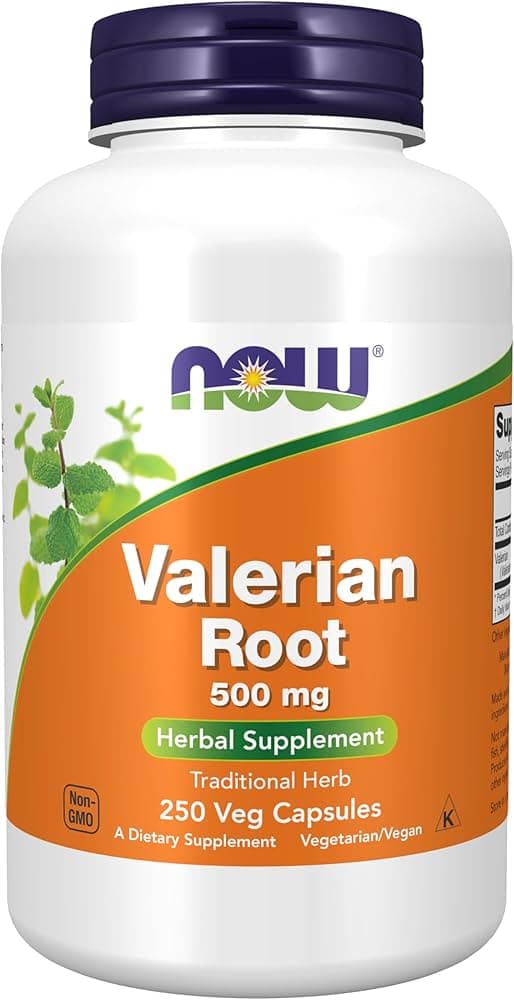
Valerian Aqueous Extract.
Valerian Aqueous Extract supplementation for targeted health support. Supports sleep through GABA modulation. Aqueous extraction captures different compounds than alcohol extraction, potentially more water-soluble actives.
Reviewed March 2026
- Category
- Sleep
What Valerian Aqueous Extract is, and what it does.
- Does it work
- Milder than standard valerian. Good for those sensitive to strong extracts. Evidence is decent but not overwhelming.
- How much to take
- 300-600mg aqueous extract 30-60 minutes before bed. May need higher doses than alcohol extracts.
- Time to feel it
- Some people notice a gentler settling on the first evening. The sleep quality changes measured in trials build across two to four weeks of taking it at the same time nightly.
- The first dose
- Mild relaxation. May or may not notice sleep improvement first night.
- With regular use
- Sleep quality often improves over 2-4 weeks of consistent use.
- How well tolerated
- Good safety profile. Morning drowsiness possible. Avoid with sedatives.
- How it feels
- Gentle calming. Less intense than alcohol-based valerian.
- The overlooked benefit
- Hot water pulls out the root's water-soluble fraction, including free GABA and glutamine, and leaves most of the volatile oil behind, so it smells milder than an alcohol extract.
300 to 600mg a day is where Valerian Aqueous Extract works.
Source: Bent 2006 meta + Fernández 2004 review
The proof, claim by claim.
These words describe the research, not the molecule's worth. Research strength is how much work stands behind one claim, and it is never a product score.
- Improves sleep qualityClinical trials (mixed results)
- Reduces sleep onset timeSome studies positive
- Less odor than alcohol extractChemical analysis
Questions people ask about Valerian Aqueous Extract.
- Why aqueous vs regular?
- Water extraction captures different compounds than alcohol. Less pungent smell, potentially milder effects.
- Does it work as well?
- Possibly milder. Some prefer it for the gentler approach. Others need stronger alcohol-based extracts.
- Why does valerian smell bad?
- Isovaleric acid and other volatile compounds. Aqueous extracts have less of this, hence less smell.
- Can I take it with melatonin?
- Generally yes. Start with lower doses of each to assess combined effect.
Why these belong in the same formula. Each row says what the basis is, from settled biochemistry through to a trial that measured the pair.
Valerian and hops have been formulated as a fixed combination in European sleep preparations for decades. Valerenic acid modulates the beta subunit of the GABA-A receptor while hop bitter acids act on GABA and melatonin receptor signalling.
Lemon balm rosmarinic acid inhibits GABA transaminase, so more GABA stays in the synapse, which complements the receptor-side modulation of valerenic acid. The two are a long-standing European combination.
Passiflora flavonoids act on GABA-A binding and GABA uptake, the same inhibitory system valerenic acid modulates. It is one of the standard third members of a valerian sleep blend.
Melatonin acts on MT1 and MT2 receptors to shift circadian timing while valerian acts on inhibitory neurotransmission. One handles when sleep starts, the other handles how readily it comes on.
Theanine modulates glutamate receptor binding and raises alpha-band activity, lowering excitatory tone from a direction different to the GABA-A modulation of valerenic acid.
Magnesium blocks the NMDA receptor channel and positively modulates GABA-A, and the glycine carrier is itself an inhibitory transmitter. It is the standard mineral base under a valerian sleep formula.
Glycine acts at its own inhibitory receptor and lowers core body temperature through peripheral vasodilation, the normal signal that precedes sleep onset. That is a separate route from GABA-A modulation.
Apigenin from chamomile binds the benzodiazepine site of the GABA-A receptor, a neighbouring site to where valerenic acid acts on the same complex.
Jujubosides and spinosin from sour date seed act on GABAergic and serotonergic sleep signalling, which overlaps with the inhibitory route valerenic acid works through. It is a common addition to valerian blends.
Kavalactones modulate GABA-A binding and block voltage-gated sodium channels, which layers directly onto the inhibitory action of valerian. The combined drowsiness is additive, so total load and timing matter.
Valerenic acid from valerian root behaves as a partial modulator at the beta subunit of the GABA-A receptor, and water extraction also carries free GABA and glutamine out of the root. Supplemental GABA is poorly transported across the blood brain barrier in adults, so most of any combined effect is likely receptor-side rather than additive transmitter loading. The pairing is common in evening formulas and rests on shared pathway logic, not on a combination trial.
Apigenin, the flavone concentrated in chamomile, binds the benzodiazepine site of the GABA-A receptor with low affinity. Valerenic acid acts at the beta2 and beta3 subunits instead, so the two occupy separate sites on one receptor complex. Formulators pair them for that reason. The additive claim is mechanistic and has not been isolated in a human combination trial.
L-tryptophan is the dietary precursor for serotonin and, downstream, melatonin, which is a different lever from valerian's receptor-side activity. Because the two do not compete for the same target, a formula can carry both without one blunting the other. Support for the pair is pathway reasoning rather than a head-to-head study.
5-HTP bypasses the rate-limiting hydroxylation step that governs tryptophan conversion, so it raises serotonin synthesis capacity more directly. Paired with valerian it addresses a separate signalling route in normal sleep onset. Sedation from the two may stack, which belongs on a label. No combination trial has measured the pair.
Honokiol and magnolol act as positive modulators at GABA-A receptors, the same complex valerenic acid touches. Stacking two modulators of one receptor may produce more drowsiness than either alone, which is the intended effect at night and an unwanted one during the day. Dose the pair for evening use and expect the sedative component to add.
Ashwagandha root extracts show GABA-mimetic activity in receptor work and are widely used in evening formulas alongside valerian. The two act through overlapping inhibitory signalling, so calm and drowsiness tend to add rather than cancel. No combination trial isolates the pair, so this is a mechanism-level pairing.
Caffeine blocks adenosine A1 and A2A receptors to reduce sleep pressure, while valerian constituents interact with A1 signalling and GABA-A in the direction of increased inhibition. Taken close together the two oppose each other on the same axis. Separating them by time of day is the practical consequence, and this is settled pharmacology rather than a study finding.
Hyperforin in St John's wort is a potent activator of the pregnane X receptor, which induces CYP3A4 and P-glycoprotein. Anything cleared through that route, including co-administered botanicals and many prescription medicines, is turned over faster. Sedative effects may also stack, so the combination is worth flagging in both directions.
Hops cones and valerian root have been combined in European evening preparations for a long time and appear together in many modern sleep formulas. Both carry constituents with activity at inhibitory receptors. The pairing has more usage history behind it than isolated combination data, so it reads as a long-standing formulation practice rather than a tested combination.
Lavender oil constituents act on voltage-gated calcium channels and on serotonergic signalling rather than directly on the GABA-A beta subunit. That makes lavender a non-overlapping partner for valerian in an evening formula. Evidence for the pair is limited to shared use, not a combination trial.
Nothing specific on file for Valerian Aqueous Extract. Match the label to the daily amount above, and tell your doctor what you take.
Not medical advice. Show the label to your pharmacist.What Valerian Aqueous Extract actually does.
Valerenic acid, a compound concentrated in valerian root, works as a positive modulator at the beta2 and beta3 parts of the GABA-A receptor. It turns up the receptor's answer to GABA already present rather than opening the channel itself.
Hot-water extraction pulls the water-loving fraction of the root, including free GABA, glutamine and valepotriate breakdown products, and leaves most of the volatile oil behind. That oil carries isovaleric acid, the source of the smell.
Valepotriates in fresh valerian root are unstable and fall apart during drying and extraction, so a finished extract's compound profile reflects the processing route as much as the raw plant.
Valerian root compounds also slow GABA transaminase, the enzyme that breaks GABA down, which is a second route by which inhibitory tone can be kept up.
Getting Valerian Aqueous Extract from food.
The whole-food sources on file. A supplement closes the gap, it does not replace dinner.
A gram-for-gram figure (how much of each you would eat to match a dose) will appear here once it is sourced and reviewed. This page will not print a number it cannot cite.
The forms it comes in.
The essence, in one line each.
- Among botanicals reviewed for psychological wellbeing in older women, valerian was one of the more studied options, with the included trials reporting modest improvement in self-reported mood and sleep measures.Systematic review. Sultana et al., 2025 (Frontiers in pharmacology). PMID 41158136 ↗
- In a review of herbal and nutritional supplements taken for feelings of anxiousness, valerian trials gave mixed results and the authors judged the supporting evidence limited.Systematic review. Lakhan et al., 2010 (Nutrition journal). PMID 20929532 ↗
- Reviewing the human and mechanistic work on Valeriana species and sleep, the authors describe small improvements in self-reported sleep quality alongside GABAergic mechanisms, while noting the clinical trials are small and varied.Review. Yang et al., 2026 (Pharmaceutical biology). PMID 41995686 ↗
- A literature review of natural supplements used for sleep placed valerian among the most studied, with reported benefits on self-reported time to fall asleep that were not consistent across trials.Review. Yeom et al., 2024 (Psychiatry investigation). PMID 39086164 ↗
- Valerian extract delivered in drinking water was assessed against stress indicators, performance and egg quality under different stocking densities. The findings are animal-husbandry outcomes and do not carry over to human sleep.Animal study. Huapaya et al., 2026 (Poultry Science). PMID 41946076 ↗
- Valerian extract and lemon balm shifted several neurobiomarkers in broilers, which supports a central mechanism and is a marker change in birds rather than a human outcome.Animal study. Maty et al., 2025 (Open Veterinary Journal). PMID 41630723 ↗
- The review summarises the herbal preparations people most often take for sleep difficulty and counts valerian among them, noting the human evidence base is mixed and the preparations studied differ widely.Narrative review. Chabo et al., 2024 (American Journal of Lifestyle Medicine). PMID 38737887 ↗
- Valerian appears in this review of medicinal plants used in children, with the authors describing active constituents and calling for rational, dose-aware use rather than asserting an established effect.Narrative review. Rigillo et al., 2025 (Children). PMID 41007011 ↗
- Valerian is named among the herbal interventions pooled in this systematic review and meta-analysis of phytotherapy in children with attention and activity difficulties. The pooled data for any single plant, including valerian, is thin.Systematic review. Dutta et al., 2022 (Frontiers in Pharmacology). PMID 35592415 ↗
These are the studies our verdict leans on, chosen from the 80 we read for Valerian Aqueous Extract. The full linked list is below.
FDA Disclaimer: These statements have not been evaluated by the Food and Drug Administration. This information is for educational purposes only and is not intended to diagnose, treat, cure, or prevent any disease. Consult your healthcare provider before starting any supplement regimen.