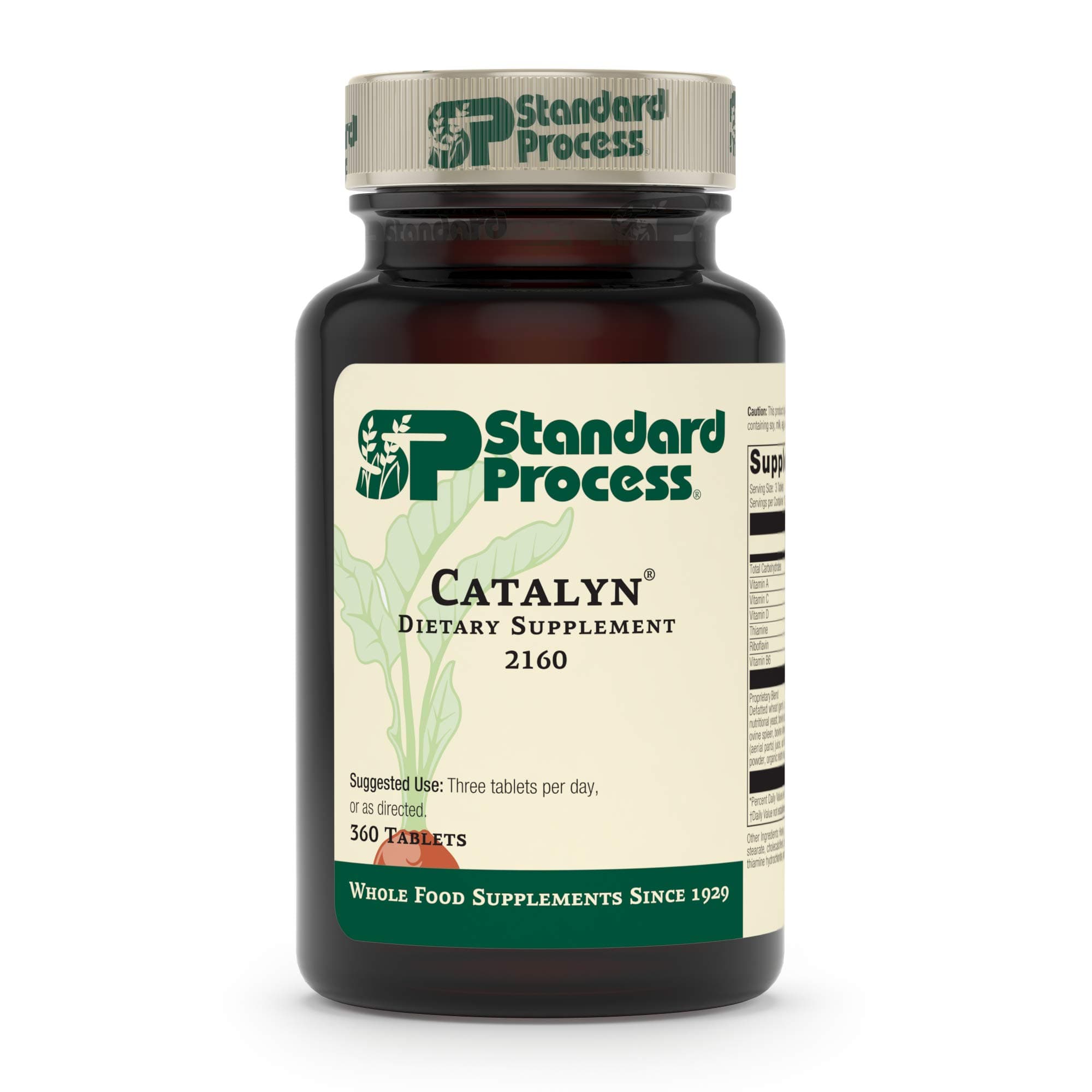
Whole Food Nutrient Complex.
A food-based nutrient blend designed to deliver vitamins and minerals in their whole-food matrix for better absorption. Delivers vitamins and minerals embedded in a dried food matrix, theoretically improving recognition and absorption by your body
Reviewed March 2026
- Category
- General
- Also filed under
- Nutrients in natural food matrixMay include beneficial cofactorsGenerally well tolerated
What Whole Food Nutrient Complex is, and what it does.
- Does it work
- Suits people who prefer nutrients in a food or culture matrix, and those who find plain mineral salts hard on the stomach. Selenium yeast is the version with the most direct human data.
- How much to take
- Follow product labeling. Most require 3-6 capsules daily because the food matrix takes up a lot of space, leaving less room for actual nutrients.
- Time to feel it
- Nutrient markers move over weeks. Selenium grown into yeast builds into body protein gradually, so an eight to twelve week blood reading is where it shows.
- The first dose
- Nothing beyond how it sits in your stomach. A food matrix is often easier to take before breakfast than a plain mineral salt.
- With regular use
- Over months, you'll maintain nutrient levels. Whether they'll be maintained better than with a quality synthetic multivitamin is debatable.
- How well tolerated
- Well tolerated. It's food-based ingredients. May actually be gentler on the stomach than synthetic vitamins, which is a real practical advantage for some people.
- How it feels
- Mostly a stomach story: many people find it sits more easily than a plain mineral salt. The nutrient side shows up on a blood panel rather than as a feeling.
- The overlooked benefit
- Selenium from yeast arrives mostly as selenomethionine, which slots into body protein and builds a store, while an inorganic selenium salt is used or cleared quickly.
500 to 2,000mg a day is where Whole Food Nutrient Complex works.
Source: Limited comparative studies on whole-food vs synthetic vitamins
The proof, claim by claim.
These words describe the research, not the molecule's worth. Research strength is how much work stands behind one claim, and it is never a product score.
- Better absorbed than synthetic vitamins
- Gentler on the stomach
- More effective for health outcomes
Questions people ask about Whole Food Nutrient Complex.
- Are whole food vitamins actually better?
- The honest answer: maybe slightly, for some nutrients, in some people. But the evidence isn't strong enough to justify the 2-4x price premium for most people. A quality synthetic multivitamin works fine.
- Why do I need 6 capsules a day?
- Because the food matrix takes up physical space. Synthetic vitamins are concentrated pure chemicals that fit into one tablet. Embedding them in food means each capsule contains less active nutrient.
- Is the 'food state' marketing hype?
- Partly. The concept has theoretical merit (nutrients in food context), but the marketing dramatically overstates the proven advantages. 'Better recognized by your body' sounds great but isn't solidly demonstrated.
- Can I just eat better instead?
- Yes, and you should. A diverse, balanced diet beats any multivitamin, whole food or synthetic. Supplements are for filling gaps, not replacing good eating habits.
- Stomach sensitivity: is this really easier to digest?
- This is probably the most legitimate advantage. Many people who get nauseous from synthetic multivitamins report no issues with whole food versions. If stomach sensitivity is your problem, it's worth trying.
Why these belong in the same formula. Each row says what the basis is, from settled biochemistry through to a trial that measured the pair.
Food-matrix nutrient complexes carry non-heme iron alongside the phytate and polyphenols of the growth medium or the plant material. Ascorbate reduces ferric iron to the ferrous form and holds it soluble in the duodenum, which is the standard way that inhibition is countered. The effect is on absorption, measured as iron uptake, not on any downstream outcome.
Whole-food and grain-derived matrices carry phytate, which binds zinc, iron and calcium into complexes the gut cannot take up. Phytase cleaves phosphate groups off the inositol ring and releases the bound minerals. This is the mechanism behind soaking, sprouting and fermenting grains, and it applies directly to a mineral delivered inside a plant or yeast matrix.
A large calcium dose in the same window reduces uptake of non-heme iron and of zinc. That holds whether the iron sits in a mineral salt or inside a food matrix. Products bundling calcium with iron in one serving accept that interaction. Splitting them across the day sidesteps it.
Sustained higher zinc intakes induce metallothionein in enterocytes, which binds copper preferentially and sheds it when the cell turns over. A multi-mineral complex therefore has to hold a workable zinc-to-copper ratio rather than maximising zinc alone. This is one of the better characterised mineral interactions in nutrition.
Copper and zinc compete at the enterocyte, and the same is true in the other direction: sustained high copper intakes affect zinc handling. A food-matrix complex delivering both needs the ratio held deliberately. The point is formulation ratio, not a claim about either mineral alone.
Vitamins A, D, E and K and the carotenoids need dietary fat to form mixed micelles before they cross the enterocyte. A dry food-matrix powder taken with water and no fat delivers those nutrients into a poor absorption environment. Any fat source in the meal works. A medium-chain oil is one convenient carrier.
In a yeast-grown or food-cultured complex the nutrient sits inside cellular structures rather than free in the capsule. Protease, cellulase and glucanase activity contributes to breaking that structure down so the nutrient is released in the gut. How much this matters depends on how far the raw material was already processed.
Piperine slows the UGT glucuronidation and CYP3A4 metabolism that clear many plant compounds on first pass, which raises circulating levels of co-taken polyphenols. That is why it appears in food-derived blends. The same inhibition applies to anything else metabolised by those routes, which is the trade-off attached to the benefit.
Colonic bacteria produce menaquinones and several B vitamins, and bacterial and brush-border enzymes handle the polyglutamate forms of folate that food matrices carry. Pairing a live culture with a food-derived nutrient blend acts on the same handling step. The size of the contribution in a person is not well quantified.
Fermentation of inulin produces short-chain fatty acids that drop colonic pH, which keeps calcium and magnesium in solution for absorption in the large bowel. Balance studies report increased calcium absorption with inulin-type fructans. Absorption is a measured intermediate, not a bone outcome.
When selenium is grown into yeast it appears largely as selenomethionine, which the body cannot distinguish from methionine and so stores in body protein. That gives a different tissue distribution from an inorganic selenite or selenate dose. Adding a second selenium source on top stacks intake against an upper limit that is not generous.
Vitamin D raises calcium absorption while vitamin K-dependent gamma-carboxylation is what allows osteocalcin and matrix Gla protein to bind that calcium into the right tissue. Food-derived multi-nutrient products frequently carry vitamin D without a menaquinone. The pairing is standard nutrition biochemistry and is about normal mineral handling.
Folate in a food or yeast matrix is mostly polyglutamate, which glutamate carboxypeptidase II must strip at the brush border before uptake, and its bioavailability is generally described as lower and more variable than that of a free monoglutamate form. Products combining a matrix folate with a reduced monoglutamate deliver two differently handled forms. That is a handling difference, stated without ranking either.
Talk to a doctor before taking Whole Food Nutrient Complex if any of these apply to you: Doses per nutrient often unstated, Can be significantly underdosed, 'Whole food' doesn't guarantee adequacy, Premium price for unclear benefit. These are flags to check first, not effects Whole Food Nutrient Complex is known to cause.
Not medical advice. Show the label to your pharmacist.What Whole Food Nutrient Complex actually does.
Here the mineral or vitamin is fed to a living organism that builds it into its own proteins and structures, so you get the nutrient woven into food material instead of a bare salt.
Selenium grown into yeast mostly ends up as selenomethionine, which your body slots into protein, so it's stored and moved around differently from a plain inorganic selenium salt.
Folate from food comes in a longer chain form your gut has to trim down before absorbing it, which is why food folate is taken up less completely and less predictably than the simple form.
Grains and plants carry phytate and polyphenols that tie up iron, zinc and calcium so they're harder to absorb. Soaking, sprouting and fermenting all work by breaking down that phytate.
Where Whole Food Nutrient Complex comes from.
Instead of adding a nutrient to a capsule as a plain salt, the maker feeds it to yeast or a culture and lets the organism build it into itself, then dries the whole thing into a powder. Plant versions skip the culture and simply dry and grind the food. Either way the amount in each batch has to be measured, because living material is not consistent the way a chemical is.
The same molecule is reached more than one way. Which route a given product used is a manufacturing choice, and the finished compound is the same either way.
A carbohydrate medium, often molasses or a grain hydrolysate, is dosed with the mineral or vitamin the organism is meant to take up. For plant-derived concentrates the feedstock is instead the harvested crop.
Yeast or a bacterial culture is grown in the enriched medium under controlled temperature, pH and oxygenation, and incorporates the nutrient into its amino acids and cellular structures during growth. The uptake, not the addition, is what makes the material an organically bound form.
Biomass is separated by centrifugation or filtration and washed to remove unincorporated mineral from the medium, which is the step that separates a genuinely incorporated material from a mineral simply mixed with yeast.
The washed biomass is spray-dried or drum-dried to a stable powder. Drying temperature affects heat-labile vitamins and is where a food concentrate can lose part of what it was made for.
The dried powder is assayed for total nutrient content, and for materials such as selenium yeast also speciated to establish how much sits as the organic form. Blending with a carrier brings the batch to a declared figure.
The standardised powder is blended with other nutrient inputs and any excipients, then filled into capsules, pressed into tablets or packed as a loose powder.
Getting Whole Food Nutrient Complex from food.
The whole-food sources on file. A supplement closes the gap, it does not replace dinner.
A gram-for-gram figure (how much of each you would eat to match a dose) will appear here once it is sourced and reviewed. This page will not print a number it cannot cite.
The forms it comes in.
The essence, in one line each.
- In adults taking a whole-food-style nutrient powder daily, intakes of several vitamins and minerals moved closer to recommended amounts and the gut microbial profile shifted, compared with the control condition.Randomised trial. Gonzalez et al., 2026 (Frontiers in nutrition). PMID 41988471 ↗
- Eight weeks of a yeast cell-derived formulation shifted several redox and immune markers in the supplemented group. These are laboratory markers, not clinical outcomes.Randomised trial. König et al., 2026 (Nutrients). PMID 42197007 ↗
- The review sets out how traditional food combinations and preparation methods act on bioavailability, including phytate reduction, fat pairing for fat-soluble vitamins and ascorbate pairing for non-heme iron.Narrative review. Zugravu et al., 2026 (Nutrients). PMID 42124046 ↗
- A review of macronutrient and micronutrient roles, nutritional balance and the consequences of low intake, useful as background on why multi-nutrient products are formulated the way they are.Narrative review. Radhika et al., 2026 (Cureus). PMID 41994836 ↗
- A clinical framework for assessing low micronutrient status in higher-risk groups, describing assessment rather than any product effect.Narrative review. Tumah et al., 2026 (Integrative Medicine). PMID 42222197 ↗
- A systematic review of dietary approaches supporting cognition in older adults, in which whole-diet and food-based patterns rather than isolated nutrients are the exposure.Systematic review. Woolsey et al., 2026 (Frontiers in Nutrition). PMID 42494770 ↗
- A narrative review of individual food items and their reported relationship with cognition across the life course. Associations described at review level, not causes.Narrative review. Hardaway et al., 2026 (Nutrients). PMID 42280422 ↗
- A perspective arguing for whole-food beef as a dietary intervention vehicle for cognition in young adults. A perspective piece, so it frames a hypothesis rather than reporting a result.Narrative review. Riviere et al., 2026 (Frontiers in Nutrition). PMID 42027567 ↗
- A narrative review of maternal nutrition during pregnancy and short and long-term offspring outcomes, covering the food-matrix and micronutrient adequacy background.Narrative review. Capra et al., 2026 (Nutrients). PMID 42123976 ↗
- A review of fortified formula supplementation and neurocognitive development alongside gut microbiota measures in infants. Relevant as context on nutrient-matrix delivery, not as evidence for an adult product.Systematic review. Gong et al., 2026 (Nutrients). PMID 41978217 ↗
- A systematic review of a whole-plant feed material and its effect on physiology in goats. Animal nutrition data, cited here only for the food-matrix mechanism.Systematic review. Mohai Ud Din et al., 2026 (Frontiers in Nutrition). PMID 42063948 ↗
- A scoping review of how changing growing conditions shift the nutrient content of food crops, which is the reason a food-derived nutrient input varies batch to batch.Narrative review. Mutonhodza et al., 2026 (Frontiers in Nutrition). PMID 42293179 ↗
These are the studies our verdict leans on, chosen from the 20,160 we read for Whole Food Nutrient Complex. The full linked list is below.
FDA Disclaimer: These statements have not been evaluated by the Food and Drug Administration. This information is for educational purposes only and is not intended to diagnose, treat, cure, or prevent any disease. Consult your healthcare provider before starting any supplement regimen.