Eicosapentaenoic Acid.
Research-backed compound with potential health benefits.
Reviewed March 2026
- Category
- Compound
What Eicosapentaenoic Acid is, and what it does.
- Does it work
- Yes. The modern diet is overloaded with inflammatory omega-6s. EPA helps restore a healthier balance. It's foundational.
- How much to take
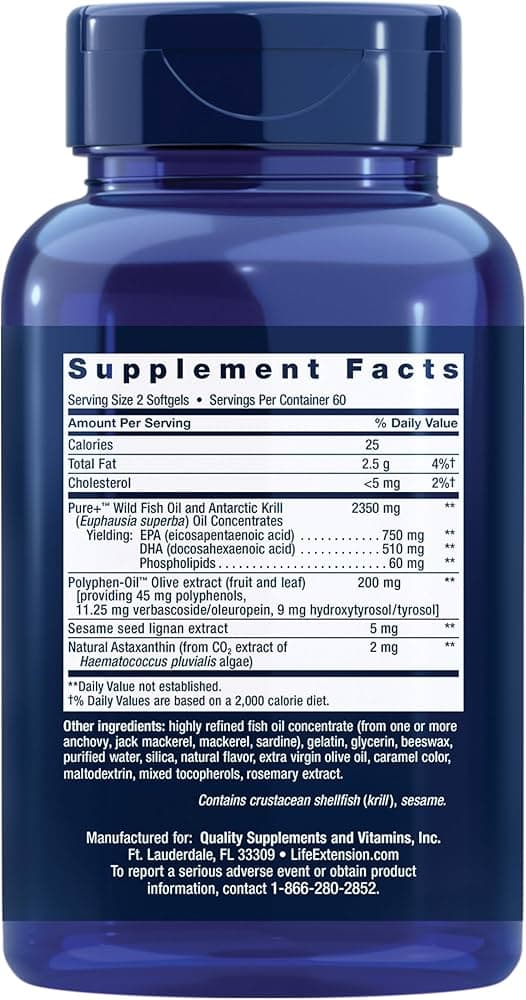
- For general health, 500mg daily. For mood or joint support, aim for 1,000-2,000mg of *just EPA* per day. Read the back of the label, not the front.
- Time to feel it
- About 4 to 8 weeks in blood plasma, about 6 months in red blood cells.
- The first dose
- Nothing. It needs weeks to accumulate in your body's cell membranes to start making a difference.
- With regular use
- Reduced inflammation, potentially better mood regulation, and improved cardiovascular markers. The benefits are cumulative.
- How well tolerated
- Well tolerated for most people. Look for brands that are third-party tested for mercury and PCBs. Don't take with blood thinners without a doctor's okay.
- How it feels
- You don't feel it directly. It’s the absence of things: less joint stiffness, a more even mood. It's not a stimulant or a sedative.
- The overlooked benefit
- Your body makes very little EPA from the alpha-linolenic acid in flax or walnuts. That conversion runs slowly, which is why marine or algal EPA counts as its own input.
250 to 1,000mg a day is where Eicosapentaenoic Acid works.
Source: REDUCE-IT trial, Bhatt et al., NEJM, 2019; Siscovick et al., Circulation, 2017
In the trial record, EPA in blood plasma plateaus after 4 to 8 weeks of daily fish oil, while EPA in the red blood cell membrane rises with a 28 day half-life and reaches a steady state at about 180 days.
The proof, claim by claim.
These words describe the research, not the molecule's worth. Research strength is how much work stands behind one claim, and it is never a product score.
Eicosapentaenoic Acid is documented in the library. The clinical read is in the queue. Nothing about the strength of the research prints until the read is done.
- Triglycerides already in the normal rangeMeta-analysis
- Heart and circulatory functionMeta-analysis
- A healthy inflammatory responseRandomised trial
- Mood steadinessMeta-analysis
- Joint comfortMeta-analysis
- Omega 3 index and membrane fatty acid statusRandomised trial
- Tear film comfort in dry eyeRandomised trial
- Production of E-series resolvins during the resolution phase of inflammationIn vitro study
Questions people ask about Eicosapentaenoic Acid.
- Is this the same as fish oil?
- It's one of the two active ingredients in fish oil, along with DHA. EPA is the star player for inflammation and mood.
- What about mercury in fish oil?
- Reputable brands use molecular distillation to purify the oil and remove heavy metals. Look for a third-party testing seal like IFOS.
- Can I just eat fish instead?
- Yes, but you'd need to eat fatty fish like salmon or sardines 3-4 times a week to get a therapeutic dose. A supplement is often more practical and consistent.
- What's the difference between EPA and DHA?
- A simple way to think of it: EPA is for the 'body' (inflammation, mood, heart). DHA is for the 'brain' (structure, cognition).
- How do I avoid fishy burps?
- Take it with a meal. Some people freeze the capsules. Look for enteric-coated softgels, which dissolve in your intestine, not your stomach.
- Should I get the Triglyceride or Ethyl Ester form?
- Triglyceride (TG) form. Your body absorbs it much better. It costs a little more, but it's worth it. The label will specify.
Why these belong in the same formula. Each row says what the basis is, from settled biochemistry through to a trial that measured the pair.
EPA and DHA are the two long-chain omega-3 fatty acids the body incorporates into cell membrane phospholipids, and DHA can retroconvert to EPA, so the two run through one shared metabolic pathway and are almost always supplied and used together.
The many double bonds in EPA make it quick to oxidize, so a fat-soluble antioxidant like vitamin E is routinely added to omega-3 oils to keep the fatty acids from going rancid. Taking in more polyunsaturated fat also raises the body's vitamin E requirement, which is the other half of why the two belong together.
GLA taken on its own is partly elongated onward toward arachidonic acid. EPA competes at the delta 5 desaturase step that runs that conversion, so adding EPA helps hold more of the GLA at the DGLA stage. The two are combined for exactly that balancing reason.
Astaxanthin is a fat-soluble antioxidant that sits in the same lipid droplets and membranes as EPA and helps shield its fragile double bonds from oxidation. The two occur together naturally in krill, which is why they are often formulated as a single oil.
Vitamin D uptake depends on fat in the same meal to drive bile release and micelle formation, and a long-chain fatty acid provides exactly that. Co-formulating vitamin D in an EPA oil raises how much of the vitamin is taken up.
Carnosic acid and rosmarinic acid from rosemary are used as in-oil antioxidants because a five-double-bond fatty acid oxidises readily. This is formulation chemistry that protects the ingredient before it is swallowed.
Glutathione peroxidase is a selenoenzyme that removes lipid hydroperoxides from membranes. Once EPA is incorporated into cell membranes, selenium status shapes how well those peroxides are cleared.
EPA shifts eicosanoid production toward the less aggregatory thromboxane A3, and ginkgolides antagonise platelet activating factor. Both damp normal platelet aggregation, so the effect adds up and belongs on a label as a caution.
Garlic organosulfur compounds reduce platelet aggregation through a separate route from the eicosanoid shift EPA produces. Stacking the two increases the combined effect on normal clotting.
Gingerols act on thromboxane synthase, the same eicosanoid branch EPA competes with as a substrate. The two together push harder on normal platelet function than either alone.
Fatty acids carried on a phospholipid backbone enter the gut in an already partly emulsified form and route into membrane phospholipid pools. Phosphatidylcholine alongside a triglyceride oil improves emulsification of the dose.
Long-chain fatty acids can only cross the inner mitochondrial membrane as carnitine esters via the carnitine palmitoyltransferase shuttle. Carnitine availability sets how readily a long-chain fatty acid is oxidised for energy.
MK-7 is highly lipophilic and its uptake tracks with dietary fat and chylomicron formation. An EPA-rich oil supplies the lipid vehicle the vitamin needs.
EPA competes with arachidonic acid at cyclooxygenase and lipoxygenase, while curcuminoids act upstream on NF-kB driven expression of those enzymes. Substrate competition plus expression control is a genuine two-step on the same pathway.
Medium-chain triglycerides are absorbed rapidly and stimulate the bile and lipase response that long-chain EPA depends on. A structured lipid pairing the two was studied over eight weeks with the EPA to arachidonic acid ratio as the readout, which is a membrane marker rather than a clinical outcome. The mechanism is delivery, not added activity.
Ethyl ester EPA must be hydrolysed by pancreatic lipase before the free acid can be taken up. Lipase-containing preparations supply that step when pancreatic output is low. This is why ester-form fish oils are conventionally taken with a fat-containing meal.
Pancreatic lipase cleaves the fatty acid from its glycerol or ethanol backbone at the intestinal brush border. Without that cleavage the esterified form is poorly absorbed. The relationship is substrate and enzyme.
Phospholipids emulsify long-chain oils into fine droplets, raising the surface area available to lipase. Lecithin is added to marine oil emulsions for exactly this reason. It is a formulation aid rather than a second active.
Alpha-linolenic acid from flaxseed is the plant precursor that the body elongates and desaturates toward EPA, and the conversion rate in adults is low. Supplying EPA directly bypasses that pathway, and high alpha-linolenic intake competes for the same delta-6 desaturase. Stacking both is common but the two are not interchangeable inputs.
Linoleic acid and alpha-linolenic acid compete for the same delta-6 desaturase, and a diet heavy in linoleic acid pushes the enzyme toward the omega-6 branch that ends at arachidonic acid. EPA sits at the other end of that balance and displaces arachidonic acid from membrane phospholipids. This is a competition worth stating rather than a pairing to recommend.
A standard fish oil already contains EPA alongside docosahexaenoic acid in a fixed ratio. Adding an EPA-only concentrate on top shifts that ratio toward EPA rather than adding a separate nutrient. Total intake should be counted across both products.
Krill oil carries EPA bound mostly to phospholipids rather than triglycerides, so it delivers the same fatty acid on a different backbone. Taken together the two stack the same input. The phospholipid backbone changes the digestion route, not the fatty acid itself.
EPA displaces arachidonic acid from platelet membranes and shifts eicosanoid production toward less aggregatory 3-series products. Nattokinase acts on fibrin and is used in the same formulation space. Where both are taken the effects on normal clotting physiology point the same direction, which is a caution to state rather than a benefit to claim.
Salicin-derived salicylate inhibits platelet cyclooxygenase, and EPA changes the substrate that enzyme works on. The two influence the same eicosanoid step from different angles. Combining them stacks an effect on normal platelet behaviour and warrants clinical awareness rather than promotion.
EPA carries five double bonds and is among the most peroxidation-prone fatty acids in the diet. Tocopherol intercepts the lipid peroxyl radical and ascorbate regenerates the resulting tocopheroxyl radical back to tocopherol. The recycling loop is why marine oils are formulated with both antioxidants in mind.
Free ferrous iron catalyses lipid peroxidation of polyunsaturated fatty acids through Fenton chemistry. In a formulation or a stomach carrying both, that chemistry raises the oxidation load on EPA. Separating the two doses and keeping an antioxidant in the oil are the usual formulation answers.
Coenzyme Q10 is fat-soluble and poorly absorbed from a dry matrix, so it is routinely dissolved in a marine or vegetable oil softgel. EPA-rich oil serves as that vehicle. The relationship is carrier and passenger in a single capsule.
Polyphenols added to a marine oil matrix can slow oxidation of the oil during shelf life, which is a stability property rather than a physiological effect. Some polyphenols also behave as pro-oxidants at high concentration with transition metals present. The interaction belongs to the dose form.
Nothing specific on file for Eicosapentaenoic Acid. Match the label to the daily amount above, and tell your doctor what you take.
Not medical advice. Show the label to your pharmacist.What Eicosapentaenoic Acid actually does.
EPA is a fatty acid with a 20-carbon backbone and five kinks in it, written 20:5n-3. The first kink sits three carbons in from the tail end, which is what earns it the omega-3 name.
EPA works its way into your cell membranes and partly takes the place of arachidonic acid there. That changes the pool of fats available to the enzyme that clips them back out.
The cyclooxygenase and lipoxygenase enzymes will happily work on EPA too, and the signalling molecules that come out of it differ in potency from the ones made from arachidonic acid.
Your body can build EPA from the plant omega-3 in foods like flax, but in adults the fractional conversion is low. That's why the EPA you eat gets counted as its own separate input.
Where Eicosapentaenoic Acid comes from.
It comes from oily fish or, for a vegan version, from algae grown in tanks. The oil is cleaned to strip out mercury and pollutants, then concentrated so each capsule carries more EPA than the raw oil did.
The same molecule is reached more than one way. Which route a given product used is a manufacturing choice, and the finished compound is the same either way.
Most commercial EPA starts as body oil pressed from anchovy, sardine, menhaden or similar oily fish, which accumulate it from the algae at the base of the marine food chain. The vegan route ferments heterotrophic microalgae in tanks on a sugar feedstock, making the same molecule without the fish.
Fish are cooked and pressed, and the oil separated from press liquor by centrifugation. Algal biomass is harvested and the oil recovered by mechanical or solvent extraction.
The crude oil is degummed, alkali refined, bleached with clay and deodorised. Short-path or molecular distillation under high vacuum removes environmental contaminants including mercury and organic pollutants, and this step is also where concentration happens.
The triglycerides are transesterified into ethyl esters, which can be separated by boiling point, so distillation and urea complexation raise EPA from its natural share to a much higher one. Products wanting the triglyceride backbone then re-esterify enzymatically.
Fatty acid content is assayed by gas chromatography and blended to the declared EPA and docosahexaenoic acid numbers. Peroxide and anisidine values are checked and tocopherols or rosemary extract are added as oil antioxidants.
The finished oil is encapsulated in a gelatin or plant-based softgel under nitrogen, or emulsified and flavoured for a liquid.
Getting Eicosapentaenoic Acid from food.
The whole-food sources on file. A supplement closes the gap, it does not replace dinner.
A gram-for-gram figure (how much of each you would eat to match a dose) will appear here once it is sourced and reviewed. This page will not print a number it cannot cite.
The forms it comes in.
The essence, in one line each.
- Across 71 randomised trials, a combined 2 to 3 g a day of EPA plus DHA lowered systolic blood pressure by about 2.6 mmHg and diastolic by about 1.6 to 1.8 mmHg.Meta-analysis. Zhang et al., 2022 (Journal of the American Heart Association). PMID 35647665 ↗
- Pooling 33 randomised trials, EPA lowered blood triglycerides by about 0.77 mmol/L, total cholesterol by about 0.24 mmol/L and LDL cholesterol by about 0.13 mmol/L.Meta-analysis. Zhang et al., 2021 (Clinical Nutrition). PMID 34229258 ↗
- In a network meta-analysis of randomised trials, EPA lowered LDL cholesterol about 8.5 mg/L more than DHA did, while the two acted much alike on the other markers measured.Meta-analysis. Fatahi et al., 2022 (Nutrition, Metabolism and Cardiovascular Diseases). PMID 36319578 ↗
- In head to head and network comparisons of 20 randomised trials, EPA and DHA moved C-reactive protein, interleukin-6 and TNF-alpha to a similar degree, with no difference detected between the two.Meta-analysis. Vors et al., 2021 (Advances in Nutrition). PMID 32790827 ↗
- Pooled trials found that the EPA to DHA ratio of a supplement shapes which fatty acids rise in the blood, with higher EPA shares linked to larger falls in circulating inflammatory markers, which are blood measures rather than outcomes.Meta-analysis. Khabir et al., 2026 (Critical reviews in food science and nutrition). PMID 41568426 ↗
- Across trials in exercising adults, omega-3 supplementation was associated with lower post-exercise inflammatory and muscle damage markers and a modest reduction in reported soreness.Meta-analysis. Li et al., 2026 (FASEB journal). PMID 41891174 ↗
- In healthy adults, taking DHA and EPA improved measured sleep efficiency compared with placebo.Randomised trial. Yokoi-Shimizu et al., 2022 (Nutrients). PMID 36235788 ↗
- Pooling high-dose EPA trials, the authors report that observed cardiovascular outcomes differed by the formulation studied rather than being uniform across preparations.Meta-analysis. Faheem MA et al., 2026 (American Journal of Cardiovascular Drugs). PMID 42070013 ↗
- A pooled analysis of docosahexaenoic acid and EPA supplementation reporting cardiovascular endpoints alongside an observed signal for irregular heart rhythm, which the authors present as a risk consideration.Meta-analysis. Shayan SK et al., 2026 (Pharmacology Research and Perspectives). PMID 42144851 ↗
- Eight weeks of an EPA and medium-chain triacylglycerol structured lipid changed the EPA to arachidonic acid ratio, a membrane fatty acid marker rather than a clinical outcome.Randomised trial. Shimizu T et al., 2026 (Journal of the International Society of Sports Nutrition). PMID 41992745 ↗
- EPA supplementation was assessed for its effect on nutritional status measures in adults receiving oncology care, with body composition and intake as the reported endpoints.Open-label trial. Arribas L et al., 2025 (Nutrition Journal). PMID 41013487 ↗
- A review of polyunsaturated fatty acid supplementation and nutritional status measures, naming EPA among the fatty acids studied. The authors describe the evidence base as limited.Systematic review. Liu G et al., 2026 (PeerJ). PMID 42180603 ↗
- Pooled omega-3 trials in adults on dialysis reported changes in inflammatory markers. Inflammatory markers are laboratory measures rather than clinical outcomes.Meta-analysis. Blair C et al., 2026 (Clinical Nutrition ESPEN). PMID 41692069 ↗
- EPA supplementation was reported to change itch scores, skin moisture measurements and mood scores in adults on maintenance dialysis over the study period.Randomised trial. Lin YL et al., 2024 (Frontiers in Nephrology). PMID 39139799 ↗
- A review of omega-3 intake and age-related changes in the macula, in which the authors describe the pooled evidence as not settling the question.Systematic review. Chen KY et al., 2026 (The Journal of Nutrition). PMID 41482231 ↗
- A review of maternal docosahexaenoic acid and EPA supplementation summarising reported effects on lipid handling and the mechanisms proposed for them.Narrative review. Shao C et al., 2026 (Frontiers in Nutrition). PMID 41798834 ↗
- A perspective piece setting out how docosahexaenoic acid and EPA supplementation is understood to act on normal immune signalling and where the evidence thins.Narrative review. Munhoz J et al., 2025 (Advances in Nutrition). PMID 40523478 ↗
- In an animal model of maternal metabolic stress, docosahexaenoic acid and EPA supplementation was reported to change offspring metabolic markers. An animal finding, not human evidence.Animal study. Mašek T et al., 2025 (Metabolites). PMID 39852375 ↗
- EPA supplementation shifted the balance between bone-forming and bone-resorbing cell activity in an inflammatory model. A preclinical mechanism observation.Animal study. Wang Z et al., 2023 (Clinical Nutrition). PMID 37542949 ↗
- In cultured 3T3 adipocytes, EPA and palmitic acid produced different lipid storage and oxidative stress profiles. A cell-culture mechanism finding with no human readout.In vitro study. Bakondi E et al., 2024 (Redox Report). PMID 39607809 ↗
These are the studies our verdict leans on, chosen from the 15,586 we read for Eicosapentaenoic Acid. The full linked list is below.
The studies, linked.
2 sources behind our Eicosapentaenoic Acid verdict: peer-reviewed studies and registered clinical trials. Every one links straight to PubMed, the journal, or ClinicalTrials.gov. Read them yourself.
- Clinical trialThe Effect of EPA on the Serum Activities of Paraoxonase 1, Homocystein, Thiolactonase and Some Indicators of Vascular Inflammation and PON2 Gene Expression in PBMC Ofthe Patients With Type II DiabetesClinicalTrials.gov ↗36 participants, Completed
- Clinical trialA Randomized, Crossover Study to Assess the Relative Bioavailability of Eicosapentaenoic Acid and Docosahexaenoic Acid in a Self-micro-emulsifying Delivery System (SMEDS) Formulation Compared With a Standard Omega-3-acid Ethyl Ester ProductClinicalTrials.gov ↗24 participants, Completed
Evidence surfaced via Semantic Scholar (Allen Institute for AI) and ClinicalTrials.gov. Ranked by study type and citation weight, not cherry-picked.
Problems people have reported.
Read this carefully. These are 7,128 voluntary, unverified reactions reported to the FDA (openFDA). The number mostly reflects how popular Eicosapentaenoic Acid is, not how risky it is. A report is not proof Eicosapentaenoic Acid caused anything. It is a signal of what to watch for, nothing more.
Source: openFDA adverse-event reports. Voluntary reporting, not an incidence rate.
FDA Disclaimer: These statements have not been evaluated by the Food and Drug Administration. This information is for educational purposes only and is not intended to diagnose, treat, cure, or prevent any disease. Consult your healthcare provider before starting any supplement regimen.