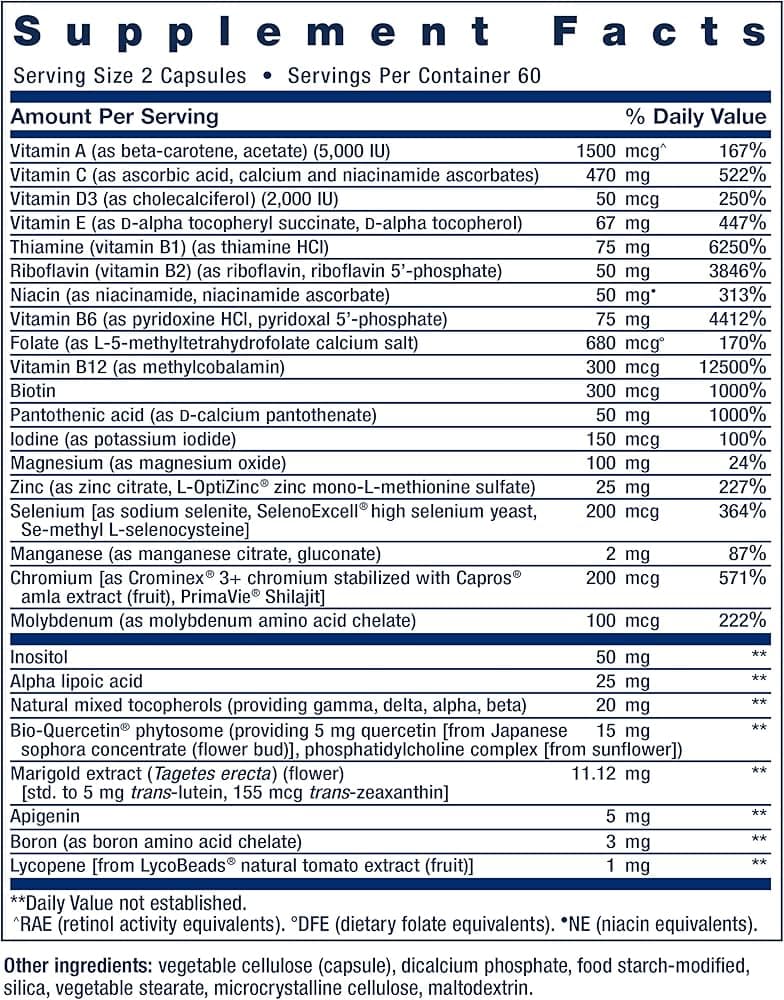
Food Starch-Modified.
Same thing as modified food starch, just listed with different wording on the label. It is a formulation starch. In a tablet it binds the powder and then swells with water to break the tablet apart, and in a powder it stops clumping and holds a mix together.
Reviewed March 2026
- Category
- General
- Also filed under
- Effective binder and stabilizer
What Food Starch-Modified is, and what it does.
- Does it work
- This is the maker's choice rather than yours. It suits formulas needing a plant-derived binder, and the heavily cross-linked grades double as a fermentable fibre.
- How much to take
- No daily amount is on record and none applies. It arrives at whatever level the formulation needs, set by the person building the product rather than by you.
- Time to feel it
- This is a formulation starch, not an active. In a tablet it pulls in water and swells within minutes to break the compact apart, so it has no onset of its own to wait for.
- The first dose
- It hydrates or swells in the stomach within minutes and does its job on the tablet. Day one is about the product breaking apart on time.
- With regular use
- Weeks of ordinary intake pass as starch. The heavily cross-linked grades reach the colon intact and feed fermentation there, which is where any longer contribution sits.
- How well tolerated
- Well tolerated, and used widely across the food supply. Large amounts of the resistant grades can bring wind or loose stools, as any fermentable fibre can.
- How it feels
- No subjective experience. Its footprint is in how the product behaves, holding a tablet together and then releasing it on time, rather than in anything you sense.
- The overlooked benefit
- Heavily cross-linked versions resist amylase and reach the colon intact, where gut bacteria ferment them into short-chain fatty acids. That is the RS4 class of resistant starch.
The proof, claim by claim.
These words describe the research, not the molecule's worth. Research strength is how much work stands behind one claim, and it is never a product score.
- Identical to modified food starch
Why these belong in the same formula. Each row says what the basis is, from settled biochemistry through to a trial that measured the pair.
Octenyl succinate starch is the workhorse wall material for spray-drying fish oil into a free-flowing powder. The hydrophobic side chain anchors the oil droplet while the glucose backbone forms the glassy shell. That shell is what keeps oxygen away from the double bonds until the powder is wetted.
Algal and fish DHA oils are supplied as starch-encapsulated powders for dry blends, gummies and infant formula. The starch matrix controls oxidation and masks the oil flavour. It contributes nothing nutritionally at the levels used.
Retinyl esters are supplied as beadlets in which the oil is dispersed in a modified starch and sugar matrix. Without that matrix the ester oxidises quickly and cannot be dry-blended. The starch is the carrier, not an active.
Beta-carotene is a crystalline, water-insoluble polyene that has to be milled and dispersed in a modified starch matrix to be usable in a tablet or a drink. The dispersion also determines how much is released for uptake. Different beadlet matrices give different measured bioavailability, which is a formulation property rather than a property of the carotene.
Cholecalciferol is an oil-soluble sterol supplied for dry blending as a starch-matrix powder. The matrix protects it from oxygen and light and makes a microgram-scale dose distributable through a large blend. Content uniformity in the finished tablet depends on that carrier.
Tocopheryl acetate oil is converted to a dry powder on a modified starch carrier for tabletting. It is also added into starch-encapsulated oil powders as the in-matrix antioxidant. Both roles are about handling and stability.
Lutein esters and free lutein are crystalline and poorly wetted, so they are supplied as starch-matrix beadlets. Dispersion in the matrix is what allows the pigment to be emulsified during digestion. The carrier choice materially affects how much is measured in plasma.
Lycopene crystals are highly oxidation-prone and effectively insoluble in water, so a modified starch matrix is the standard way to carry them in a dry format. The matrix also shields the conjugated double bonds from light. This is delivery, not activity.
Astaxanthin oleoresin is either softgel-filled or dried onto a modified starch carrier for powder formats. The starch shell reduces oxidation of the ketocarotenoid during storage. Nothing about the starch changes the molecule itself.
Ubiquinone is a large lipid with poor water solubility and a melting point near body temperature. Octenyl succinate starch is one of the emulsifier systems used to build a water-dispersible form for powders and drinks. Whether a given dispersion changes measured plasma levels depends on the specific system, not on starch as a category.
Modified and pregelatinised starches are used as cryoprotectants and carriers in freeze-dried probiotic powders, and as flow aids in the finished blend. Sugars and starch fragments help preserve membrane structure during drying. The starch protects viability during processing and storage rather than doing anything in the gut.
Chemically modified starches that are cross-linked or esterified enough to resist alpha-amylase are classified as RS4, one of the recognised resistant starch types. They reach the colon as fermentable substrate alongside RS2 granular starch. The two types are fermented at different rates and by partly different taxa.
The fraction of modified starch that escapes small-intestinal digestion is fermented in the colon, and starch is among the substrates most associated with butyrate production through cross-feeding. Butyrate is the preferred fuel of the colonocyte. How much a given modified starch yields depends entirely on how resistant that particular modification made it.
Cross-linking and substitution place chemical groups on the glucose backbone that block alpha-amylase from binding and cutting. That is the deliberate design intent of an RS4 starch. The same modification that gives freeze-thaw stability in a food is what slows enzymatic digestion.
The digestible portion of a modified starch is broken by amylase to dextrins, then finished by brush-border maltase-glucoamylase and sucrase-isomaltase. A digestive enzyme blend containing amylase and glucoamylase acts on the same substrate. Heavily substituted grades are largely outside the reach of both.
Protein and octenyl succinate starch are combined as dual wall materials in spray-dried emulsions, where the protein provides fast interfacial adsorption and the starch provides matrix strength. The pairing is a process design choice. It has no nutritional meaning at encapsulation levels.
Nothing specific on file for Food Starch-Modified. Match the label to the daily amount above, and tell your doctor what you take.
Not medical advice. Show the label to your pharmacist.What Food Starch-Modified actually does.
Modified food starch is regular plant starch that's been altered physically or chemically to change how it thickens and holds up, but the underlying sugar chains stay the same.
Adding certain chemical groups keeps starch chains from clumping back together as it cools, which is why the product doesn't turn grainy or weep water after chilling or freezing.
Linking starch chains together makes the granules more sturdy so they don't fall apart under heat, acid, or mixing, keeping the texture steady through processing.
One treatment gives starch a fat-loving side, which is why it can work as an emulsifier or as the coating for spray-dried oil powders.
Getting Food Starch-Modified from food.
The whole-food sources on file. A supplement closes the gap, it does not replace dinner.
A gram-for-gram figure (how much of each you would eat to match a dose) will appear here once it is sourced and reviewed. This page will not print a number it cannot cite.
The forms it comes in.
The essence, in one line each.
- Heat-moisture treatment of cassava roots, a physical starch modification, was reported to change growth performance, glucose measures and carcass yield in the fed animals.Animal study. Incharoen et al., 2026 (Veterinary Medicine International). PMID 42318135 ↗
- Enzymatic modification of oat fibre with a cellulase changed the digestion profile of the material under simulated older-adult gastrointestinal conditions.In vitro study. Zhou et al., 2026 (Food Chemistry). PMID 42208432 ↗
- Phosphate supplementation of plantain flour noodles, a starch cross-linking chemistry, altered the texture and the fermentation behaviour of the material in a gut microbiota model.In vitro study. Shen et al., 2026 (International Journal of Biological Macromolecules). PMID 41519337 ↗
These are the studies our verdict leans on, chosen from the 3 we read for Food Starch-Modified. The full linked list is below.
FDA Disclaimer: These statements have not been evaluated by the Food and Drug Administration. This information is for educational purposes only and is not intended to diagnose, treat, cure, or prevent any disease. Consult your healthcare provider before starting any supplement regimen.