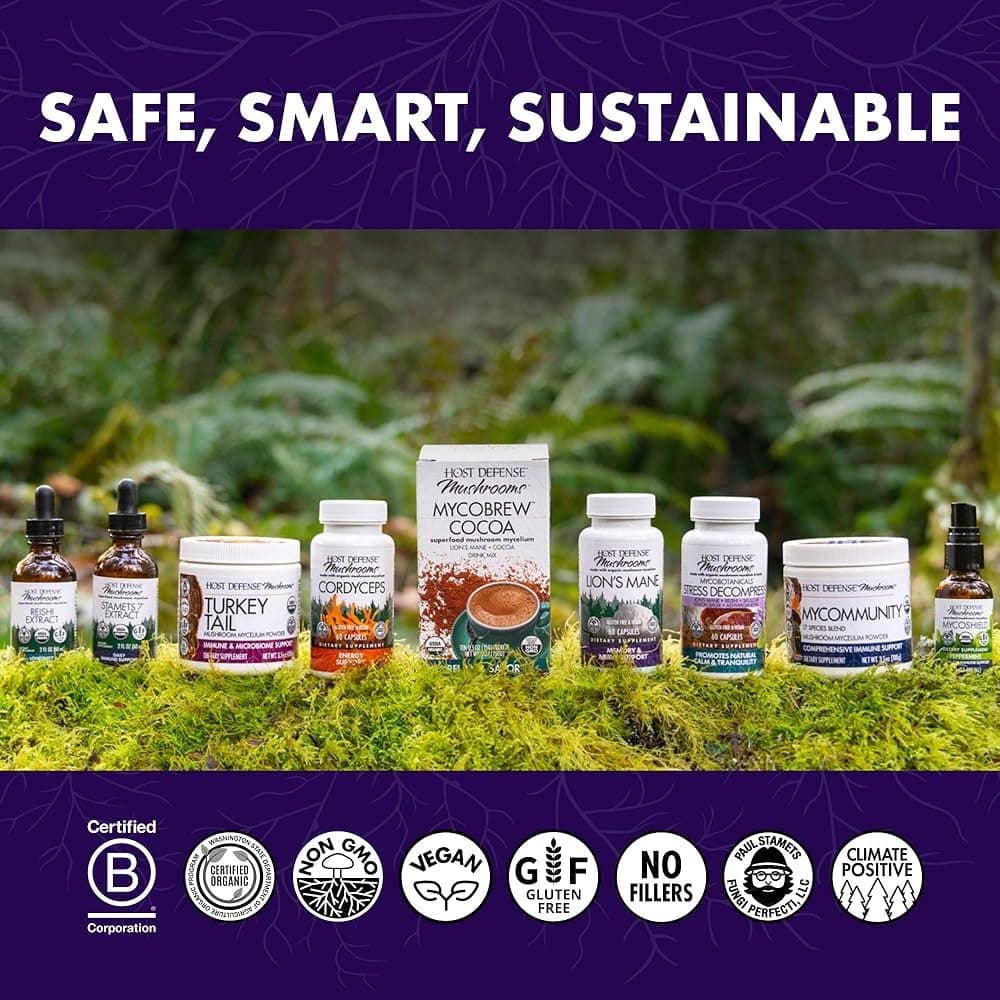
Freeze-Dried Myceliated Brown Rice.
Brown rice colonized by mushroom mycelium, providing beta-glucans and mushroom compounds in a whole-food matrix. Provides mushroom beta-glucans and mycelium-specific compounds that support immune function.
Reviewed March 2026
- Category
- General
- Also filed under
- Contains beta glucansMushroom mycelium compoundsWhole food matrix
What Freeze-Dried Myceliated Brown Rice is, and what it does.
- Does it work
- The beta-glucan content is real but lower than fruiting body extracts. The starch from rice dilutes the active compounds.
- How much to take
- 500-3000 mg depending on mushroom species. Higher doses compensate for lower beta-glucan concentration.
- Time to feel it
- There is no onset to wait for. Beta-glucan work is read in immune markers measured across weeks, and any change you notice builds over four to eight weeks.
- The first dose
- No noticeable effect. Mushroom supplements are slow builders.
- With regular use
- After 4-8 weeks, some people report fewer colds and better energy. The immune modulation is subtle.
- How well tolerated
- Well tolerated. Both mushroom mycelium and brown rice are food.
- How it feels
- Subtle immune support. Don't expect to feel a dramatic difference.
- The overlooked benefit
- Only an assay that separates alpha from beta linkages can tell fungal beta-glucan from rice starch, so a total polysaccharide figure is counting the rice as well.
500 to 3,000mg a day is where Freeze-Dried Myceliated Brown Rice works.
Source: Stamets (2005) Mycelium Running; general mycology literature
The proof, claim by claim.
These words describe the research, not the molecule's worth. Research strength is how much work stands behind one claim, and it is never a product score.
- Contains immune-boosting beta-glucans
- Equal to fruiting body extracts
- Rice starch dilutes the product
Questions people ask about Freeze-Dried Myceliated Brown Rice.
- Is mycelium-on-grain as good as fruiting body mushroom supplements?
- It's debated. Fruiting bodies generally have higher beta-glucan content. Mycelium products contain unique compounds but also rice starch.
- Which mushroom species matters?
- Absolutely. Lion's mane for brain, reishi for stress, turkey tail for immunity. The species determines the benefit.
- Is freeze-drying important?
- Yes. It preserves the bioactive compounds better than heat drying.
- Can I just eat mushrooms instead?
- You can, and you should. Culinary mushrooms provide beta-glucans plus fiber, vitamins, and other nutrients. Supplements concentrate specific compounds.
- Why is Paul Stamets always mentioned?
- He's the leading advocate for mycelium-on-grain products and founded Host Defense (a major brand). His research is cited, though some is disputed by the fruiting body camp.
Why these belong in the same formula. Each row says what the basis is, from settled biochemistry through to a trial that measured the pair.
Yeast-derived beta-glucan and mushroom mycelial beta-glucan share the same branched 1,3 and 1,6 linkage pattern and are recognised by the same class of pattern-recognition receptors on immune cells, supporting normal immune cell signalling. Yeast beta-glucan is usually supplied as a purified isolate at a declared percentage. Myceliated grain supplies it inside the whole biomass at a much lower and more variable concentration. Stacking them raises total branched glucan intake but from two different matrices.
Cereal beta-glucan from oats is a linear 1,3 and 1,4 linked polymer that forms a viscous gel in the gut, which is a physical action on digestion. Fungal beta-glucan is 1,3 and 1,6 branched and does not gel that way. Two products can both declare beta-glucan and be describing unrelated behaviour, which is worth knowing when reading a label rather than a reason to combine or avoid.
Fungal cell membranes contain ergosterol where animal membranes contain cholesterol. Ultraviolet exposure converts ergosterol to ergocalciferol, which is vitamin D2. A myceliated grain product carries ergosterol from the fungal fraction, so whether it contributes any vitamin D2 depends entirely on whether it was UV treated, and untreated material should not be assumed to.
Brown rice is largely alpha-glucan starch, and a myceliated grain product contains whatever substrate the mycelium did not consume. Amylase hydrolyses that alpha-glucan and leaves fungal beta-glucan untouched, because the two have different glycosidic linkages and need different enzymes. This is the clearest practical illustration of why an assay that measures total polysaccharide is not measuring beta-glucan.
A broad digestive enzyme blend brings amylase and often cellulase and hemicellulase activity. Amylase acts on the residual rice starch. Cellulase-type activity can begin to break the fungal cell wall, which is otherwise the barrier that hot-water extraction is used to overcome. Whether that changes anything measurable in a person has not been established.
A portion of the starch in a cooked and dried grain matrix escapes small-intestinal digestion and is fermented in the colon. Myceliated brown rice therefore carries fermentable substrate independent of any fungal contribution. Anyone framing this ingredient purely as a mushroom product is leaving out the grain half of what is in the jar.
Both the beta-glucan fraction and the residual starch reach the colon and are fermented there. Supplying live organisms alongside fermentable substrate is a standard formulation pattern. The specific fermentation of mycelial biomass by named probiotic strains has not been characterised in evidence available here.
Reishi is one of the species most often grown as myceliated grain and also sold as a fruiting body extract, and blends commonly carry several species together. The pairing is formulation practice with a long traditional history. What matters more than the species list on such a label is whether each entry is biomass or extract, since those are different materials.
Lion's mane appears in the same blends and is frequently supplied in the myceliated grain format. Its characteristic compounds differ between the mycelium and the fruiting body, so the format is not a cosmetic detail. No combination evidence is cited here.
Turkey tail is the species most associated with polysaccharide fractions in the mushroom literature and is a common blend component. Grown on grain and freeze dried, it arrives as whole biomass rather than as the isolated fractions that literature usually studies. Worth reading the format before assuming the two are interchangeable.
Maitake is routinely included in mushroom blends and cultivates well as mycelium on grain. The pairing is conventional rather than evidence-led. Species stacking widens the polysaccharide profile without changing the biomass-versus-extract question.
Most commercial cordyceps is itself a cultivated mycelial product rather than the wild fungus, so it sits naturally in a myceliated blend. The species is included in performance-oriented formulas. No combination evidence is available here.
Zinc has an established role in normal immune function through its requirement in hundreds of enzymes and transcription factors, which is a nutrient adequacy argument. Fungal beta-glucan is a receptor-engagement argument. They are combined because they are different, not because either enhances the other.
Talk to a doctor before taking Freeze-Dried Myceliated Brown Rice if any of these apply to you: Significant starch content from rice substrate, Lower beta-glucan concentration than fruiting bodies, Mycelium vs. fruiting body debate. These are flags to check first, not effects Freeze-Dried Myceliated Brown Rice is known to cause.
Not medical advice. Show the label to your pharmacist.What Freeze-Dried Myceliated Brown Rice actually does.
A myceliated grain product is fungus grown through a grain, then dried and milled with the grain still in it. It's a mix of fungal material and leftover grain, not a concentrated extract and not the mushroom's fruiting body.
The beta-glucan in fungi has a different structure than the beta-glucan in cereal grains, so even though they share a name, they behave differently, which matters when a label just says beta-glucan.
The starch in rice is a different kind of sugar chain than fungal beta-glucan, and a generic carbohydrate test lumps them together, so only a test that tells the two apart can report the actual beta-glucan content.
Fungi use a different membrane building block than animals do, and UV light can convert that into vitamin D2, so any vitamin D in a fungal product depends on the fungus actually having been exposed to UV.
Where Freeze-Dried Myceliated Brown Rice comes from.
Brown rice is sterilised, seeded with mushroom culture and left for weeks while the fungus grows through it. The whole thing, rice included, is then freeze dried and ground into powder. Nothing is extracted or separated out, so the rice is still in there, and how much of the powder is fungus versus rice depends on the growing run and on which laboratory test the supplier chose to report.
Built by fermentation, the same way vitamin B12 and many amino acids are made at scale. Controlled conditions, consistent output.
Whole brown rice is used as the solid substrate because it is cheap, sterilises well and supports fungal colonisation. The grain is hydrated to a controlled moisture content before sterilisation, since too dry will not colonise and too wet invites contamination.
The hydrated grain is sterilised under pressure and steam, cooled, then inoculated with a liquid or grain culture of the chosen mushroom species under clean conditions. Sterility at this stage is what determines whether the batch grows the intended organism or something else.
The inoculated grain incubates for a period of weeks at controlled temperature and humidity while mycelium grows through and binds the grain into a solid cake. The organism consumes part of the starch as it grows, and how much depends on how long the run is allowed to continue.
The colonised cake is frozen and dried by sublimation under vacuum, then milled to a powder. No water or alcohol extraction takes place, so the residual rice substrate stays in the finished material by design. This is the defining difference between a biomass product and an extract, not a defect in either.
Testing may report total polysaccharide or, using an enzymatic method, beta-glucan specifically. Only the second distinguishes fungal beta-glucan from the alpha-glucan starch of the grain, which is why the assay method named on a certificate of analysis carries as much information as the number beside it.
Getting Freeze-Dried Myceliated Brown Rice from food.
The whole-food sources on file. A supplement closes the gap, it does not replace dinner.
A gram-for-gram figure (how much of each you would eat to match a dose) will appear here once it is sourced and reviewed. This page will not print a number it cannot cite.
The forms it comes in.
FDA Disclaimer: These statements have not been evaluated by the Food and Drug Administration. This information is for educational purposes only and is not intended to diagnose, treat, cure, or prevent any disease. Consult your healthcare provider before starting any supplement regimen.