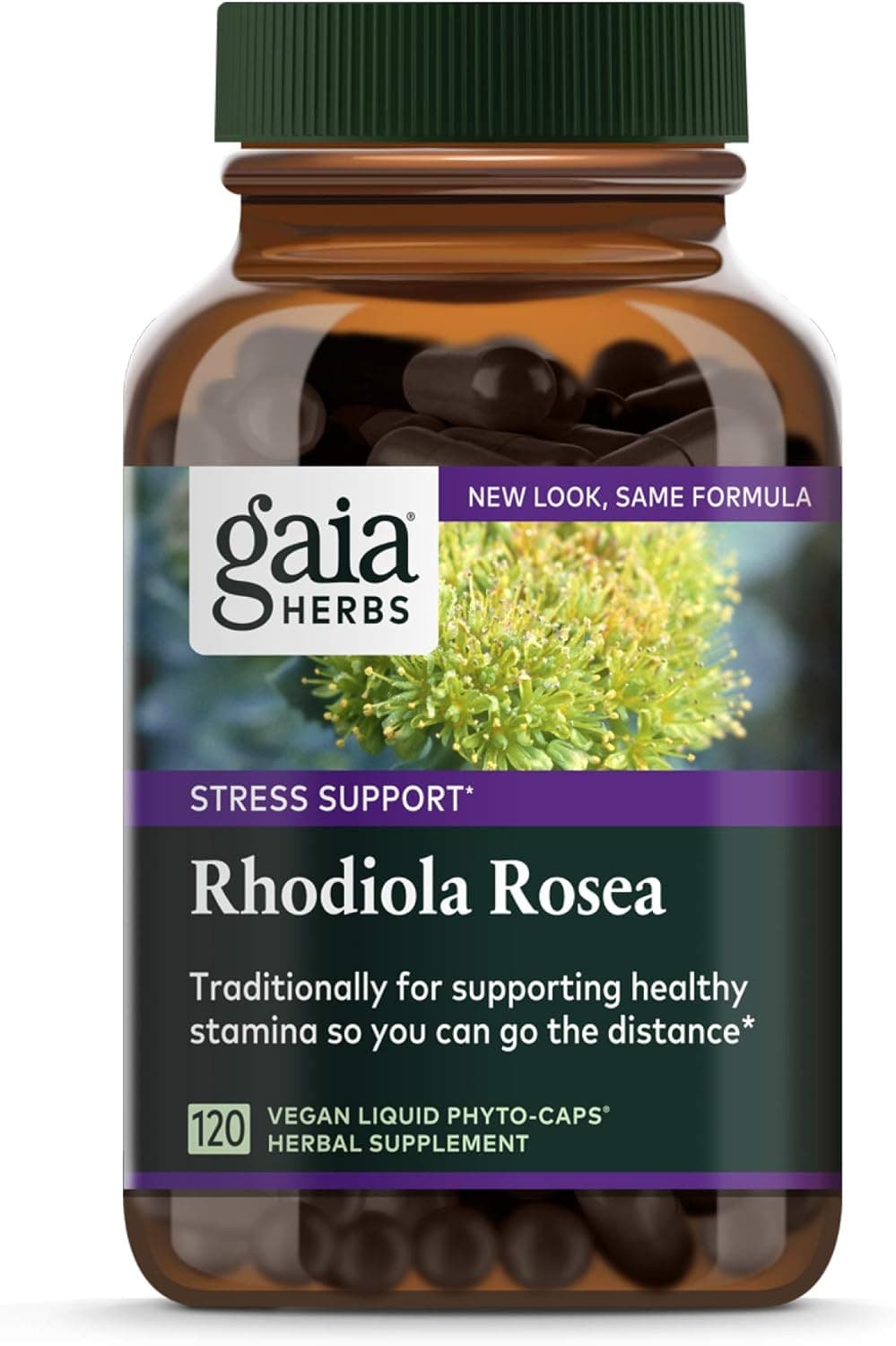
Rhodiola Rosavins 3 Salidroside 1.
Rhodiola Rosavins 3 Salidroside 1 supplementation for targeted health support. A Rhodiola rosea extract held to 3 percent rosavins and 1 percent salidroside, used for mental and physical fatigue under stress. The ratio is an identity statement, verified by HPLC.
Reviewed March 2026
- Category
- Adaptogen
What Rhodiola Rosavins 3 Salidroside 1 is, and what it does.
- Does it work
- Suits people whose stress shows up as mental drag by mid-afternoon. The 3 to 1 specification is what tells you the material really is R. rosea rather than another species.
- How much to take
- 200-600mg daily of extract standardized to 3% rosavins/1% salidroside.
- Time to feel it
- Many people notice less mental drag within the first few days. The fuller stress and fatigue picture is judged across two to four weeks.
- The first dose
- Often a calm, clear alertness within a few hours, without a stimulant edge. For some, day one is quiet and the effect arrives over the first week.
- With regular use
- Improved stress tolerance, reduced fatigue, better cognitive function.
- How well tolerated
- Well tolerated. Long use history. Few side effects.
- How it feels
- Clear energy, improved mood, better stress handling.
- The overlooked benefit
- That 3 to 1 figure is a batch-consistency and species-identity statement, not a strength rating, so a higher percentage would not mean a stronger extract.
100 to 400mg a day is where Rhodiola Rosavins 3 Salidroside 1 works.
Source: Ishaque 2012 meta-analysis
The proof, claim by claim.
These words describe the research, not the molecule's worth. Research strength is how much work stands behind one claim, and it is never a product score.
- Reduces fatigueMultiple clinical trials
- Improves stress responseHPA axis studies
- Enhances cognitive functionClinical trials
- 3:1 ratio is optimalMost studied standardization
Questions people ask about Rhodiola Rosavins 3 Salidroside 1.
- Why does the 3:1 ratio matter?
- This ratio matches wild Siberian Rhodiola rosea roots, which were used in the original research. Products with different ratios may not have the same effects. It's the most validated standardization.
- Is higher salidroside better?
- Not necessarily. Some products boost salidroside, but the 3:1 ratio has the most research. Rosavins and salidroside may work together synergistically.
- When will I feel it working?
- Some notice effects within days. Full benefits typically develop over 2-4 weeks. Rhodiola is one of the faster-acting adaptogens.
- Can I take it with caffeine?
- Yes, but may be overstimulating for some. Start with lower caffeine if combining. Many find the combo effective for focus.
- Morning or evening?
- Morning or early afternoon. Can interfere with sleep if taken late. The energizing effects last several hours.
- How long can I take it?
- Some traditions cycle (2-3 weeks on, 1 week off). Clinical trials ran up to 12 weeks continuously. No established long-term concerns.
Why these belong in the same formula. Each row says what the basis is, from settled biochemistry through to a trial that measured the pair.
Tyrosine is the substrate for dopamine and noradrenaline while salidroside and rosavins slow the monoamine oxidase and catechol-O-methyltransferase routes that clear them. The pair works on the same catecholamine pool from opposite ends.
5-HTP is the direct precursor to serotonin and the rhodiola fraction slows monoamine oxidase A, which clears it. Raising input while slowing clearance pushes the same pool from both directions and calls for caution.
Tryptophan feeds serotonin synthesis one step above 5-HTP. Paired with slowed monoamine oxidase A activity the same additive concern applies.
St John's wort reduces monoamine reuptake while rhodiola slows enzymatic breakdown. Two separate control points on one transmitter pool, so the effects add.
SAM-e is the methyl donor for monoamine synthesis and metabolism. Combined with slowed monoamine breakdown the two act on the same system.
B6, folate and B12 drive the decarboxylation and methylation steps that build dopamine, noradrenaline and serotonin. Rhodiola slows their clearance but does not supply what builds them.
Ascorbate is the reducing cofactor for dopamine beta-hydroxylase, the step that converts dopamine into noradrenaline. It supports the same catecholamine pathway rhodiola conserves.
Caffeine blocks adenosine receptors and raises central arousal, and a stimulating adaptogen extract taken with it adds to that arousal rather than balancing it. The practical consequence is additive jitteriness and delayed sleep onset when both are taken late in the day. This is a pharmacology-level interaction worth flagging, not a benefit claim.
L-theanine crosses into the brain and is associated with increased alpha-band activity and a calmer quality of alertness. It is paired with stimulating extracts to take the edge off arousal without lowering it. The pairing rationale is mechanistic. A combination effect with this standardised extract has not been measured.
Both are classed as adaptogens and both are described as acting on the hypothalamic-pituitary-adrenal stress axis, though through different constituents: withanolides in one, rosavins and salidroside in the other. Stacking them is common, and the mechanistic overlap means the effect is not necessarily doubled. Regard this as a plausible additive pairing at moderate confidence.
Eleutherococcus senticosus is one of the plants that defined the adaptogen category alongside Rhodiola rosea, and the two are routinely formulated together. Their active constituent classes differ, so the overlap is in the described mechanism rather than the chemistry. No combination data supports a size of effect.
Schisandra lignans are grouped with rosavins and salidroside in the adaptogen literature as constituents described to act on stress-response signalling. The three-plant combination of Rhodiola, Schisandra and Eleuthero is a long-standing formulation pattern. Class-level grounding only.
Cordyceps preparations are formulated for the same endurance and energy-handling positioning as Rhodiola extracts, and both are described in the adaptogen literature as acting on cellular energy metabolism. The link is positional and mechanistic rather than measured. Low confidence.
Bacosides are described as acting over weeks of daily intake, whereas salidroside-standardised extracts are studied over short exposures. Combining a slow-onset and a short-acting botanical is a formulation strategy rather than a synergy. Neither the onset difference nor the combination has been quantified for this specific standardisation.
Pyridoxal 5-phosphate is the required cofactor for aromatic L-amino acid decarboxylase, the enzyme that converts L-DOPA to dopamine and 5-HTP to serotonin. Any formula built around monoamine turnover depends on that cofactor being present. The cofactor requirement is textbook. It says nothing about the extract adding to it.
Folate in its reduced forms supports tetrahydrobiopterin regeneration, and BH4 is the obligatory cofactor for tyrosine and tryptophan hydroxylase, the rate-limiting steps in monoamine synthesis. A monoamine-oriented formula therefore rests on adequate folate status. This is a cofactor relationship, not evidence that the two act together.
Magnesium is required as the counter-ion for ATP in every kinase reaction and it blocks the NMDA receptor channel at rest. Both roles sit under the energy and stress-response positioning of a Rhodiola extract without overlapping its chemistry. Established biochemistry, no combination measurement.
Melatonin acts on MT1 and MT2 receptors to shift the circadian signal toward sleep onset, while a stimulating adaptogen extract raises arousal. Taking them close together sets the two against each other. The direction of the conflict follows from established pharmacology and is worth flagging on timing grounds.
Alpha-GPC supplies choline for acetylcholine synthesis, a separate transmitter system from the monoamines the adaptogen literature emphasises. Stacking them targets two systems at once rather than reinforcing one. Mechanistically distinct and unmeasured together.
Nothing specific on file for Rhodiola Rosavins 3 Salidroside 1. Match the label to the daily amount above, and tell your doctor what you take.
Not medical advice. Show the label to your pharmacist.What Rhodiola Rosavins 3 Salidroside 1 actually does.
Rosavins are marker compounds specific to Rhodiola rosea, so measuring them is how you confirm you have the right plant.
Salidroside is tyrosol with a sugar attached, and the sugar is cleaved off during digestion.
The 3 to 1 number describes what is in the extract and keeps batches consistent. It is not a potency rating.
The two marker compounds are made by different plant pathways, so their ratio varies with where and how the root was grown and extracted.
Where Rhodiola Rosavins 3 Salidroside 1 comes from.
The root is dried and extracted with a water and alcohol mix, then lab-tested and adjusted until the two marker compounds hit the stated percentages.
Made from a plant. What ends up in the capsule tracks the harvest, so batch testing and a stated marker matter more here than with a made molecule.
Roots are collected from cultivated or wild-harvested plants. Species identity matters because other Rhodiola species contain salidroside but little or no rosavin.
Roots are washed, sliced and dried at controlled temperature, since the glycosides and the enzymes that cleave them are both heat-sensitive.
A water and ethanol mixture is used so that both the cinnamyl glycosides and the phenylethanoid glycoside are carried into the same extract.
Ethanol is recovered under vacuum and the concentrate is spray- or vacuum-dried to a powder, with residual solvent tested against specification.
Marker content is quantified against reference standards and the extract is adjusted with carrier or with a higher-assay lot until both numbers are met.
Blended with excipients and filled, with identity confirmed by the rosavin peak pattern rather than by appearance.
The forms it comes in.
The essence, in one line each.
- Across the trials reviewed, Rhodiola rosea showed some signal for easing physical and mental fatigue, but the authors judged the evidence inconclusive because of methodological weaknesses in the studies.Systematic review. Ishaque et al., 2012 (BMC complementary and alternative medicine). PMID 22643043 ↗
- Reviewing exercise and sport trials, Rhodiola rosea supplementation was linked to small improvements in endurance performance and perceived exertion, with results inconsistent across studies.Systematic review. Lu et al., 2022 (Frontiers in nutrition). PMID 35464040 ↗
- In nursing students working shifts, this trial did not detect a clear reduction in mental or physical fatigue with Rhodiola rosea compared with placebo, and the authors called the findings uncertain.Randomised trial. Punja et al., 2014 (PloS one). PMID 25268730 ↗
- Short-term Rhodiola rosea supplementation did not show a clear improvement in resistance exercise performance measures in this placebo-controlled trial.Randomised trial. Williams et al., 2021 (International journal of environmental research and public health). PMID 34209617 ↗
- Rhodiola rosea root powder was reported to reduce anxiety-type behaviour and corticosterone, a stress-hormone marker, in a chronic stress model.Animal study. Lelong C et al., 2026 (Journal of Pharmaceutical Health Care and Sciences). PMID 41559802 ↗
- A review of system-level, molecular and cellular mechanisms described for selected plant adaptogens, with Rhodiola named among them.Narrative review. Such S et al., 2026 (Nutrients). PMID 41901106 ↗
These are the studies our verdict leans on, chosen from the 42 we read for Rhodiola Rosavins 3 Salidroside 1. The full linked list is below.
FDA Disclaimer: These statements have not been evaluated by the Food and Drug Administration. This information is for educational purposes only and is not intended to diagnose, treat, cure, or prevent any disease. Consult your healthcare provider before starting any supplement regimen.