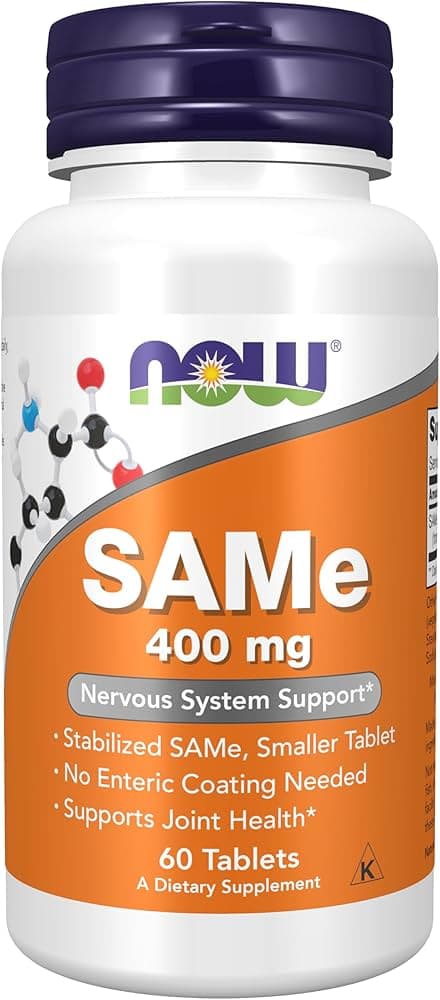
SAMe (S-Adenosyl Methionine).
Natural antidepressant and joint support. Expensive but effective. It's the body's main methyl donor, handing methyl groups to neurotransmitters, phospholipids and cartilage upkeep. Supports steady mood and joint comfort.
Reviewed March 2026
- Category
- Compound
- Also filed under
- DepressionJoint healthLiver support
What SAMe (S-Adenosyl Methionine) is, and what it does.
- Does it work
- It suits people wanting steady mood and joint comfort from the body's own methyl donor. If you take a prescription mood medication, ask your doctor before starting.
- How much to take
- Start with 200mg a day on an empty stomach. 200 to 800mg daily is the maintenance band. 1,600mg is a research condition, not a daily target.
- Time to feel it
- Mood-related change tends to show around two to four weeks. Joint comfort is slower, closer to four to eight weeks of daily use.
- The first dose
- Mild stomach unsettledness is possible on an empty stomach. The methyl donation starts on day one, but it shows on markers rather than in how you feel.
- With regular use
- Most effects take 2-8 weeks. Be patient.
- How well tolerated
- Generally well tolerated. Check with your doctor if on medications.
- How it feels
- Mood lift within 2 weeks. Joint benefits over months.
- The overlooked benefit
- Every methyl group it donates leaves homocysteine behind. Folate, B12 and B6 are what clear it, so covering those keeps the whole cycle turning.
400 to 800mg a day is where SAMe (S-Adenosyl Methionine) works.
Source: Sharma et al. 2017 Ann Gen Psychiatry review; Papakostas et al. 2010 Am J Psychiatry
The proof, claim by claim.
These words describe the research, not the molecule's worth. Research strength is how much work stands behind one claim, and it is never a product score.
- joint comfort and mobilityMeta-analysis
- mood steadinessMeta-analysis
- everyday liver supportRandomised trial
- role as the body's universal methyl donorNarrative review
- cartilage matrix supportIn vitro study
Questions people ask about SAMe (S-Adenosyl Methionine).
- When should I take it?
- Timing matters less than consistency. Pick a time that works for you and take it daily.
- Can I take it with other supplements?
- Usually fine. The main thing to watch is not doubling up on the same ingredient from different products. If you're on prescription meds, check with your pharmacist first.
- Any side effects to watch for?
- Most people tolerate it well at recommended doses. GI upset is the most common complaint with any supplement. Start with a lower dose and work up. If something feels off, stop and reassess.
Why these belong in the same formula. Each row says what the basis is, from settled biochemistry through to a trial that measured the pair.
SAMe is formed when methionine adenosyltransferase joins methionine to ATP. Methionine supply is the direct upstream input to the whole methylation cycle.
5-MTHF hands its methyl group to homocysteine to rebuild methionine, which is then re-adenosylated to SAMe. Without folate the cycle stalls at homocysteine and SAMe regeneration slows.
Methionine synthase carries a cobalamin cofactor that shuttles the methyl group from folate to homocysteine. B12 status therefore sets how fast methionine, and with it SAMe, is regenerated.
Betaine-homocysteine methyltransferase uses TMG as an alternative methyl donor to rebuild methionine independently of folate. It gives the cycle a second lane back to SAMe.
Cystathionine beta-synthase and cystathionine gamma-lyase both need pyridoxal-5-phosphate to move homocysteine down the transsulfuration route. That clears the by-product of every SAMe methyl transfer.
MTHFR is a flavoprotein that needs FAD derived from riboflavin to generate 5-MTHF. Low riboflavin slows the folate arm that feeds methionine regeneration.
Choline is oxidised to betaine, the methyl donor for the alternative remethylation route, and its synthesis by PEMT consumes three SAMe molecules per phosphatidylcholine. Choline intake therefore both spares and supplies methyl groups.
The PEMT route methylates phosphatidylethanolamine three times using SAMe to make phosphatidylcholine. Supplying phosphatidylcholine directly lowers how much SAMe that pathway draws.
Guanidinoacetate methyltransferase uses SAMe to make creatine and accounts for a large share of daily methyl transfer. Dietary creatine reduces the pull on the SAMe pool.
Glycine N-methyltransferase methylates glycine to sarcosine specifically to soak up surplus SAMe. Glycine availability is how the body buffers a high methyl donor load.
Methionine adenosyltransferase is an ATP-dependent enzyme that requires magnesium at its active site. Magnesium status gates the step that actually forms SAMe.
Betaine-homocysteine methyltransferase is a zinc metalloenzyme, with the zinc holding the methyl-accepting thiol of homocysteine in place. Zinc supply supports that route back to methionine.
Homocysteine generated by SAMe methyl transfer can be routed through transsulfuration to cysteine. NAC supplies cysteine directly, easing demand on that route and supporting glutathione synthesis.
Transsulfuration of homocysteine is a main endogenous source of the cysteine used for glutathione. SAMe and glutathione therefore sit at two ends of the same sulfur pathway.
Folinic acid enters the folate pool upstream of 5-MTHF and can be reduced onward to the methyl donor form. It supports the same remethylation step that regenerates methionine.
After SAMe donates its methyl group it becomes S-adenosylhomocysteine and then homocysteine. One disposal route condenses that homocysteine with serine to form cystathionine, which is cleaved to cysteine. Cysteine availability therefore sits directly downstream of methyl donation. This is settled one-carbon and transsulfuration biochemistry.
Cysteine generated through transsulfuration is oxidised to cysteine sulfinate and decarboxylated toward taurine. SAMe is an allosteric activator of cystathionine beta-synthase, the entry enzyme of that branch, so methyl-donor status influences how much sulfur is routed this way. The link is enzymology, not a supplement trial.
Sulfur that leaves the methionine cycle through transsulfuration ends as sulfite and then sulfate. That last oxidation is carried out by sulfite oxidase, which requires a molybdenum cofactor. Adequate molybdenum is what lets the pathway terminate cleanly. The cofactor requirement is textbook. No combination study exists.
Nicotinamide is methylated by NNMT using SAMe as the methyl donor, producing N1-methylnicotinamide and S-adenosylhomocysteine. High nicotinamide intake therefore acts as a methyl sink and draws on the same SAMe pool other methyltransferases use. This is a well-characterised competition for methyl groups. It says nothing about a clinical outcome in either direction.
Three sequential methyl transfers from SAMe convert protein-bound lysine to trimethyllysine, the committed first step toward carnitine. Lysine supplies the carbon skeleton and SAMe supplies the methyl groups. Neither substitutes for the other. The stepwise pathway is established biochemistry.
Endogenous carnitine formation depends on SAMe for the trimethyllysine step. Supplying carnitine directly bypasses that methyl demand, which is why intake of preformed carnitine spares methyl groups for other acceptors. The relationship is a metabolic dependency, not a tested clinical pairing.
Acetylserotonin O-methyltransferase transfers a methyl group from SAMe to N-acetylserotonin to give melatonin. Methyl donor availability is therefore built into the last step of the pathway. Supplemental melatonin bypasses it entirely. The enzymology is settled. The practical significance of methyl supply for endogenous production has not been quantified in people.
Hepatic phosphatidylcholine can be made by three sequential SAMe methylations of phosphatidylethanolamine, and phosphatidylserine decarboxylation feeds that ethanolamine pool. The membrane phospholipid classes are therefore linked through methyl donor supply. This is a hepatic pathway relationship rather than a supplement combination with outcome data.
Phosphatidylethanolamine N-methyltransferase preferentially generates phosphatidylcholine species enriched in long-chain polyunsaturates, and each molecule costs three SAMe methyl groups. Methyl donor supply and long-chain fatty acid supply therefore meet at the same product. The link is biochemical, and no human combination trial anchors it.
SAMe influences cysteine supply through the transsulfuration branch, and cysteine is what limits glutathione synthesis. Alpha lipoic acid works on the reduced-to-oxidised thiol ratio once glutathione exists. The two act at different points of the same thiol economy. Thiol status is a marker, not a clinical outcome.
SAMe is synthesised largely in the liver and its methyl transfers dominate hepatic one-carbon flux. Silymarin is a flavonolignan complex studied against the same hepatic oxidative markers. The pairing is common in formulation and mechanistically plausible on shared hepatic redox ground. It has not been resolved as a combination in controlled human work.
Phosphatidylinositol and phosphatidylcholine draw on overlapping diacylglycerol precursors in the liver, and one of the two routes to phosphatidylcholine costs three SAMe methyl groups. The connection is indirect and sits at the level of lipid class balance. Regard it as mechanistic background rather than a supported pairing.
Methylenetetrahydrofolate reductase carries an FAD cofactor derived from riboflavin, and its product supplies the methyl group that converts homocysteine back to methionine, from which SAMe is remade. Low riboflavin status therefore constrains the recycling arm of the methionine cycle. This is a settled cofactor relationship.
Excess niacin is disposed of by N-methylation, which consumes SAMe and generates S-adenosylhomocysteine. High-dose niacin therefore competes for the same methyl pool as every other methyltransferase reaction. The competition is documented pharmacology. What it means for any endpoint depends on dose and on the rest of the one-carbon supply.
Nothing specific on file for SAMe (S-Adenosyl Methionine). Match the label to the daily amount above, and tell your doctor what you take.
Not medical advice. Show the label to your pharmacist.What SAMe (S-Adenosyl Methionine) actually does.
Your body builds SAMe out of methionine and ATP using methionine adenosyltransferase, which hands over the whole adenosyl group. That reaction is the only route to the molecule you've got.
The sulfonium centre carries a positive charge that leaves the attached methyl group primed to jump ship. That's why SAMe, and not methionine itself, is the methyl donor doing the actual work.
Once SAMe hands off its methyl group it becomes S-adenosylhomocysteine, which then splits into adenosine and homocysteine. The ratio of those first two is the standard index of a cell's methylation capacity.
Homocysteine has two ways to go. It can be remethylated back to methionine, either by 5-methyltetrahydrofolate with B12-dependent methionine synthase or by betaine with BHMT, or it can head down transsulfuration to cystathionine through B6-dependent cystathionine beta-synthase.
Where SAMe (S-Adenosyl Methionine) comes from.
Two routes are in use. One grows yeast on a methionine-rich feed and lets the cells make it, then breaks the cells open and purifies what is inside. The other builds it chemically from methionine. Either way it is turned into a stable salt and coated, because the molecule falls apart in moisture and stomach acid.
The same molecule is reached more than one way. Which route a given product used is a manufacturing choice, and the finished compound is the same either way.
Two commercial routes exist. The enzymatic and fermentation route grows yeast, commonly Saccharomyces cerevisiae, on a methionine-enriched medium so the cells accumulate SAMe internally. The chemical route starts from L-methionine and adenosine derivatives.
In the biological route, methionine adenosyltransferase inside the yeast cell performs the transfer, which yields the natural S,S diastereomer. Chemical synthesis produces a mixture of diastereomers, only one of which is biologically active.
Fermentation-derived material requires the yeast cells to be lysed and the intracellular SAMe recovered into an acidified aqueous phase, since the molecule degrades quickly at neutral pH.
The sulfonium cation is captured on ion exchange resin and then precipitated as the tosylate or butanedisulfonate salt. Salt formation is a purification step and a stabilisation step at once.
Release testing measures total SAMe content and the proportion present as the active S,S form, since the inactive R,S form is a real and quantifiable component of some material.
Tabletting and coating run under controlled low-moisture conditions, then the product is blister packed because bulk bottles expose the salt to repeated humidity swings.
Getting SAMe (S-Adenosyl Methionine) from food.
The whole-food sources on file. A supplement closes the gap, it does not replace dinner.
A gram-for-gram figure (how much of each you would eat to match a dose) will appear here once it is sourced and reviewed. This page will not print a number it cannot cite.
The forms it comes in.
The essence, in one line each.
- S-adenosyl methionine is one of the nutraceuticals compared in this network meta-analysis of efficacy and tolerability for adults with low mood. The comparison ranks interventions against one another and does not establish an effect in isolation.Meta-analysis. Cheng YC et al., 2025 (Psychological Medicine). PMID 40314175 ↗
- The review pools pharmacological and nutraceutical interventions in adults with milder low mood and names S-adenosyl methionine among the agents assessed.Meta-analysis. Urata M et al., 2025 (Neuropsychopharmacology Reports). PMID 40014460 ↗
- The review situates S-adenosyl methionine within the B12-dependent methylation pathway when discussing mood and the gut-brain axis. It is mechanistic narrative, not a measurement of effect.Narrative review. Xu C et al., 2025 (Alpha Psychiatry). PMID 41523970 ↗
- Co-supplementation of S-adenosyl-L-methionine with B vitamins was associated with better maintained redox markers than ethanol exposure alone in the animal model used.Animal study. Nandagopal PB et al., 2026 (Frontiers in Pharmacology). PMID 42100316 ↗
- Methionine and guanidinoacetic acid supplementation across the periconceptual period altered metabolic measures, which bears on how methyl donor supply shifts when a methyl acceptor is loaded.Animal study. Hauxwell KMM et al., 2026 (Journal of Animal Science). PMID 41803637 ↗
- Dietary folate supplementation modified DNA methylation profiles in sperm of arsenic-exposed mice, which is direct evidence that one-carbon substrate supply changes methylation output.Animal study. Shang B et al., 2026 (Archives of Toxicology). PMID 41807790 ↗
- S-adenosyl methionine is named among the nutraceuticals reviewed for cognitive measures in aged companion animals. The review is non-human and reports mixed evidence quality across included studies.Systematic review. Blanchard T et al., 2025 (GeroScience). PMID 39827310 ↗
- The review synthesises metabolomic data on the arginine, transsulfuration and folate pathways and reports where S-adenosyl methionine and related metabolites were measured. These are pathway markers rather than outcomes.Systematic review. Zinellu A et al., 2023 (Cells). PMID 37681911 ↗
These are the studies our verdict leans on, chosen from the 8 we read for SAMe (S-Adenosyl Methionine). The full linked list is below.
FDA Disclaimer: These statements have not been evaluated by the Food and Drug Administration. This information is for educational purposes only and is not intended to diagnose, treat, cure, or prevent any disease. Consult your healthcare provider before starting any supplement regimen.